 The Nexus Archive
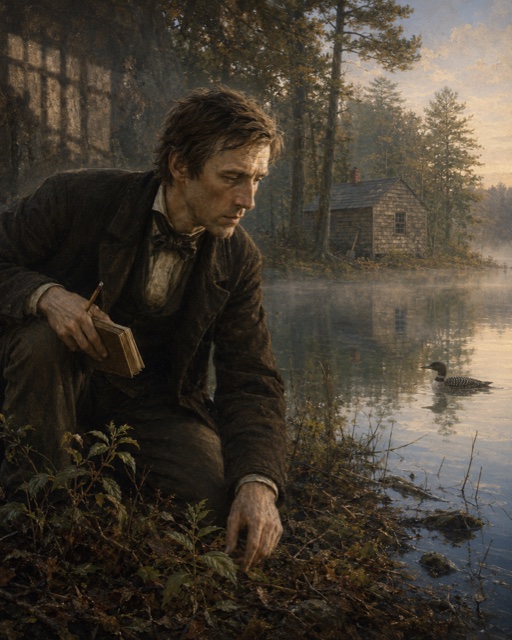
Transcendentalism · Memoir
A Week on the Concord and Merrimack Rivers
by Thoreau · The Experimenter at Walden · 19th-century America, 1817-1862
A river journey opens into memory, poetry, natural history, friendship, and philosophical digression.
- Brutal
- ~8 hr 30 min read
- 2 chapter guides
- Public domain
Start reading · Read the MONDAY — Part 1 guide free
Before the text
Editor's Prelude
A River Wide Enough for a Life
Before the boat leaves Concord, Thoreau asks his brother to be his Muse. Henry and John made their river journey in 1839; by the time Henry published this book in 1849, John was dead. The shared adventure survives in the work of the brother who remembers it: rowing, camping, talking, and finding unfamiliar country close to home.
The seven weekday headings give thought a course to follow. They also contain a week of walking beyond the boat’s stopping place, and memories of other journeys interrupt the voyage. A riverbank can open into Greek poetry, Indian scripture, a quarrel with custom, or a question about what friends owe each other. Poems and prose let these different currents meet.
Thoreau’s attention is both intimate and unsettled. He notices a fish, a boatman’s work, the damage a dam does, and the people whose histories settlers have displaced. He questions those histories while sharing some of their prejudices. Under the movement between places and books lies a harder question: how much of another person’s life can attention and love preserve?
The opening pages
SUNDAY — Part 1
SUNDAY.
“The river calmly flows,
Through shining banks, through lonely glen,
Where the owl shrieks, though ne’er the cheer of men
Has stirred its mute repose,
Still if you should walk there, you would go there again.”
CHANNING.
“The Indians tell us of a beautiful River lying far to the south, which they call Merrimack.”
SIEUR DE MONTS, Relations of the Jesuits, 1604.
In the morning the river and adjacent country were covered with a dense fog, through which the smoke of our fire curled up like a still subtiler mist; but before we had rowed many rods, the sun arose and the fog rapidly dispersed, leaving a slight steam only to curl along the surface of the water. It was a quiet Sunday morning, with more of the auroral rosy and white than of the yellow light in it, as if it dated from earlier than the fall of man, and still preserved a heathenish integrity:—
An early unconverted Saint,
Free from noontide or evening taint,
Heathen without reproach,
That did upon the civil day encroach,
And ever since its birth
Had trod the outskirts of the earth.
But the impressions which the morning makes vanish with its dews, and not even the most “persevering mortal” can preserve the memory of its freshness to mid-day. As we passed the various islands, or what were islands in the spring, rowing with our backs down stream, we gave names to them. The one on which we had camped we called Fox Island, and one fine densely wooded island surrounded by deep water and overrun by grape-vines, which looked like a mass of verdure and of flowers cast upon the waves, we named Grape Island. From Ball’s Hill to Billerica meeting-house, the river was still twice as broad as in Concord, a deep, dark, and dead stream, flowing between gentle hills and sometimes cliffs, and well wooded all the way. It was a long woodland lake bordered with willows. For long reaches we could see neither house nor cultivated field, nor any sign of the vicinity of man. Now we coasted along some shallow shore by the edge of a dense palisade of bulrushes, which straightly bounded the water as if clipt by art, reminding us of the reed forts of the East-Indians, of which we had read; and now the bank slightly raised was overhung with graceful grasses and various species of brake, whose downy stems stood closely grouped and naked as in a vase, while their heads spread several feet on either side. The dead limbs of the willow were rounded and adorned by the climbing mikania, Mikania scandens, which filled every crevice in the leafy bank, contrasting agreeably with the gray bark of its supporter and the balls of the button-bush. The water willow, Salix Purshiana, when it is of large size and entire, is the most graceful and ethereal of our trees. Its masses of light green foliage, piled one upon another to the height of twenty or thirty feet, seemed to float on the surface of the water, while the slight gray stems and the shore were hardly visible between them. No tree is so wedded to the water, and harmonizes so well with still streams. It is even more graceful than the weeping willow, or any pendulous trees, which dip their branches in the stream instead of being buoyed up by it. Its limbs curved outward over the surface as if attracted by it. …
Chapter guides · 2
MONDAY — Part 1
Whose Rules Govern a Life?
The upstream journey brings inherited customs and histories under pressure.
The river carries a contested past
After one brother’s troubled dreams on Sunday night, Monday’s rowing passes places associated with Lovewell’s expedition. Thoreau retells the colonial accounts and ballads, but also asks who remembers the wounded Indigenous survivors. The fame of the victors leaves other lives without a written record.
Custom and conscience
A pause for melons opens into reform, Thoreau’s later tax refusal, and resistance to institutions that sustain slavery and war. Antigone’s refusal to obey Creon sharpens the conflict between an established law and a higher obligation. Thoreau admires the Bhagavad Gita’s lofty contemplation while questioning the authority of caste and assigned duty; freedom and flexibility, he says, are what its thinking lacks.
Books become resting places
The brothers briefly attach themselves to a descending scow, then resume their upstream journey. Exposed traces of earlier Indigenous habitation and a rest beneath the trees accompany reflections on Asian scriptures. Thoreau treats each sacred book as a caravansary, a resting place on the way rather than a final home, because we are “freemen of the universe.” His speculation about human progress closes with an admission of how little he knows.
WEDNESDAY — Part 1
What Makes a Friend?
The river’s work and history lead into a demanding account of love.
Questions readers ask
- How long does it take to read A Week on the Concord and Merrimack Rivers?
- About 8 hr 30 min in total.
- How difficult is A Week on the Concord and Merrimack Rivers?
- Brutal. A long memoir; about 9 hours of reading.
- Can I read A Week on the Concord and Merrimack Rivers for free?
- A Week on the Concord and Merrimack Rivers is part of Nexus Premium, so reading it needs an account and a Premium subscription. The opening above and one chapter guide on this page are free to read.
- How many chapter guides are there?
- 2 chapter guides, written by the Nexus editors. One opens in full here; the rest show their opening line.
About Thoreau
Henry David Thoreau was an American writer and Transcendentalist whose Walden and Civil Disobedience shaped arguments about nature, simplicity, conscience, and political resistance.
“How little can a person need, and what must conscience refuse?”
Thoreau shaped later traditions of environmental writing, civil disobedience, and moral self-experiment.
Source text: public domain. Chapter guides: original Nexus writing. A Week on the Concord and Merrimack Rivers is part of The Nexus Archive, guided Quests through the great works.