 The Nexus Archive
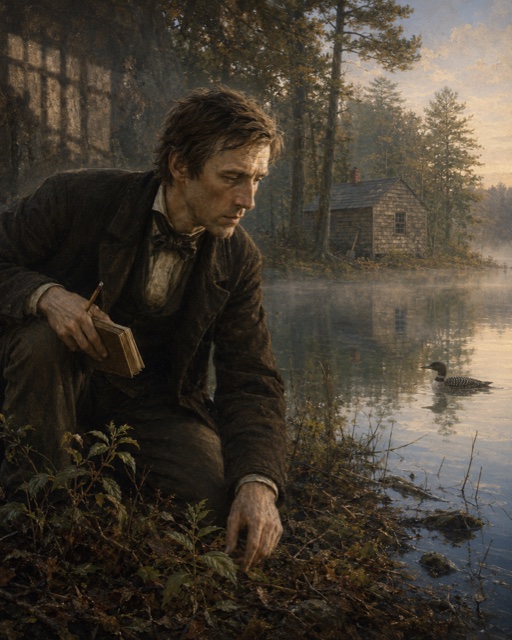
Transcendentalism · Essay
Walking
by Thoreau · The Experimenter at Walden · 19th-century America, 1817-1862
Thoreau's complete essay on wildness, sauntering, freedom, and the moral pressure of leaving the road.
- Intermediate
- 1862
- ~55 min read
- 6 chapter guides
- Public domain
Start reading · Read the The Art of Sauntering guide free
Before the text
Editor's Prelude
Walking Into the Wild
The modest title hides an extreme argument. Four hours outside each day would overturn many people’s idea of a responsible life. Thoreau makes the walker a dissenter from schedules, property lines, settled roads, and secondhand knowledge—someone willing to test whether civilization has enlarged human life or merely made it easier to manage.
Thoreau developed “Walking” through years of lecturing and revision. The Atlantic Monthly published it in June 1862, one month after his death. Its voice moves easily between a neighbor’s field and the fate of civilizations; the pleasure of a walk becomes a measure of what a culture can still feel and imagine.
His hunger for freedom does not release him from the prejudices of his world. Reverence for uncultivated ground sits uneasily beside a settler’s language of conquest and improvement. That tension belongs to the essay’s force: the man who finds confinement almost everywhere is not always able to see whose freedom his own vision leaves out.
The opening pages
The Art of Sauntering
I wish to speak a word for Nature, for absolute Freedom and Wildness, as contrasted with a freedom and culture merely civil,—to regard man as an inhabitant, or a part and parcel of Nature, rather than a member of society. I wish to make an extreme statement, if so I may make an emphatic one, for there are enough champions of civilization: the minister and the school committee and every one of you will take care of that.
I have met with but one or two persons in the course of my life who understood the art of Walking, that is, of taking walks—who had a genius, so to speak, for sauntering, which word is beautifully derived “from idle people who roved about the country, in the Middle Ages, and asked charity, under pretense of going à la Sainte Terre,” to the Holy Land, till the children exclaimed, “There goes a Sainte-Terrer,” a Saunterer, a Holy-Lander. They who never go to the Holy Land in their walks, as they pretend, are indeed mere idlers and vagabonds; but they who do go there are saunterers in the good sense, such as I mean. Some, however, would derive the word from sans terre without land or a home, which, therefore, in the good sense, will mean, having no particular home, but equally at home everywhere. For this is the secret of successful sauntering. He who sits still in a house all the time may be the greatest vagrant of all; but the saunterer, in the good sense, is no more vagrant than the meandering river, which is all the while sedulously seeking the shortest course to the sea. But I prefer the first, which, indeed, is the most probable derivation. For every walk is a sort of crusade, preached by some Peter the Hermit in us, to go forth and reconquer this Holy Land from the hands of the Infidels.
It is true, we are but faint-hearted crusaders, even the walkers, nowadays, who undertake no persevering, never-ending enterprises. Our expeditions are but tours, and come round again at evening to the old hearth-side from which we set out. Half the walk is but retracing our steps. We should go forth on the shortest walk, perchance, in the spirit of undying adventure, never to return,—prepared to send back our embalmed hearts only as relics to our desolate kingdoms. If you are ready to leave father and mother, and brother and sister, and wife and child and friends, and never see them again,—if you have paid your debts, and made your will, and settled all your affairs, and are a free man; then you are ready for a walk.
Read it in a Quest
A test of inward trust, civil conscience, nature, and the deliberate life.
Chapter guides · 6
The Art of Sauntering
A Walk Is Not Exercise
Thoreau turns sauntering into a demanding test of freedom rather than a healthy habit added to an otherwise settled life.
An order of walkers
Thoreau offers two competing stories for the word saunterer: a pilgrim bound for the Holy Land and someone at home everywhere. These speculative etymologies make walking a vocation outside ordinary respectability. The daily walk requires leisure and inward independence that money alone cannot supply.
Four free hours
Thoreau is not recommending a break from work. He is asking what kind of life makes four free hours seem impossible, and whether staying indoors has become a moral numbness mistaken for duty. The comic exaggeration sharpens a serious accusation.
Skin and experience
Exposure has its costs: sun and wind coarsen the skin, while staying indoors softens it. Thoreau wants a balance, but he ends by preferring the calloused hands of labor to a delicacy that has avoided experience. Freedom here demands contact with the world.
Roads and the West
Leaving the Road
Fields, abandoned roads, and the western horizon turn local walking into an argument about direction, ownership, and national desire.
The abandoned road
The walk moves from personal discipline into geography. Roads pull toward villages and business, while cross-lot walking follows a different magnetism. The Old Marlborough Road becomes valuable precisely because commerce has nearly abandoned it.
Westward longing
Westward movement carries two pressures at once: the desire for an unworn future and the historical language of settlement, empire, and possession. Thoreau tries to make the West a spiritual direction, but the national story he borrows does not become innocent simply because he uses it metaphorically.
A landscape under ownership
A body can enter the woods while its thoughts remain in the village. Even inward departure depends on a landscape still open to wandering: Thoreau fears the division of fields into exclusive pleasure grounds and the fences that will confine walking to public roads. Property threatens the freedom his daily practice requires.
In Wildness Is Preservation
The Standard of Wildness
Thoreau makes wildness a source of renewal while carrying the colonial assumptions of his westward hopes into the argument.
The Wild in Life and Letters
What Tameness Costs
Swamps, forests, poems, and unruly animals become measures of how much life a culture allows to remain free.
Useful Ignorance
Useful Ignorance
Thoreau challenges the confidence that naming, illumination, and accumulated facts amount to genuine knowledge.
Border Life
The Gospel of This Moment
A familiar Concord walk opens into another country, and the essay ends by turning perception into a form of awakening.
Questions readers ask
- How long does it take to read Walking?
- About 55 min in total.
- How difficult is Walking?
- Intermediate. A short essay; about 55 minutes of reading.
- Which edition is this?
- The original English text, first published in 1862. The text follows Project Gutenberg #1022 digital HTML and plain-text witnesses of Walking.
- Can I read Walking for free?
- Walking is part of Nexus Premium, so reading it needs an account and a Premium subscription. The opening above and two chapter guides on this page are free to read.
- How many chapter guides are there?
- 6 chapter guides, written by the Nexus editors. Two open in full here; the rest show their opening line.
About Thoreau
Henry David Thoreau was an American writer and Transcendentalist whose Walden and Civil Disobedience shaped arguments about nature, simplicity, conscience, and political resistance.
“How little can a person need, and what must conscience refuse?”
Thoreau shaped later traditions of environmental writing, civil disobedience, and moral self-experiment.
Source text: public domain. Chapter guides: original Nexus writing. Walking is part of The Nexus Archive, guided Quests through the great works.