 The Nexus Archive
Transcendentalism · Essay
Walden
by Thoreau · The Experimenter at Walden · 19th-century America, 1817-1862
Thoreau's full Walden, preserving Walden only and excluding the separate Civil Disobedience text bundled in the PG packet.
- Advanced
- 1854
- ~8 hr read
- 19 chapter guides
- Public domain
Start reading · Read the Economy guide free
Before the text
Editor's Prelude
What One Life Costs
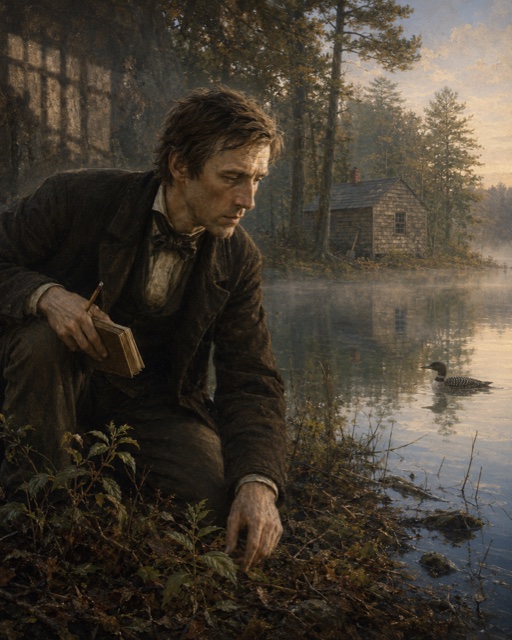
Henry David Thoreau wanted to find how much of a life was needed to pay for living. On July 4, 1845, he moved into a cabin he had built beside Walden Pond, on land owned by his friend Ralph Waldo Emerson. Concord was within walking distance, visitors came, and trains sounded through the woods. These familiar surroundings became the place to test what he could choose for himself.
He stayed for two years and two months. By the time Walden appeared in 1854, those years had become one turn of the seasons, enlarged by memories and later observations. The book moves between household accounts, satire, natural history, conversations, poems and fables. Its opening questions about food, shelter, work and loneliness keep widening into the use of a whole life.
Thoreau measures closely and speaks boldly. The price of a house can become a claim on its owner’s time; a passing train can carry both human enterprise and the cost of progress. A pond gives attention something to sound, watch and return to. His experiment asks what becomes possible when the means of living leave room to live.
The opening pages
Economy: Quiet Desperation
"I do not propose to write an ode to dejection, but to brag as lustily as chanticleer in the morning, standing on his roost, if only to wake my neighbors up."
When I wrote the following pages, or rather the bulk of them, I lived alone, in the woods, a mile from any neighbor, in a house which I had built myself, on the shore of Walden Pond, in Concord, Massachusetts, and earned my living by the labor of my hands only. I lived there two years and two months. At present I am a sojourner in civilized life again.
I should not obtrude my affairs so much on the notice of my readers if very particular inquiries had not been made by my townsmen concerning my mode of life, which some would call impertinent, though they do not appear to me at all impertinent, but, considering the circumstances, very natural and pertinent. Some have asked what I got to eat; if I did not feel lonesome; if I was not afraid; and the like. Others have been curious to learn what portion of my income I devoted to charitable purposes; and some, who have large families, how many poor children I maintained. I will therefore ask those of my readers who feel no particular interest in me to pardon me if I undertake to answer some of these questions in this book. In most books, the I, or first person, is omitted; in this it will be retained; that, in respect to egotism, is the main difference. We commonly do not remember that it is, after all, always the first person that is speaking. I should not talk so much about myself if there were anybody else whom I knew as well. Unfortunately, I am confined to this theme by the narrowness of my experience. Moreover, I, on my side, require of every writer, first or last, a simple and sincere account of his own life, and not merely what he has heard of other men’s lives; some such account as he would send to his kindred from a distant land; for if he has lived sincerely, it must have been in a distant land to me. Perhaps these pages are more particularly addressed to poor students. As for the rest of my readers, they will accept such portions as apply to them. I trust that none will stretch the seams in putting on the coat, for it may do good service to him whom it fits.
Read it in a Quest
A test of inward trust, civil conscience, nature, and the deliberate life.
Chapter guides · 19
Economy: The House That Owns You
Comfort Has a Hidden Price
Thoreau weighs the comfort of a furnished house against the labor and hardship that support it.
What a House Demands
Better houses have not necessarily made better lives. Thoreau looks from palaces to the railway workers’ shanties and asks who pays for civilized comfort. Even the objects on his own desk make demands: three pieces of limestone need daily dusting while his mind remains neglected, so he throws them out.
Beauty from Within
A house becomes another tool that can take possession of its owner. Thoreau wants beauty to begin in the life lived inside it. He recalls settlers meeting their urgent needs in rough shelters, then accepts the practical advantages of boards and bricks. His complaint concerns the purposes those materials serve. He closes by turning toward his own experiment.
Economy: Philanthropy and Poverty
Economy Becomes the Art of Living
Thoreau questions charitable good intentions as sharply as he has questioned the cost of comfort.
Being Good
The end of Economy turns from earning a living to doing good. Thoreau refuses philanthropy as a profession that would displace his own calling, while encouraging those who give themselves wholly to it. An ice cutter who comes to warm himself already has more layers of clothing than Thoreau. The encounter reverses his idea of who needs help.
Roots and Branches
He asks whether a benefactor’s way of life creates the misery his gifts relieve. Courage, generosity and a life of lasting value matter more to him than an isolated charitable act. Sadi’s date tree and cypress offer different forms of worth; the closing Carew poem attacks a poverty that merely excuses passive virtue. Economy ends by testing the quality of a whole life.
Where I Lived
The Cabin Becomes a Method
Morning, simplicity and resistance to hurry become ways of meeting life directly.
Reading
Reading Demands Another Kind of Labor
Serious books ask for sustained attention, and Thoreau wants the village to make room for that work.
Sounds
The World Enters Through the Ear
After the train passes, distant bells and animal voices give the woods a changing music.
Solitude
Solitude Is a Change of Scale
An hour of loneliness gives way to a sense of company in rain, seasons and the observing mind.
Visitors
The Cabin Opens to the World
Frank conversation, demands on hospitality and a fugitive’s danger test the freedom of the cabin.
The Bean-Field
Labor Becomes Attention
Seven miles of bean rows bring accounts, history, birds and moral questions into the same field.
The Village
Concord Has Its Own Wilderness
Village gossip, a night in jail and an unlocked house reveal different kinds of social power.
The Ponds
A Pond Becomes a Moral Measure
White Pond’s submerged tree and clear water widen Thoreau’s sense of his lake country.
Baker Farm
Simplicity Meets Another Person’s Poverty
Shelter from a storm brings Thoreau’s solitary economy into John Field’s crowded household.
Higher Laws
The Body Becomes a Moral Battleground
Thoreau’s ideal of purity reaches the dinner table and the body, while his habits fall short.
Brute Neighbors
Animal Life Refuses a Single Lesson
A cat’s curious fur and a loon’s evasive dives keep discovery mixed with story.
House-Warming
The Experiment Must Survive Winter
Gathering fuel and tending a fire make warmth a daily task with its own pleasures and risks.
Winter Visitors
Company Finds the Cabin
Rare winter callers bring conversation through the snow, while Thoreau continues to wait for an ideal guest.
Winter Animals
Winter Makes Life Legible by Traces
Calls, tracks, scattered corn and hunting stories reveal life beneath the season’s apparent stillness.
The Pond in Winter
The Pond Enters World Trade
A hundred ice cutters remove Walden’s winter cover, linking the small pond to distant cities.
Spring
Spring Opens Another Chance
Returning birds, new grass and thawed water make renewal visible as Thoreau ends his account of life by the pond.
Conclusion
There Is More Day to Dawn
Truth and a tale of dormant life bring the experiment to an open ending.
Questions readers ask
- How long does it take to read Walden?
- About 8 hr in total.
- How difficult is Walden?
- Advanced. A long essay; about 8 hours of reading.
- Which edition is this?
- The original English text, first published in 1854. The text follows Project Gutenberg #205, Walden, and On The Duty Of Civil Disobedience.
- Can I read Walden for free?
- Walden is part of Nexus Premium, so reading it needs an account and a Premium subscription. The opening above and two chapter guides on this page are free to read.
- How many chapter guides are there?
- 19 chapter guides, written by the Nexus editors. Two open in full here; the rest show their opening line.
About Thoreau
Henry David Thoreau was an American writer and Transcendentalist whose Walden and Civil Disobedience shaped arguments about nature, simplicity, conscience, and political resistance.
“How little can a person need, and what must conscience refuse?”
Thoreau shaped later traditions of environmental writing, civil disobedience, and moral self-experiment.
Source text: public domain. Chapter guides: original Nexus writing. Walden is part of The Nexus Archive, guided Quests through the great works.