 The Nexus Archive
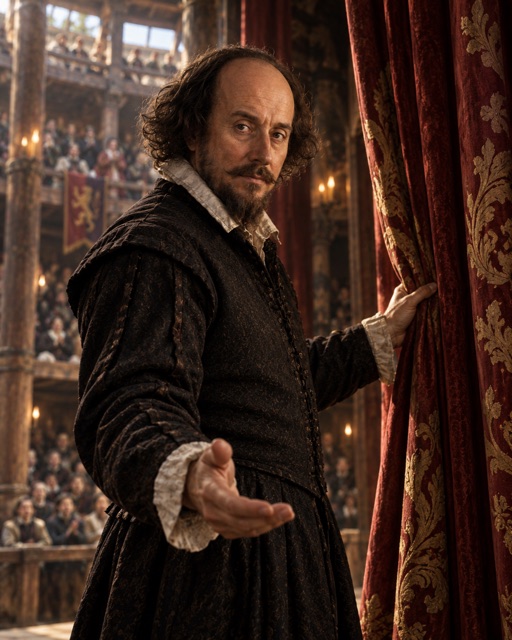
Drama · Play
Macbeth
by Shakespeare · The Stage of the Soul · Elizabethan and Jacobean England, 1564-1616
A swift tragedy of prophecy, ambition, murder, fear, tyranny, and imagination turning violent.
- Advanced
- c. 1606
- ~1 hr 30 min read
- 11 chapter guides
- Public domain
Start reading · Read the Act I, Scene III guide free
Before the text
Editor's Prelude
The Crown Inside The Mind
The play opens in a storm, but its first human news is victory. Macbeth has fought with startling courage for King Duncan and returns covered in honor. On a heath, three strangers greet him with a title he does not yet know is his and another that belongs to the future.
The tragedy moves between battlefield scale and private pressure: a letter read alone, a husband and wife testing one another's resolve, a mind giving shape to what a hand has not done. Prophecy speaks in riddles; ambition supplies its own frightening clarity.
The opening pages
Act I, Scene I: The Witches
Thunder and Lightning. Enter three Witches.
FIRST WITCH.
When shall we three meet again?
In thunder, lightning, or in rain?
SECOND WITCH.
When the hurlyburly’s done,
When the battle’s lost and won.
THIRD WITCH.
That will be ere the set of sun.
FIRST WITCH.
Where the place?
SECOND WITCH.
Upon the heath.
THIRD WITCH.
There to meet with Macbeth.
FIRST WITCH.
I come, Graymalkin!
SECOND WITCH.
Paddock calls.
THIRD WITCH.
Anon.
ALL.
Fair is foul, and foul is fair:
Hover through the fog and filthy air.
[Exeunt.]
Act I, Scene II: A Soldier's Fame
Alarum within. Enter King Duncan, Malcolm, Donalbain, Lennox, with Attendants, meeting a bleeding Captain.
DUNCAN.
What bloody man is that? He can report,
As seemeth by his plight, of the revolt
The newest state.
MALCOLM.
This is the sergeant
Who, like a good and hardy soldier, fought
’Gainst my captivity.—Hail, brave friend!
Say to the King the knowledge of the broil
As thou didst leave it.
SOLDIER.
Doubtful it stood;
As two spent swimmers that do cling together
And choke their art. The merciless Macdonwald
(Worthy to be a rebel, for to that
The multiplying villainies of nature
Do swarm upon him) from the Western Isles
Of kerns and gallowglasses is supplied;
And Fortune, on his damned quarrel smiling,
Show’d like a rebel’s whore. But all’s too weak;
For brave Macbeth (well he deserves that name),
Disdaining Fortune, with his brandish’d steel,
Which smok’d with bloody execution,
Like Valour’s minion, carv’d out his passage,
Till he fac’d the slave;
Which ne’er shook hands, nor bade farewell to him,
Till he unseam’d him from the nave to the chops,
And fix’d his head upon our battlements.
DUNCAN.
O valiant cousin! worthy gentleman!
SOLDIER.
As whence the sun ’gins his reflection
Shipwracking storms and direful thunders break,
So from that spring, whence comfort seem’d to come
Discomfort swells. Mark, King of Scotland, mark:
No sooner justice had, with valour arm’d,
Compell’d these skipping kerns to trust their heels,
But the Norweyan lord, surveying vantage,
With furbish’d arms and new supplies of men,
Began a fresh assault.
DUNCAN.
Dismay’d not this
Our captains, Macbeth and Banquo?
SOLDIER.
Yes;
As sparrows eagles, or the hare the lion.
If I say sooth, I must report they were
As cannons overcharg’d with double cracks;
So they
Doubly redoubled strokes upon the foe:
Except they meant to bathe in reeking wounds,
Or memorize another Golgotha,
I cannot tell—
But I am faint, my gashes cry for help.
Chapter guides · 11
Act I, Scene III
The Prophecy Finds Macbeth Ready
Battlefield honors become dangerous when the witches give ambition a future tense.
From victory to greeting
A wounded captain and Ross describe Macbeth's violence against Macdonwald and Norway, and Duncan transfers the traitorous Cawdor's title to him. On the heath, the witches hail Macbeth as Glamis, Cawdor, and king while promising Banquo no crown but a line of kings.
What confirmation releases
Ross's news proves the middle title before Macbeth knew it was his. Banquo warns that instruments of darkness may tell small truths to betray people in deepest consequence; Macbeth, though never commanded to act, is already frightened by an image of murder and divided between letting chance crown him and imagining a shortcut.
Act I, Scene V
A Crown Enters The Marriage
Duncan names an heir while Lady Macbeth turns her husband's report into a plan for the king's visit.
The obstacle named in public
Duncan thanks Macbeth and Banquo, then declares Malcolm Prince of Cumberland. Macbeth immediately treats Malcolm as a step on which he must fall or overleap and asks the stars to hide his black desires before riding ahead to Inverness.
The reader of the letter
Lady Macbeth reads Macbeth's account, judges him ambitious but too kind for the nearest way, and calls on spirits to make her cruel enough for what she anticipates. When a messenger announces Duncan's arrival and Macbeth follows, she tells her husband to disguise the heart in his face and leaves the night's business to herself.
Act I, Scene VII
The Host Knows Why He Must Stop
Duncan enters a gracious castle while Macbeth inventories every bond his contemplated murder would break.
Act II, Scene II
The Bell Ends Deliberation
A spectral weapon leads Macbeth to Duncan; the first consequences arrive before the blood is dry.
Act III, Scene I
The Crown Creates Its Next Victim
Discovery, flight, and coronation leave Macbeth fearing the future promised to Banquo.
Act III, Scene IV
A Feast Cannot Contain The Dead
Macbeth hides a second murder from his wife, but the failed half of the plan takes Banquo's seat.
Act IV, Scene I
True Words Manufacture False Safety
Scotland's fear and the apparitions' riddles turn Macbeth's insecurity into confidence and another household's sentence.
Act IV, Scene III
Tyranny Reaches Macduff's House
A child's murder gives Macduff's political choice a private cost before Malcolm accepts him as an ally.
Act V, Scene I
Sleep Repeats What Waking Hid
Lady Macbeth's body reenacts the murders before witnesses who cannot treat their cause.
Act V, Scene V
The Promise Begins To Move
As Malcolm's army takes branches for concealment, Macbeth hears of the queen's death and discovers how empty his victory has become.
Act V, Scene VIII
The Last Riddle Breaks Open
Macbeth's remaining confidence survives the moving wood only until Macduff names the condition of his birth.
Questions readers ask
- How long does it take to read Macbeth?
- About 1 hr 30 min in total.
- How difficult is Macbeth?
- Advanced. A mid-length play; about an hour of reading.
- How many chapter guides are there?
- 11 chapter guides, written by the Nexus editors. Two open in full here; the rest show their opening line.
About Shakespeare
William Shakespeare was the central playwright of the English stage, writing tragedies, comedies, histories, and poems that became part of the world's shared dramatic language. His plays survive because they make private thought and public action move together.
“What happens when the inner life becomes impossible to hide?”
Shakespeare gives Nexus drama at maximum human range: kings, fools, lovers, ghosts, soldiers, daughters, murderers, and minds arguing with themselves.
Source text: public domain. Chapter guides: original Nexus writing. Macbeth is part of The Nexus Archive, guided Quests through the great works.