 The Nexus Archive
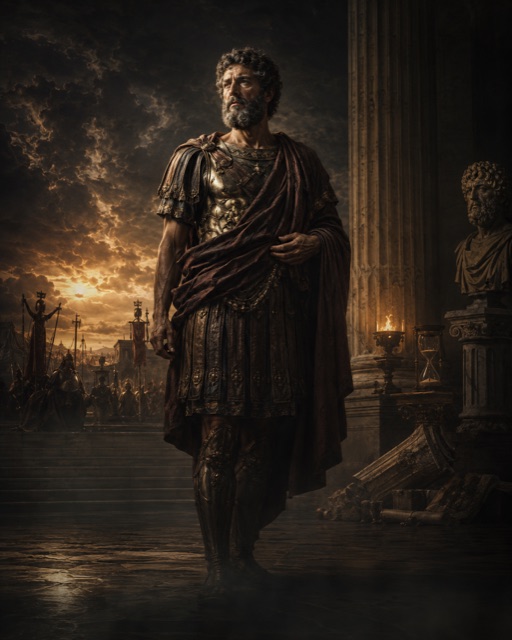
Stoicism · Aphorisms
Meditations
by Marcus Aurelius · The Philosopher Emperor · Roman Empire, 121-180
Private Stoic notes on discipline, mortality, duty, judgment, and self-command.
- Intermediate
- c. 175 CE
- ~3 hr 15 min read
- 12 chapter guides
- Public domain
Start reading · Read the Book I guide free
Before the text
Editor's Prelude
The Emperor Writes to Himself
Marcus Aurelius ruled the Roman Empire from 161 to 180 CE, through war and an outbreak of plague. In these pages, the emperor repeatedly turns from the conduct of others to his own. Authority can make a command obeyed; it cannot make its author patient, just, or free from the desire for praise. The distance between possessing power and using it well gives his reminders their urgency.
He wrote in Greek, addressing himself rather than explaining his philosophy to an audience. Some of the writing belongs to his years on military campaign: two books carry the names of places along the empire’s northern frontier. The twelve books gather gratitude to teachers, arguments, remembered sayings, and corrections to his own conduct. Their order does not establish a continuous account of his life. A conviction may return many times because understanding it has not made it easy to live by.
Marcus’s Stoicism places human beings within a larger natural order and makes them responsible to one another through their shared reason. His concern with the mind therefore reaches beyond private composure. Anger can damage a relationship; vanity can distort a judgment; fear of death can consume the time still available for useful action. The severe voice belongs to someone trying to keep those failures from governing his life.
The opening pages
Book I: Gratitude and Formation
BOOK I
1. I learned from my grandfather, Verus, to use good manners, and to put restraint on anger.
2. In the famous memory of my father I had a pattern of modesty and manliness.
3. Of my mother I learned to be pious and generous; to keep myself not only from evil deeds, but even from evil thoughts; and to live with a simplicity which is far from customary among the rich.
4. I owe it to my great-grandfather that I did not attend public lectures and discussions, but had good and able teachers at home; and I owe him also the knowledge that for things of this nature a man should count no expense too great.
5. My tutor taught me not to favour either green or blue at the chariot races, nor, in the contests of gladiators, to be a supporter either of light or heavy armed. He taught me also to endure labour; not to need many things; to serve myself without troubling others; not to intermeddle in the affairs of others, and not easily to listen to slanders against them.
6. Of Diognetus I had the lesson not to busy myself about vain things; not to credit the great professions of such as pretend to work wonders, or of sorcerers about their charms, and their expelling of Demons and the like; not to keep quails (for fighting or divination), nor to run after such things; to suffer freedom of speech in others, and to apply myself heartily to philosophy. Him also I must thank for my hearing first Bacchius, then Tandasis and Marcianus; that I wrote dialogues in my youth, and took a liking to the philosopher's pallet and skins, and to the other things which, by the Grecian discipline, belong to that profession.
7. To Rusticus I owe my first apprehensions that my nature needed reform and cure; and that I did not fall into the ambition of the common Sophists, either by composing speculative writings or by declaiming harangues of exhortation in public; further, that I never strove to be admired by ostentation of great patience in an ascetic life, or by display of activity and application; that I gave over the study of rhetoric, poetry, and the graces of language; and that I did not pace my house in my senatorial robes, or practise any similar affectation. I observed also the simplicity of style in his letters, particularly in that which he wrote to my mother from Sinuessa. I learned from him to be easily appeased, and to be readily reconciled with those who had displeased me or given cause of offence, so soon as they inclined to make their peace; to read with care; not to rest satisfied with a slight and superficial knowledge; nor quickly to assent to great talkers. I have him to thank that I met with the discourses of Epictetus, which he furnished me from his own library.
Read it in a Quest
A training ground for the power that remains yours when fortune refuses to obey.
Chapter guides · 12
Book I
The People Behind His Character
Marcus credits particular people with the habits he still hopes to practice.
Lessons in Conduct
The debts are concrete: restraint of anger from his grandfather, careful reading and reconciliation from Rusticus, affectionate firmness from Sextus. The father remembered near the beginning is his biological father; the long portrait later in the book concerns Antoninus Pius, his adoptive father and predecessor as emperor. Public office enters through Antoninus’s patience in council, stewardship of money, and willingness to listen.
Gratitude Without a Claim of Perfection
Marcus ends by thanking the gods for people and circumstances that made a good life possible. He also says that his failure to achieve it belongs to himself. Remembering models of character gives him standards for his conduct, rather than evidence that he already meets them.
Book II
A Morning Among Other People
The anticipated difficulty of the day is a reason to remember human kinship.
Resentment and Mutual Assistance
Marcus expects ingratitude, interference, and deceit. He answers that expectation by treating the wrongdoer as a relative through shared reason. Hands, feet, and rows of teeth serve one body; human beings likewise exist to assist one another. Anger and estrangement work against that purpose, even when another person has behaved badly.
The Remaining Time
Death and the brevity of the present recur throughout the book. Wealth, pain, praise, and disgrace can befall good and bad people alike; Marcus therefore denies that they determine moral worth. Philosophy means guarding the judgment by which he responds to them, while doing the work that remains his to do.
Book III
While Judgment Still Holds
Marcus considers how to act before time or the capacity to understand runs out.
Book IV
A Retreat That Returns to the World
Inward quiet is meant to restore Marcus to his work among people.
Book V
Rise for Human Work
Marcus argues that service belongs to his nature as surely as rest belongs to his body.
Book VI
Power Under Examination
The imperial office gives Marcus a particular reason to guard his character.
Book VII
Principles Kept Within Reach
Short reminders and borrowed sayings give Marcus several ways to recover his judgment.
Book VIII
The Life Still Open to Him
Marcus sets aside the hope of a flawless past and returns to the action available now.
Book IX
Justice in a Shared Life
Marcus connects truthful judgment and action for others with the order of nature.
Book X
A Character Shown in Action
Marcus asks what his chosen virtues require in the circumstances of his actual life.
Book XI
Firmness Without Hostility
Marcus studies how reason can persist in its work while remaining gentle toward other people.
Book XII
Leaving the City Graciously
The last book brings judgment, justice, and the ending of a life into the same view.
Questions readers ask
- How long does it take to read Meditations?
- About 3 hr 15 min in total.
- How difficult is Meditations?
- Intermediate. A mid-length book of aphorisms; about 3 hours of reading.
- Which translation is this?
- The George W. Chrystal translation from the Greek. The text follows The Meditations of the Emperor Marcus Aurelius Antoninus: A New Rendering Based on the Foulis Translation of 1742 (1902).
- Can I read Meditations for free?
- Yes. Meditations is free to read with a Nexus account.
- How many chapter guides are there?
- 12 chapter guides, written by the Nexus editors. Two open in full here; the rest show their opening line.
About Marcus Aurelius
Marcus Aurelius was Roman emperor from 161 to 180 and one of the central figures of Stoicism. His private notes, later known as Meditations, reveal a ruler training himself in discipline, mortality, duty, and self-command while carrying the burden of empire.
“How should a person rule himself when he cannot control the world?”
Marcus makes philosophy feel like a daily practice under pressure. He shows that power does not exempt a man from discipline, suffering, or the need to master his own mind.
Source text: public domain. Chapter guides: original Nexus writing. Meditations is part of The Nexus Archive, guided Quests through the great works.