 The Nexus Archive
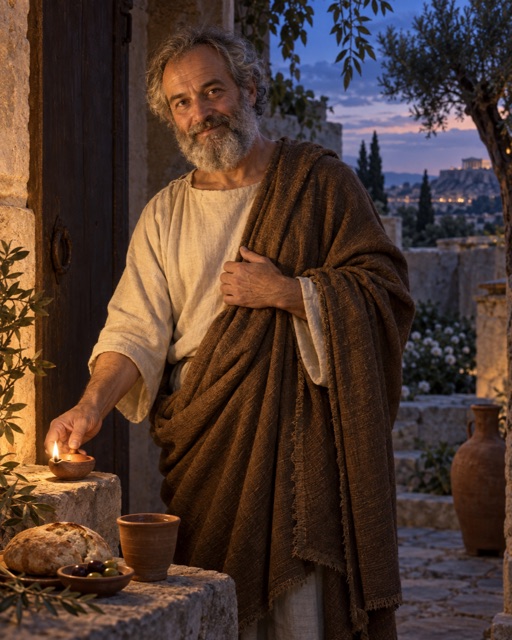
Epicureanism · Letter
Letter to Herodotus
by Epicurus · The Philosopher of a Quiet Life · Hellenistic Greece, 341–270 BC
Epicurus's condensed account of atoms, void, bodies, perception, and the study of nature, transmitted by Diogenes Laertius.
- Advanced
- 3 chapter guides
- Public domain
Start reading · Read the Principles and the first bodies guide free
Before the text
Editor's Prelude
Epicurus wrote for people who wanted to understand nature without being mastered by fear. He was born on Samos to an Athenian family, taught in several Greek cities, and eventually made his school in a garden at Athens. The world around him had been shaken by Alexander’s conquests and the wars that followed. His answer was not to seek another ruler or a grand public career. He asked what a person can know, what a body needs, and how friends can live securely together.
Herodotus was a student, not the Greek historian of the same name. This letter is a compact guide to the larger books on nature that Epicurus had written. It begins with the meanings of words and the evidence of the senses, then works through bodies, void, atoms, worlds, images, perception, and the soul. Epicurus wanted his reader to keep a short structure in memory so that detailed arguments would not become a blur. His physics was practical in this sense: a person who knows how nature works has less reason to fear divine punishment or the unknown.
An image striking the eye, a sound reaching the ear, a thought or a fear all belong to this material world. Epicurus follows their causes into particles and motion, then turns back to the anxiety that makes knowledge urgent. Knowing when an eclipse occurs would offer little comfort to someone who still imagined a hostile divine will behind it. The summary is meant to make physical inquiry a resource for peace of mind, available to beginners as well as practiced students. The letter comes to us inside Book Ten of Diogenes Laertius’s much later Lives of the Philosophers.
The opening pages
Principles and the first bodies
For those who are unable, Herodotus, to work in detail through all that I have written about nature, or to peruse the large books which I have composed, I have already prepared at sufficient length an epitome of the whole system, that they may keep adequately in mind at least the most general principles in each department, in order that as occasion arises they may be able to assist themselves on the most important points, in so far as they undertake the study of nature. But those also who have made considerable progress in the survey of the main principles ought to bear in mind the scheme of the whole system set forth in its essentials. For we have frequent need of the general view, but not so often of the detailed exposition.
Indeed it is necessary to go back on the main principles, and constantly to fix in one’s memory enough to give one the most essential comprehension of the truth. And in fact the accurate knowledge of details will be fully discovered, if the general principles in the various departments are thoroughly grasped and borne in mind; for even in the case of one fully initiated the most essential feature in all accurate knowledge is the capacity to make a rapid use of observation and mental apprehension, and this can be done if everything is summed up in elementary principles and formulae. For it is not possible for any one to abbreviate the complete course through the whole system, if he cannot embrace in his own mind by means of short formulae all that might be set out with accuracy in detail.
Wherefore since the method I have described is valuable to all those who are accustomed to the investigation of nature, I who urge upon others the constant occupation in the investigation of nature, and find my own peace chiefly in a life so occupied, have composed for you another epitome on these lines, summing up the first principles of the whole doctrine.
First of all, Herodotus, we must grasp the ideas attached to words, in order that we may be able to refer to them and so to judge the inferences of opinion or problems of investigation or reflection, so that we may not either leave everything uncertain and go on explaining to infinity or use words devoid of meaning.
For this purpose it is essential that the first mental image associated with each word should be regarded, and that there should be no need of explanation, if we are really to have a standard to which to refer a problem of investigation or reflection or a mental inference. And besides we must keep all our investigations in accord with our sensations, and in particular with the immediate apprehensions whether of the mind or of any one of the instruments of judgement, and likewise in accord with the feelings existing in us, in order that we may have indications whereby we may judge both the problem of sense perception and the unseen.
Chapter guides · 3
Principles and the first bodies
A Short Map of Nature
Epicurus compresses a large physical system into principles a student can remember.
What he establishes
He begins by fixing the meanings of words and testing claims against sensation. He then argues that bodies and empty space exist, that bodies are made from enduring atoms, and that the universe has no outer boundary. These are connected steps: without void, bodies could not move.
Why this matters
The letter is a memory aid for a fuller course of study, not a set of isolated guesses. Epicurus wants a stable account of nature so that unfamiliar events do not send the mind back to fear or myth.
Where it ends
Epicurus turns to fine images flowing from objects into sight and thought. He ends by locating error in an added judgment that fails confirmation, distinguishing that mistake from the appearance first received.
Sensation, atoms, and the soul
Sensation Has a Material Life
Epicurus connects sense perception to the motions of atoms and the partnership of soul and body.
What he argues
Epicurus explains hearing and smell through particles reaching the senses. He assigns atoms shape, weight and size, argues for smallest indivisible parts, and describes their equal speed through unobstructed void. Collisions account for differences in the motion of compounds. The soul, too, consists of fine particles, and sensation depends on its union with the body.
Why it matters
His account ties sensation to the working partnership of soul and body. When the organism dissolves, the soul disperses and its capacity to feel goes with it.
Where it ends
Epicurus rejects an incorporeal soul: only void is incorporeal, and void cannot act or be acted upon. He closes by referring the account of the soul back to feeling and sensation, as a basis for working out further details.
Properties, worlds, and peace of mind
Worlds, Words, and Peace of Mind
Epicurus brings properties, time, language and the heavens into a natural account meant to quiet fear.
Questions readers ask
- How difficult is Letter to Herodotus?
- Advanced.
- Which translation is this?
- The Cyril Bailey translation from the Ancient Greek. The text follows Epicurus: The Extant Remains (1926).
- Can I read Letter to Herodotus for free?
- Letter to Herodotus is part of Nexus Premium, so reading it needs an account and a Premium subscription. The opening above and two chapter guides on this page are free to read.
- How many chapter guides are there?
- 3 chapter guides, written by the Nexus editors. Two open in full here; the rest show their opening line.
About Epicurus
Epicurus founded his school, the Garden, at Athens in the late fourth century BC. His teaching joined an account of atoms and nature to a practical ethics of friendship, modest wants, and freedom from needless fear. Most of his books are lost; letters, maxims, fragments, and reports preserved by later writers carry the surviving record.
“What would remain of our fears if we understood nature and examined what we truly need?”
Epicurus gave philosophy a daily task: use inquiry into the world to make a human life less frightened and more self-sufficient. His letters and sayings survived through complicated ancient transmission and still challenge easy caricatures of pleasure.
Source text: public domain. Chapter guides: original Nexus writing. Letter to Herodotus is part of The Nexus Archive, guided Quests through the great works.