 The Nexus Archive
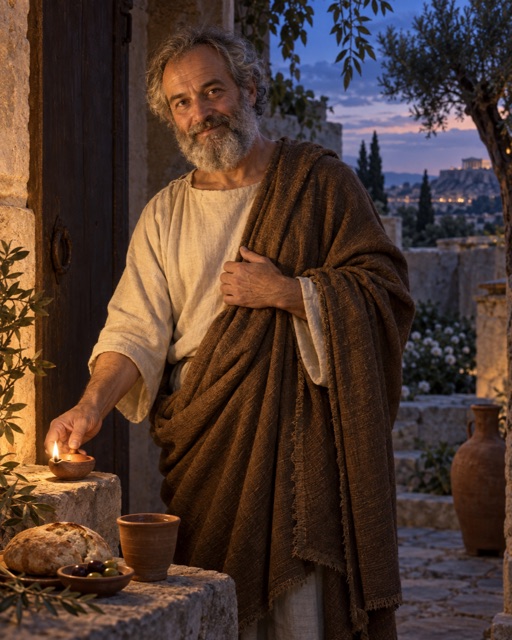
Ancient source about Epicurus · Biography
Life of Epicurus
by Diogenes Laertius
Featuring Epicurus
Diogenes's later biography and school report, including the transmitted Will and last-day letter, kept distinct from Epicurus's own voice.
- Advanced
- 5 chapter guides
- Public domain
Start reading · Read the Origins, opponents, and friends guide free
Before the text
Editor's Prelude
Diogenes Laertius gathers stories of Epicurus’s family, schooling, rivals, friends, household, death, books, and doctrines. His portrait moves between accusation and defense: hostile writers describe luxury and misconduct, while Diogenes points to the philosopher’s generosity, loyal friends, and enduring school. The competing reports make reputation part of the story, and quotations give earlier witnesses room to speak in their own voices.
Epicurus grew up on Samos in an Athenian family and eventually founded his Garden in Athens. The school’s shared study and friendships survived him. His Will makes that community concrete: property supports the Garden, Hermarchus succeeds him, children receive provision, and four enslaved people gain freedom. In the dying letter addressed here to Idomeneus, severe bodily pain meets the remembered joy of conversation and a request to care for Metrodorus’s children.
The account then turns from people and books to the standards by which the school judges truth and chooses a way of life. Sensation, concepts, and feelings underlie its reasoning; friendship joins practical need to shared life. The closing discussion makes freedom from mental trouble and bodily pain forms of pleasure, and treats virtue as inseparable from that pleasure. Biography and philosophy converge in the question of what makes a life happy.
The opening pages
Origins, opponents, and friends
EPICURUS, son of Neocles and Chaerestrata, was an Athenian of the deme of Gargettus, and the family of the Philaidae, as Metrodorus says in his work on Nobility of Birth. Heraclides in his epitome of Sotion and others say that the Athenians having colonized Samos, Epicurus was brought up there. In his eighteenth year, as they say, he came to Athens, when Xenocrates was at the Academy and Aristotle was living in Chalcis. After the death of Alexander of Macedon, when the Athenians were driven out of Samos by Perdiccas, he went to join his father in Colophon.
Having stayed there some time and gathered disciples he returned again to Athens in the archonship of Anaxicrates. For a while he joined with others in the study of philosophy, but later taught independently, when he had founded the school called after him. He tells us himself that he first made acquaintance with philosophy at the age of fourteen. Apollodorus the Epicurean in the first book of his Life of Epicurus says that he took to philosophy because he despised the teachers of literature, since they were not able to explain to him the passage about Chaos in Hesiod. Hermippus says that Epicurus was at one time a schoolmaster and then after he met with the writings of Democritus, he took eagerly to philosophy.
And this is why Timon says about him:
Last and most shameless of the scientists, infant school teacher from Samos, the most stubborn of all living beings.
His three brothers, Neocles, Chaeredemus, and Aristobulus, joined him in studying philosophy at his suggestion, according to Philodemus the Epicurean in the tenth book of his Comparison of Philosophies. Also a slave called Mys, as Muronianus says in his chapters on historical coincidences.
Diotimus the Stoic, who is ill-disposed to Epicurus, has calumniated him most bitterly by producing fifty lewd letters as Epicurus’ work; so has the writer who has assigned to Epicurus the collection of ‘billets-doux’ which were attributed to Chrysippus, and also Posidonius the Stoic and his followers, as well as Nicolaus and Sotion in the twelve books of the ‘Arguments of Diocles’ which are named after the Epicurean celebration of The Twentieth; also Dionysius of Halicarnassus. For they say that he used to go round from house to house with his mother reading out the purification prayers, and assisted his father in elementary teaching for a miserable pittance. They add that one of his brothers prostituted himself and kept company with Leontion, the hetaera. Also that he took Democritus’ atomic theory and Aristippus’ theory of pleasure and taught them as his own. Further, that he was not an Athenian born, as Timocrates says, and Herodotus too in his book The Youth of Epicurus. He is also said to have used degrading flattery towards Mithres, the steward of Lysimachus, calling him in his letters both ‘Saviour’ and ‘My lord.’
Chapter guides · 5
Origins, opponents, and friends
Competing Stories of a Life
Diogenes gives hostile reports and then argues against them.
Accusation and defense
Diogenes traces Epicurus’s family, education, and travels, then collects hostile charges of flattery, luxury, and contempt for other philosophers, many from Stoic opponents such as Diotimus and from Timocrates, a disciple who had left the school. His answer is emphatic: he points to Epicurus’s loyal friends, generosity, gentle treatment of servants, and the survival of the school. These opposing voices make the philosopher’s reputation a dispute within the account itself.
The limits of wealth
The defense ends with the Garden’s simple food and friendship without compulsory pooling of property. Bread, water, and an occasional gift of cheese serve as evidence that pleasure need not mean extravagance. Athenaeus’s closing epigram contrasts endless striving for gain with nature’s narrowly bounded wealth; Diogenes then turns toward Epicurus’s own teaching.
The school and the death of Epicurus
A Community Outlives Its Founder
Conflicting reports about teachers lead into the school’s succession and Epicurus’s death.
Teachers, language, and succession
Reports disagree about Epicurus’s teachers and the age at which he began philosophy; Epicurus’s own claim to have taught himself stands beside accounts of his debts to others. Diogenes also describes his plain language and insistence on clarity. The chronology leads from teaching at Mitylene and Lampsacus to Athens, with Hermarchus named as his successor.
The last request
Hermarchus reports a fourteen-day final illness. Hermippus supplies the scene of a hot bath and unmixed wine, followed by Epicurus’s request that his friends remember his teaching. Diogenes repeats the scene in his own epigram, closes the account of life and death, and announces the Will.
The Will and last-day letter
A Will and a Last Letter
Two embedded documents make the community’s practical arrangements visible.
Disciples, books, and teaching
The Books We Mostly Lost
Diogenes names students, catalogues writings, and explains the school’s criteria of truth.
The wise person and the close
The Wise Person in Report
The closing section describes what Epicureans say about conduct and pleasure.
Questions readers ask
- How difficult is Life of Epicurus?
- Advanced.
- Which translation is this?
- The Cyril Bailey translation from the Ancient Greek. The text follows Epicurus: The Extant Remains (1926).
- Can I read Life of Epicurus for free?
- Life of Epicurus is part of Nexus Premium, so reading it needs an account and a Premium subscription. The opening above and two chapter guides on this page are free to read.
- How many chapter guides are there?
- 5 chapter guides, written by the Nexus editors. Two open in full here; the rest show their opening line.
About Epicurus
Epicurus founded his school, the Garden, at Athens in the late fourth century BC. His teaching joined an account of atoms and nature to a practical ethics of friendship, modest wants, and freedom from needless fear. Most of his books are lost; letters, maxims, fragments, and reports preserved by later writers carry the surviving record.
“What would remain of our fears if we understood nature and examined what we truly need?”
Epicurus gave philosophy a daily task: use inquiry into the world to make a human life less frightened and more self-sufficient. His letters and sayings survived through complicated ancient transmission and still challenge easy caricatures of pleasure.
Source text: public domain. Chapter guides: original Nexus writing. Life of Epicurus is part of The Nexus Archive, guided Quests through the great works.