 The Nexus Archive
Roman Epic · Epic
The Aeneid
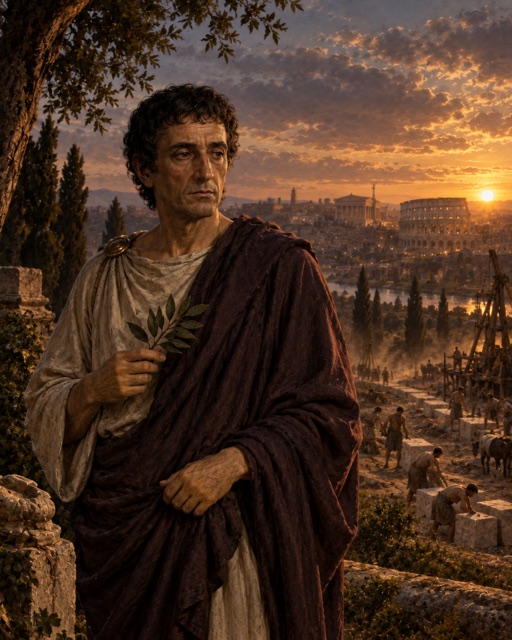
by Virgil · The Poet of Empire and Exile · Augustan Rome, 70-19 BCE
Virgil's Roman epic of Troy's fall, exile, wandering, piety, war in Italy, and the costly founding destiny that leads toward Rome.
- Advanced
- 29-19 BCE
- ~7 hr 15 min read
- 28 chapter guides
- Public domain
Start reading · Read the Book I · Jupiter's Promise guide free
Before the text
Editor's Prelude
The Cost Of A Promised Future
The Aeneid begins after the story another epic might have treated as its ending. Troy has fallen, Aeneas has gathered survivors and household gods, and the Mediterranean has become the dangerous distance between a lost home and a homeland promised by fate. Virgil writes forward from Homer: the wanderer must become a founder, and the war that seemed finished must be fought again on Italian ground.
That future is Rome, but the poem never lets destiny feel painless. Written in the political world of Augustus after decades of Roman civil war, the epic can praise order and still expose what founding demands from the people who must carry it. Dido, Turnus, Pallas, Camilla, and even Aeneas himself make the cost of providential history impossible to treat as an abstraction.
J. W. Mackail renders the poem in grave, concentrated prose. The poem sustains a double pressure: fate declares an outcome, while human beings still choose, resist, love, rage, and grieve inside it. Aeneas's defining virtue is not victory alone but pietas—duty to gods, family, people, and future—and Virgil keeps asking what that duty preserves, what it sacrifices, and what remains unsettled when the final sword falls.
The opening pages
Jupiter's Promise
'O thou who dost sway mortal and immortal things with eternal command and the terror of thy thunderbolt, how can my Aeneas have transgressed so grievously against thee? how his Trojans? on whom, after so many deaths outgone, all the world is barred for Italy's sake. From them sometime in the rolling years the Romans were to arise indeed; from them were to be rulers who, renewing the blood of Teucer, should hold sea and land in universal lordship. This thou didst promise: why, O father, is thy decree reversed? This was my solace for the wretched ruin of sunken Troy, doom balanced against doom. Now so many woes are spent, and the same fortune still pursues them; Lord and King, what limit dost thou set to their agony? Antenor could elude the encircling Achaeans, could thread in safety the Illyrian bays and inmost realms of the Liburnians, could climb Timavus' source, whence through nine mouths pours the bursting tide amid dreary moans of the mountain, and covers the fields with hoarse waters. Yet here did he set Patavium town, a dwelling-place for his Teucrians, gave his name to a nation and hung up the armour of Troy; now settled in peace, he rests and is in quiet. We, thy children, we whom thou beckonest to the heights of heaven, our fleet miserably cast away for a single enemy's anger, are betrayed and severed far from the Italian coasts. Is this the reward of goodness? Is it thus thou dost restore our throne?'
Smiling on her with that look which clears sky and storms, the parent of men and gods lightly kissed his daughter's lips; then answered thus:
'Spare thy fear, Cytherean; thy people's destiny abides unshaken. Thine eyes shall see the city Lavinium, their promised home; thou shalt exalt to the starry heaven thy noble Aeneas; nor is my decree reversed. He thou lovest (for I will speak, since this care keeps torturing thee, and will unroll further the secret records of fate) shall wage a great war in Italy, and crush warrior nations; he shall appoint his people a law and a city; till the third summer see him reigning in Latium, and three winters' camps pass over the conquered Rutulians. But the boy Ascanius, whose surname is now Iülus—Ilus he was while the Ilian state stood sovereign—thirty great circles of rolling months shall he fulfil in government; he shall carry the kingdom from its fastness in Lavinium, and make a strong fortress of Alba the Long. Here the full space of thrice an hundred years shall the kingdom endure under the race of Hector's kin, till the royal priestess Ilia from Mars' embrace shall give birth to a twin progeny. Thence shall Romulus, gay in the tawny hide of the she-wolf that nursed him, take up their line, and name them Romans after his own name. I appoint to these neither period nor boundary of empire: I have given them dominion without end. Nay, harsh Juno, who in her fear now troubles earth and sea and sky, shall change to better counsels, and with me shall cherish the lords of the world, the gowned race of Rome. Thus is it willed. A day will come in the lapse of cycles, when the house of Assaracus shall lay Phthia and famed Mycenae in bondage, and reign over conquered Argos. From the fair line of Troy a Caesar shall arise, who shall limit his empire with ocean, his glory with the firmament, Julius, inheritor of great Iülus' name. …
Read it in a Quest
Follow epic beyond Homer through Virgil's Roman exile, Dante's journey through judgment, and Milton's cosmic drama of rebellion and fall.
Chapter guides · 28
Book I · Jupiter's Promise
The Future Has Been Announced
Jupiter answers Venus by unfolding the Roman history Aeneas cannot yet see.
Jupiter promises Rome
After the storm and landfall, Venus challenges Jupiter over the suffering of the Trojans. He promises that Aeneas will reach Italy and that Rome's power will rise from his line.
Help for the refugees
Jupiter sends Mercury to Carthage so that Dido and her people will welcome the strangers. His promise of a distant empire begins with help for the survivors in immediate danger.
A destination with a cost
The prophecy settles the destination but not the moral meaning of the road. From now on, the suspense lies less in whether Rome will exist than in what that future will cost.
Book I · Dido Receives the Trojans
Welcome Becomes Danger
Dido offers the Trojans shelter while Venus quietly turns hospitality toward love.
Dido welcomes the Trojans
Dido offers the refugees help reaching Italy or a home in her own city. Aeneas steps out of Venus’s concealing cloud and thanks her. Dido knows exile herself and receives the Trojans as guests.
Cupid takes the boy’s place
Venus sends Cupid disguised as Ascanius to the feast, while the real boy sleeps safely away. Cupid works on Dido’s heart as she holds him. At the banquet’s end, Dido asks Aeneas to tell how Troy fell and how he has wandered for seven years.
Book II · The City Opens
The City Opens From Within
Hector tells Aeneas to save Troy’s future, but he first plunges into a desperate defence of the city.
Book II · Flight from Troy
The Hero Must Become an Exile
Aeneas leaves the burning city carrying both the past and a future he cannot yet name.
Book III · The Harpies' Curse
Hunger Becomes a Prophecy
The Trojans escape the Harpies, but Celaeno gives their journey a terrifying new measure.
Book III · Italy, the Cyclops, and Anchises
Italy Appears, and Anchises Is Lost
The wanderers finally touch Italy, pass the Cyclops' shore, and end the book with a father's death.
Book IV · The Queen Confronts Aeneas
Two Truths That Cannot Live Together
Dido names betrayal; Aeneas answers with gratitude, duty, and a future he says is not his choice.
Book IV · Dido's Death
Dido’s Last Moments
Anna discovers her sister’s purpose too late, and Juno sends Iris to end Dido’s suffering.
Book V · Boxing, Archery, and the Young Riders
The Games End in a Shared Tradition
Aeneas stops a brutal boxing match, honours an omen, and watches the boys perform the Trojan riding game.
Book V · A People Divided, a Life Given
Not Everyone Must Carry the Same Future
The burned ships force Aeneas to divide the people, and Palinurus pays the price of the renewed voyage.
Book VI · The Fallen and the Crossroads
The Two Roads of the Dead
Deïphobus recalls his betrayal, and the Sibyl leads Aeneas past the road to punishment towards the blessed.
Book VI · Rome to Come
Rome's Mission and Rome's Grief
Anchises reveals future Romans, then ends the parade with the young Marcellus who will not live to fulfill his promise.
Book VII · Allecto Unleashed
War Is Manufactured
Allecto turns fear inside a household into rage across a country.
Book VII · The Armies of Italy
The Promised Land Is Populated
Virgil's catalog gives Italy names, histories, equipment, and local pride before the armies die.
Book VIII · Evander's Welcome
Alliance Begins in Recognition
Shared ancestry, a common enemy, and Evander’s memories of Anchises open the way to an alliance.
Book VIII · Hercules and Rome Before Rome
Rome Before Its Monuments
Evander gives Aeneas a friendship, a history, and a view of Rome before imperial grandeur.
Book VIII · The Shield of Aeneas
A Future Carried Without Understanding
The shield displays Roman history to Aeneas, who delights in images whose events he cannot yet know.
Book IX · Nisus and Euryalus
Friendship Reaches for Glory
Nisus and Euryalus volunteer together, mixing courage, love, ambition, and foreknown risk.
Book IX · The Open Gates
The Camp Survives Its Own Mistake
Open gates let Turnus inside, but the isolated hero must finally escape through the river.
Book X · Pallas and Aeneas's Fury
Grief Changes the Hero
Turnus kills Pallas and takes his belt; Aeneas answers by turning mercy into vengeance.
Book X · Juno's Phantom
The Gods Can Delay, Not Cancel
Juno removes Turnus from battle with a phantom Aeneas, but Jupiter grants only postponement.
Book X · Mezentius and Lausus
Pity Arrives After the Blow
Lausus dies protecting Mezentius, and Aeneas recognizes too late the devotion he has destroyed.
Book XI · Council in Laurentum
Peace Is Argued Under Pressure
Diomedes refuses alliance, Latinus proposes terms, and Turnus answers political failure with confidence in battle.
Book XI · Camilla Takes the Field
Camilla Claims the Open Field
While Turnus prepares an ambush, Camilla offers to meet the Trojan cavalry herself.
Book XI · Camilla Falls
Camilla’s Death Turns the Battle
Camilla’s death breaks the cavalry’s defence and draws Turnus away from his ambush.
Book XII · The Treaty Broken
The Oath Gives Way to Slaughter
Juturna’s omen helps break the peace, and Aeneas’s recovery leads back into the fighting.
Book XII · Turnus Returns
Turnus Chooses the Duel at Last
Turnus answers the city’s call, but a broken sword and renewed divine help interrupt the combat.
Book XII · The Dira and the Death of Turnus
Victory Ends in Fury
Aeneas pauses over Turnus's plea, sees Pallas's belt, and lets vengeance decide the poem's final act.
Questions readers ask
- How long does it take to read The Aeneid?
- About 7 hr 15 min in total.
- How difficult is The Aeneid?
- Advanced. A long epic; about 7 hours of reading.
- Which translation is this?
- The J. W. Mackail translation from the Latin. The text follows The Aeneid of Virgil, translated into English by J. W. Mackail (1885).
- Can I read The Aeneid for free?
- The Aeneid is part of Nexus Premium, so reading it needs an account and a Premium subscription, and completing an earlier Quest's Mastery. The opening above and two chapter guides on this page are free to read.
- How many chapter guides are there?
- 28 chapter guides, written by the Nexus editors. Two open in full here; the rest show their opening line.
About Virgil
Virgil was the central poet of Augustan Rome. His Aeneid transforms the fall of Troy and the wanderings of Aeneas into Rome's founding myth, joining grief, piety, divine pressure, and imperial imagination.
“What must be sacrificed when a people turns survival into empire?”
Virgil gives Nexus the Roman answer to Homer: epic no longer only remembers heroic greatness, but asks how suffering becomes political origin.
Source text: public domain. Chapter guides: original Nexus writing. The Aeneid is part of The Nexus Archive, guided Quests through the great works.