 The Nexus Archive
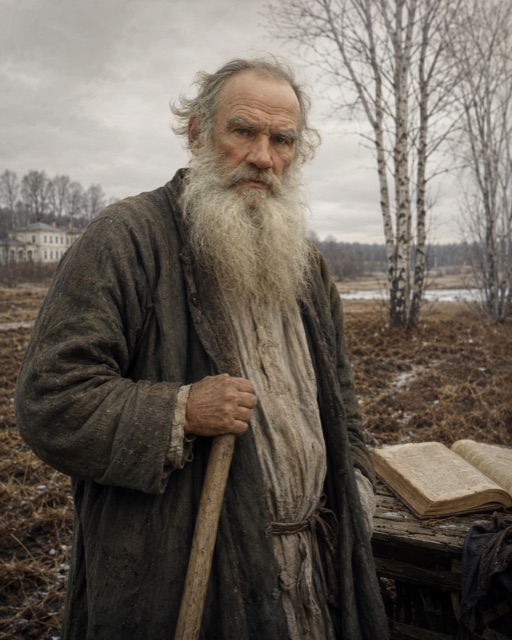
Moral Realism · Novel
War and Peace
by Tolstoy · The Searcher of Conscience · Russian Realism, 1828-1910
Tolstoy's vast novel of family, history, war, peace, moral vision, and the limits of great-man history.
- Brutal
- 1869
- ~41 hr 45 min read
- 34 chapter guides
- Public domain
Start reading · Read the Book One guide free
Before the text
Editor's Prelude
Lives Inside History
A family visit can feel as urgent as a battle when love, money, and a person’s future depend on it. War and Peace begins in a Petersburg drawing room in 1805. Aristocrats speak French, arrange introductions, and discuss Napoleon while war approaches the world they know.
Pierre Bezukhov wants a life with meaning. Prince Andrew longs to escape a life that feels too small. The Rostovs and Bolkonskys bring other hopes, fears, and loyalties into their paths. Tolstoy gives weight to a frightened soldier, a strained family meal, a dance, or a moment of kindness. People keep surprising themselves and one another.
The novel moves between intimate scenes, crowded battlefields, and arguments about history. Famous rulers share its pages with servants, peasants, and children. The two epilogues extend both the families’ lives and the question of what moves whole nations. Beneath this enormous range lies a human difficulty: wanting to direct a life while depending on people and events beyond one’s control.
The opening pages
Chapter I
“Well, Prince, so Genoa and Lucca are now just family estates of the Buonapartes. But I warn you, if you don’t tell me that this means war, if you still try to defend the infamies and horrors perpetrated by that Antichrist—I really believe he is Antichrist—I will have nothing more to do with you and you are no longer my friend, no longer my ‘faithful slave,’ as you call yourself! But how do you do? I see I have frightened you—sit down and tell me all the news.”
It was in July, 1805, and the speaker was the well-known Anna Pávlovna Schérer, maid of honor and favorite of the Empress Márya Fëdorovna. With these words she greeted Prince Vasíli Kurágin, a man of high rank and importance, who was the first to arrive at her reception. Anna Pávlovna had had a cough for some days. She was, as she said, suffering from la grippe; grippe being then a new word in St. Petersburg, used only by the elite.
All her invitations without exception, written in French, and delivered by a scarlet-liveried footman that morning, ran as follows:
“If you have nothing better to do, Count (or Prince), and if the prospect of spending an evening with a poor invalid is not too terrible, I shall be very charmed to see you tonight between 7 and 10—Annette Schérer.”
“Heavens! what a virulent attack!” replied the prince, not in the least disconcerted by this reception. He had just entered, wearing an embroidered court uniform, knee breeches, and shoes, and had stars on his breast and a serene expression on his flat face. He spoke in that refined French in which our grandfathers not only spoke but thought, and with the gentle, patronizing intonation natural to a man of importance who had grown old in society and at court. He went up to Anna Pávlovna, kissed her hand, presenting to her his bald, scented, and shining head, and complacently seated himself on the sofa.
“First of all, dear friend, tell me how you are. Set your friend’s mind at rest,” said he without altering his tone, beneath the politeness and affected sympathy of which indifference and even irony could be discerned.
“Can one be well while suffering morally? Can one be calm in times like these if one has any feeling?” said Anna Pávlovna. “You are staying the whole evening, I hope?”
“And the fete at the English ambassador’s? Today is Wednesday. I must put in an appearance there,” said the prince. “My daughter is coming for me to take me there.”
Read it in a Quest
A moral trial where guilt, death, faith, and revolt press the soul into the open.
Chapter guides · 34
Book One: 1805 · Chapter XIV
A Mother Seeks Help
Anna Mikhaylovna uses her connections to improve Boris’s chances.
The main idea
Friendship and family ties also provide access to money and powerful people. Anna Mikhaylovna pursues that access because her son’s future depends on it.
What happens
Anna Mikhaylovna tells Countess Rostova how she secured Boris’s appointment and how little money she has to equip him. She hopes the rich Count Bezukhov will help his godson. She leaves with Boris to visit him. At the door, Count Rostov asks her to invite Pierre to dinner and boasts of what his cook will serve.
Book One: 1805 · Chapter XXVIII
Andrew Leaves His Family
A departure for war exposes the fear and love inside the Bolkonsky household.
The main idea
Andrew can leave home, but his departure affects people who must stay. His family’s strained farewells give his choice a cost.
What happens
Princess Mary gives Andrew an icon to wear. His father sends him away with instructions and a letter for Kutuzov. When Andrew takes leave of his pregnant wife, Lise faints. He departs while Mary and Mademoiselle Bourienne attend to her. The old prince’s angry nose-blowing sounds from his study. Then he looks out, sees that Andrew has gone, and slams the door.
Book Two: 1805 · Chapter XI
Wit Before an Audience
Bilibin’s circle treats conversation as a contest for attention.
Book Two: 1805 · Chapter XXI
The Price of Surviving
Tushin needs another officer to defend him, while Rostov longs for home.
Book Three: 1805 · Chapter X
Devotion to the Emperor
Alexander’s presence turns the soldiers’ excitement into personal love.
Book Three: 1805 · Chapter XIX
Glory Grows Small
Wounded Andrew finds that Napoleon no longer seems important.
Book Four: 1806 · Chapter VIII
A Return During Labor
Andrew arrives home while his family waits anxiously for Lise’s delivery.
Book Four: 1806 · Chapter XVI
Promises and a Paid Debt
Nicholas leaves home with his gambling debt settled and Sonya still devoted to him.
Book Five: 1806–07 · Chapter XI
Two Ways to Judge a Good Life
Pierre and Andrew disagree about whom kindness can help.
Book Five: 1806–07 · Chapter XXII
Life Beyond Public Plans
Everyday life goes on apart from the politics of 1809.
Book Six: 1808–10 · Chapter XIII
A Visit Must End
Natasha enjoys Boris’s attention without imagining a marriage to him.
Book Six: 1808–10 · Chapter XXVI
A Wish to Leave, a Reason to Stay
Mary imagines a pilgrim’s life but remains bound to her family.
Book Seven: 1810–11 · Chapter VII
A Dance at Their Uncle’s House
Natasha finds joy in music and manners far from her usual social world.
Book Seven: 1810–11 · Chapter XIII
An Uneasy Family Truce
Nicholas’s wish to marry Sonya meets his mother’s fierce resistance.
Book Eight: 1811–12 · Chapter XI
Anatole Sees No Obstacle
His desire for Natasha rests on ignoring obligations he already has.
Book Eight: 1811–12 · Chapter XXII
Kindness Opens a Future
Pierre gives Natasha compassion when she expects judgment.
Book Nine: 1812 · Chapter XII
The Heroic Tale and the Soldier
Nicholas doubts a celebrated story about courage but keeps his doubts to himself.
Book Nine: 1812 · Chapter XXIII
A Promise Made in Public
The nobles’ patriotic excitement turns into obligations they must carry home.
Book Ten: 1812 · Chapter XX
The Wounded and the Workers
Pierre’s journey brings him closer to the human cost of battle.
Book Ten: 1812 · Chapter XXXIX
A Victory Measured in Resolve
Tolstoy calls Borodino a Russian moral victory despite the terrible losses.
Book Eleven: 1812 · Chapter XVII
A Departure With a Hidden Passenger
The Rostovs leave Moscow with the wounded, and Natasha is not told that Andrew is among them.
Book Eleven: 1812 · Chapter XXXIV
A Rescue Ends in Arrest
Pierre’s attempt to protect strangers makes him a prisoner.
Book Twelve: 1812 · Chapter VIII
The Hope Behind Sonya’s Letter
Sonya releases Nicholas while believing another marriage may keep him from Mary.
Book Twelve: 1812 · Chapter XVI
Andrew’s Death
His inward separation from life comes before his body finally stops.
Book Thirteen: 1812 · Chapter X
Orders Without Results
Napoleon’s many instructions cannot restore control over Moscow or his army.
Book Thirteen: 1812 · Chapter XIX
A Road They Cannot Leave
The French keep moving toward Smolensk while Russian attacks add needless deaths.
Book Fourteen: 1812 · Chapter X
Music Before the Raid
Petya turns a dark camp into a world of imagined triumph.
Book Fourteen: 1812 · Chapter XIX
Driving Out the Invader
Tolstoy argues that freeing Russia mattered more than capturing every French soldier.
Book Fifteen: 1812–13 · Chapter X
Honors as Power Slips Away
Kutuzov receives a great decoration after learning that his authority is ending.
Book Fifteen: 1812–13 · Chapter XX
Joy After Grief
Natasha admits that she loves Pierre, and Mary accepts her renewed happiness.
First Epilogue: 1813–20 · Chapter VIII
Learning to Restrain Anger
Mary helps Nicholas question a cruelty he once treated as ordinary.
First Epilogue: 1813–20 · Chapter XVI
The Next Generation Dreams of Glory
The adults’ settled lives leave Andrew’s son longing for a great deed.
Second Epilogue · Chapter VI
Why an Order Is Carried Out
Tolstoy argues that a command works only when other events make it possible.
Second Epilogue · Chapter XII
A Different Starting Point for History
Tolstoy ends by asking history to study human dependence rather than unlimited free will.
Questions readers ask
- How long does it take to read War and Peace?
- About 41 hr 45 min in total.
- How difficult is War and Peace?
- Brutal. A very long novel; about 42 hours of reading.
- Which translation is this?
- The Louise and Aylmer Maude translation from the Russian, first published in 1869. The text follows Project Gutenberg ebook #2600: War and Peace.
- Can I read War and Peace for free?
- War and Peace is part of Nexus Premium, so reading it needs an account and a Premium subscription, and completing an earlier Quest's Mastery. The opening above and two chapter guides on this page are free to read.
- How many chapter guides are there?
- 34 chapter guides, written by the Nexus editors. Two open in full here; the rest show their opening line.
About Tolstoy
Leo Tolstoy was a Russian novelist, moral thinker, and social critic whose major works brought family life, history, death, violence, faith, and moral awakening into vast narrative form. His later spiritual crisis reshaped his public life and gave his fiction an even sharper judgment on vanity and false living.
“What does a life become when it can no longer hide from truth?”
Tolstoy gives Nexus the widest moral canvas in fiction: private homes, public history, illness, war, faith, and the exact moment when a person sees life differently.
Source text: public domain. Chapter guides: original Nexus writing. War and Peace is part of The Nexus Archive, guided Quests through the great works.