 The Nexus Archive
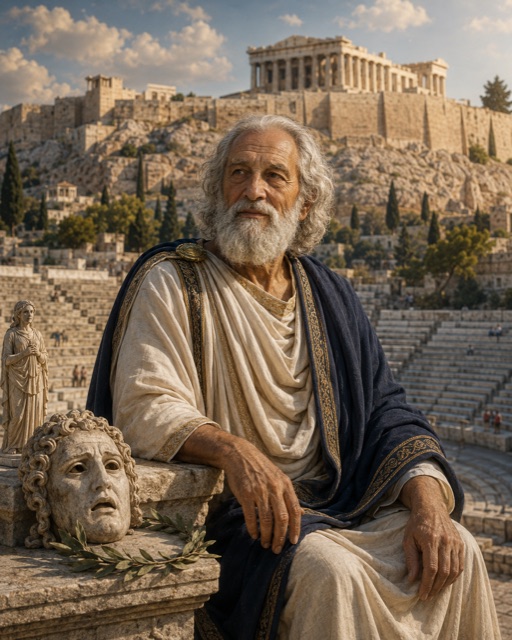
Greek Tragedy · Play
Philoctetes
by Sophocles · The Judge of Fate · Classical Athens, 496-406 BCE
Odysseus sends Neoptolemus to deceive the abandoned Philoctetes, testing honor, necessity, suffering, and consent.
- Advanced
- ~55 min read
- 2 chapter guides
- Public domain
Start reading · Read the PHILOCTETES — Part 1 guide free
Before the text
Editor's Prelude
The Bow and the Wounded Man
The Greeks need Philoctetes' invincible bow to take Troy, but they abandoned its owner on Lemnos because his wound and cries disrupted the army. Ten years later necessity sends them back to the person they betrayed.
Odysseus sends Neoptolemus, the young son of Achilles, to win Philoctetes' trust with a story of shared mistreatment. The famous father's name gives the son a welcome that Odysseus could never receive.
In this verse drama, arguments about duty keep coming back to a body in pain. Philoctetes needs help, but he also wants the freedom to refuse those who abandoned him.
The opening pages
The Persons
ODYSSEUS.
NEOPTOLEMUS.
CHORUS of Mariners.
PHILOCTETES.
Messenger, disguised as a Merchantman.
HERACLES, appearing from the sky.
SCENE. A desert shore of the Island of Lemnos.
It was fated that Troy should be taken by Neoptolemus, the son of Achilles, assisted by the bow of Heracles in the hands of Philoctetes.
Now Philoctetes had been rejected by the army because of a trouble in his foot, which made his presence with them insufferable; and had been cast away by Odysseus on the island of Lemnos.
But when the decree of fate was revealed by prophecy, Odysseus undertook to bring Philoctetes back, and took with him Neoptolemus, whose ambition could only be gratified through the return of Philoctetes with the bow.
Philoctetes was resolutely set against returning, and at the opening of the drama Neoptolemus is persuaded by Odysseus to take him with guile.
But when Philoctetes appears, the youth’s ingenuous nature is so wrought upon through pity and remorse, that his sympathy and native truthfulness at length overcome his ambition.
When the inward sacrifice is complete, Heracles appears from heaven, and by a few words changes the mind of Philoctetes, so that all ends well.
PHILOCTETES — Part 1
PHILOCTETES
ODYSSEUS. NEOPTOLEMUS.
ODYSSEUS.
This coast of sea-girt Lemnos, where we stand,
Is uninhabited, untrodden of men.
And here, O noble son of noblest sire,
Achilles-born Neoptolemus, I erewhile,—
Ordered by those who had command,—cast forth
Trachinian Philoctetes, Poeas’ son,
His foot dark-dripping with a rankling wound;
When with wild cries, that frighted holy rest,
Filling the camp, he troubled every rite,
That none might handle sacrifice, or pour
Wine-offering, but his noise disturbed our peace.
But why these words? No moment this for talk,
Lest he discern my coming, and I lose
The scheme, wherewith I think to catch him soon.
Now most behoves thy service, to explore
This headland for a cave with double mouth,
Whose twofold aperture, on wintry days,
Gives choice of sunshine, and in summer noons
The breeze wafts slumber through the airy cell.
Then, something lower down, upon the left,
Unless ’tis dried, thine eye may note a spring.
Go near now silently, and make me know
If still he persevere, and hold this spot,
Or have roamed elsewhere, that informed of this
I may proceed with what remains to say,
And we may act in concert.
NEOPTOLEMUS.
Lord Odysseus,
Thy foremost errand will not task me far.
Methinks I see the cave whereof thou speakest.
Chapter guides · 2
PHILOCTETES — Part 1
A Promise of Home, a Plan for Troy
Odysseus orders Neoptolemus to win Philoctetes and his bow with a false grievance against the Greek commanders. Philoctetes believes him, begs for passage home, and receives a promise that the ship will take him.
The lie Odysseus needs
Odysseus tells Neoptolemus to give his true name but lie about leaving Troy after being denied Achilles's armor. Neoptolemus calls deceit shameful and proposes force; he agrees to the fraud after Odysseus says neither he nor the bow can take Troy without the other.
A suppliant at Neoptolemus's feet
Philoctetes describes ten years alone on Lemnos, crawling after game struck by his arrows and supplying his own water and fire. Taking Neoptolemus for a fellow victim of Odysseus and the Atreidae, he kneels and begs for passage to Oeta. Neoptolemus says the ship will take him, and Philoctetes accepts.
Inside the cave
Odysseus's disguised messenger reports that Odysseus and Diomedes are on their way to take Philoctetes by persuasion or force. Philoctetes presses to leave at once and lets Neoptolemus handle the bow. Before they enter the cave, Philoctetes names a medicinal leaf and any fallen arrows as what he must retrieve, then insists that Neoptolemus come with him because his sickness craves a companion.
PHILOCTETES — Part 2
The Bow Changes Hands Twice
Philoctetes entrusts the bow to Neoptolemus during an attack of pain. Neoptolemus first keeps it for the Greek plan, then returns it and asks Philoctetes openly to sail for Troy.
Questions readers ask
- How long does it take to read Philoctetes?
- About 55 min in total.
- How difficult is Philoctetes?
- Advanced. A short play; about 55 minutes of reading.
- Which translation is this?
- The Lewis Campbell translation from the Ancient Greek. The text follows Sophocles: The Seven Plays in English Verse, translated by Lewis Campbell, new edition, revised (The World's Classics, Henry Frowde, Oxford University Press, 1906).
- Can I read Philoctetes for free?
- Philoctetes is part of Nexus Premium, so reading it needs an account and a Premium subscription. The opening above and one chapter guide on this page are free to read.
- How many chapter guides are there?
- 2 chapter guides, written by the Nexus editors. One opens in full here; the rest show their opening line.
About Sophocles
Sophocles was one of classical Athens' great tragedians. His surviving plays include Oedipus the King, Oedipus at Colonus, and Antigone, works that shaped dramatic structure, moral conflict, and the language of tragic recognition.
“What law must a person obey when every choice destroys something sacred?”
Sophocles gives Nexus tragedy at full force: compressed action, terrible knowledge, public conflict, and characters who discover too late what their choices mean.
Source text: public domain. Chapter guides: original Nexus writing. Philoctetes is part of The Nexus Archive, guided Quests through the great works.