 The Nexus Archive
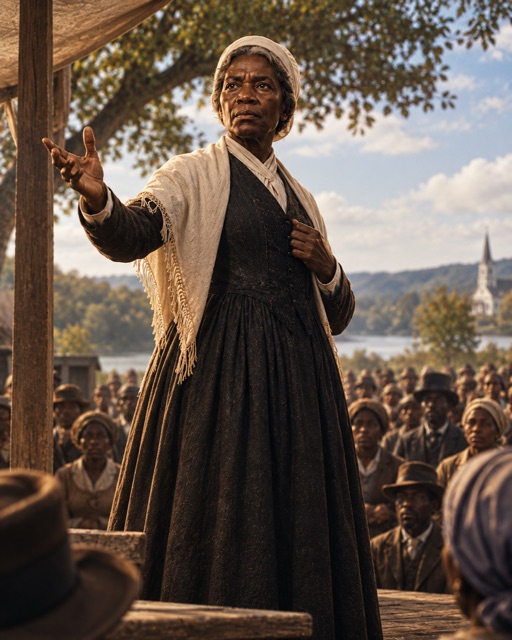
Abolition and Women's Rights · Speech
Woman's Rights Speech, 1851
by Sojourner Truth · The Voice of Liberation · Abolition and Women's Rights, c. 1797-1883
The 1851 Marius Robinson transcript of Truth's Akron women's rights speech, later remembered under the title Ain't I a Woman?
- Beginner
- 1851
- ~5 min read
- 1 chapter guide
- Public domain
Start reading · Read the Woman's Rights Speech, 1851 guide free
Before the text
Editor's Prelude
A Voice Carried By Witnesses
Sojourner Truth rose at the Woman's Rights Convention in Akron in May 1851 without a manuscript and before recording could preserve her voice. She entered a room arguing over women's public claims and answered from the authority of work, hunger, religious hearing, and a life shaped by slavery. The result survives not as an authorial text but as documentary witness.
A woman who could not read could still contest the uses others made of Scripture. A woman whose labor was demanded could ask why her rights were refused. Truth’s public authority rests on that distance between what people already expected of her and what they were prepared to recognize.
The speech survives in distinct reports. Marius Robinson’s contemporary newspaper account differs markedly from Frances Dana Gage’s much later recollection, which supplied the famous refrain “Ain’t I a Woman?” and a dialect rendering. Neither report makes the speaker’s voice directly available. Their differences give the encounter another stake: how a Black woman’s words travel through the people who preserve them.
The opening pages
Woman's Rights Speech, 1851
1851 witness. Marius Robinson's complete contemporary report in The Anti-Slavery Bugle, June 21, 1851, three weeks after the Akron convention. It is a mediated newspaper account, not a verbatim recording.
May I say a few words? Receiving an affirmative answer, she proceeded; I want to say a few words about this matter. I am a woman's rights. I have as much muscle as any man, and can do as much work as any man. I have plowed and reaped and husked and chopped and mowed, and can any man do more than that? I have heard much about the sexes being equal; I can carry as much as any man, and can eat as much too, if I can get it. I am as strong as any man that is now.
As for intellect, all I can say is, if woman have a pint and man a quart—why can't she have her little pint full? You need not be afraid to give us our rights for fear we will take too much,—for we cant take more than our pint'll hold. The poor men seem to be all in confusion, and dont know what to do. Why children, if you have woman's rights give it to her and you will feel better. You will have your own rights, and they wont be so much trouble.
I cant read, but I can hear. I have heard the bible and have learned that Eve caused man to sin. Well if woman upset the world, do give her a chance to set it right side up again. The Lady has spoken about Jesus, how he never spurned woman from him, and she was right. When Lazarus died, Mary and Martha came to him with faith and love and besought him to raise their brother. And Jesus wept—and Lazarus came forth. And how came Jesus into the world? Through God who created him and woman who bore him. Man, where is your part?
But the women are coming up blessed be God and a few of the men are coming up with them. But man is in a tight place, the poor slave is on him, woman is coming on him, and he is surely between-a hawk and a buzzard.
Later comparison. Frances Dana Gage's retrospective version as reprinted in History of Woman Suffrage, Volume I, second edition (1889). Its famous refrain and dialect rendering are comparison evidence, not substitutions for Robinson's 1851 witness.
Chapter guides · 1
Woman's Rights Speech, 1851
Rights Spoken Plainly
Truth answers abstract arguments with labor, Scripture, and direct experience.
Labor, intellect and Scripture
Truth moves from bodily strength and labor to intellect, then to Scripture. Each answer takes an argument used to limit women and asks what follows if women already work, think, believe, suffer, and act in the world.
A right to the full measure
The pint and quart do not claim that everyone has the same capacities. They expose the injustice of refusing a person even the chance to fill her own measure. The final hawk-and-buzzard image refuses to separate women's rights from the pressure of slavery and abolition.
Two distinct witnesses
Robinson’s contemporary report records “I am a woman’s rights,” not the later refrain “Ain’t I a Woman?” Gage’s retrospective version adds that refrain, a dialect rendering and a dramatic account of the audience. Their differences belong to the history of how Truth’s words were reported; they do not supply interchangeable parts of one recoverable transcript.
Questions readers ask
- How long does it take to read Woman's Rights Speech, 1851?
- About 5 min in total.
- How difficult is Woman's Rights Speech, 1851?
- Beginner. A short speech; about 5 minutes of reading.
- Which translation is this?
- The Marius Robinson, reporter/transcriber; Frances Dana Gage, later comparison reporter translation from the English, first published in 1851. The text follows The Anti-Slavery Bugle, June 21, 1851, page 4.
- Can I read Woman's Rights Speech, 1851 for free?
- Woman's Rights Speech, 1851 is part of Nexus Premium, so reading it needs an account and a Premium subscription. The opening above and one chapter guide on this page are free to read.
- How many chapter guides are there?
- One chapter guide, written by the Nexus editors; it opens in full here.
About Sojourner Truth
Sojourner Truth was an abolitionist, speaker, and women's rights advocate who had escaped slavery and became one of the most powerful moral witnesses of the nineteenth century. Her speeches and narrative confront slavery, gender, faith, and human dignity.
“Who gets counted as fully human?”
Truth gives Nexus a voice of moral force rooted in testimony, courage, and spiritual authority.
Source text: public domain. Chapter guides: original Nexus writing. Woman's Rights Speech, 1851 is part of The Nexus Archive, guided Quests through the great works.