 The Nexus Archive
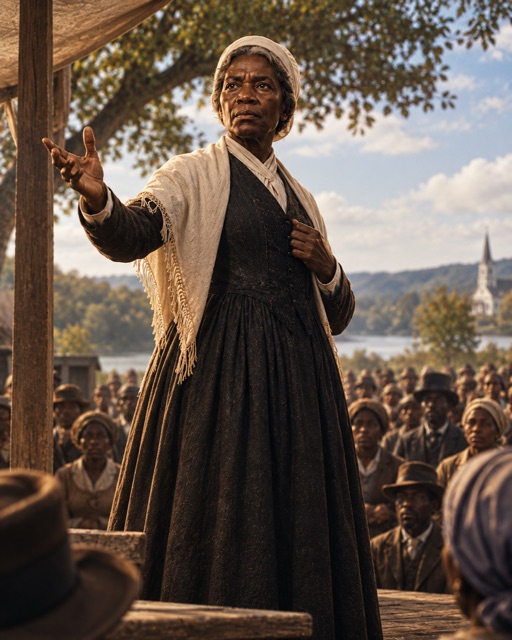
Abolition and Women's Rights · Memoir
Narrative of Sojourner Truth
by Sojourner Truth and Olive Gilbert
Featuring Sojourner Truth
A mediated but important narrative of Truth's life, faith, witness, and liberation.
- Intermediate
- ~2 hr 45 min read
- 10 chapter guides
- Public domain
Start reading · Read the The Auction guide free
Before the text
Editor's Prelude
A Life Reclaimed In The Telling
Sojourner Truth could not write the book that bears her life. Her 1850 Narrative grew from the story she told to Olive Gilbert, who shaped memory, reported speech, religious testimony, and editorial commentary into a third-person narrative. Gilbert’s role remains visible: the book calls its subject Isabella through most of her early life, pauses to describe what print cannot capture in her voice, and sometimes lets Gilbert's own moral judgments enter the frame.
The story begins in a Dutch-speaking enslaved family in New York. An owner’s convenience can separate a family, undo a marriage or cancel a promise. The pressure on Isabella is intimate: how to protect her children, act on her faith and trust people who claim to help.
Truth's remembered sayings can be funny, blunt, prayerful, and strategically exact; Gilbert's narration can be admiring, intrusive, or openly didactic. The final certificates add still another set of voices, asking named witnesses to support Truth's character and the sale of the Narrative. The book is a contested act of self-possession assembled through speech, editorial labor, and public testimony.
The opening pages
Her Birth and Parentage
THE subject of this biography, SOJOURNER TRUTH, as she now calls herself-but whose name, originally, was Isabella-was born, as near as she can now calculate, between the years 1797 and 1800. She was the daughter of James and Betsey, slaves of one Colonel Ardinburgh, Hurley, Ulster County, New York.
Colonel Ardinburgh belonged to that class of people called Low Dutch.
Of her first master, she can give no account, as she must have been a mere infant when he died; and she, with her parents and some ten or twelve other fellow human chattels, became the legal property of his son, Charles Ardinburgh. She distinctly remembers hearing her father and mother say, that their lot was a fortunate one, as Master Charles was the best of the family,-being, comparatively speaking, a kind master to his slaves.
James and Betsey having, by their faithfulness, docility, and respectful behavior, won his particular regard, received from him particular favors-among which was a lot of land, lying back on the slope of a mountain, where, by improving the pleasant evenings and Sundays, they managed to raise a little tobacco, corn, or flax; which they exchanged for extras, in the articles of food or clothing for themselves and children. She has no remembrance that Saturday afternoon was ever added to their own time, as it is by some masters in the Southern States.
Accommodations
Among Isabella's earliest recollections was the removal of her master, Charles Ardinburgh, into his new house, which he had built for a hotel, soon after the decease of his father. A cellar, under this hotel, was assigned to his slaves, as their sleeping apartment,-all the slaves he possessed, of both sexes, sleeping (as is quite common in a state of slavery) in the same room. She carries in her mind, to this day, a vivid picture of this dismal chamber; its only lights consisting of a few panes of glass, through which she thinks the sun never shone, but with thrice reflected rays; and the space between the loose boards of the floor, and the uneven earth below, was often filled with mud and water, the uncomfortable splashings of which were as annoying as its noxious vapors must have been chilling and fatal to health. She shudders, even now, as she goes back in memory, and revisits this cellar, and sees its inmates, of both sexes and all ages, sleeping on those damp boards, like the horse, with a little straw and a blanket; and she wonders not at the rheumatisms, and fever-sores, and palsies, that distorted the limbs and racked the bodies of those fellow-slaves in after-life. Still, she does not attribute this cruelty-for cruelty it certainly is, to be so unmindful of the health and comfort of any being, leaving entirely out of sight his more important part, his everlasting interests,-so much to any innate or constitutional cruelty of the master, as to that gigantic inconsistency, that inherited habit among slaveholders, of expecting a willing and intelligent obedience from the slave, because he is a MAN-at the same time every thing belonging to the soul-harrowing system does its best to crush the last vestige of a man within him; and when it is crushed, and often before, he is denied the comforts of life, on the plea that he knows neither the want nor the use of them, and because he is considered to be little more or little less than a beast.
Chapter guides · 10
The Auction
A Family Becomes An Inventory
The heirs avoid the cost of caring for Bomefree by making his wife’s freedom depend on supporting him.
An auction after Charles’s death
The death of Charles Ardinburgh breaks up the household. Isabella, her younger brother Peter and their mother face sale. The heirs argue over who must support Bomefree, whose damaged health has made him a burden in their eyes.
Freedom with a condition
Rather than sell Mau-mau Bett, the heirs free her on condition that she support her husband. The couple escape separation and remain in their old cellar, but must provide for themselves.
Care grows harder
Kind tenants and neighbors help them survive. As Mau-mau Bett’s health declines, both parents struggle to gather enough food. The chapter ends with their growing frailty and dependence on small gifts.
Death of Bomefree
Freedom Without Provision
Bomefree dies from cold and hunger; John Ardinburgh offers paint and whiskey for his funeral.
Left without care
After the elderly couple caring for Bomefree die, he is blind and alone in a remote cabin. Soan, another elderly freed woman, visits and hears his plea to wash and mend him. She fears becoming ill there herself and cannot undertake the work.
A funeral instead of help
Bomefree is soon found frozen and dead. John Ardinburgh orders a good funeral: black paint for the coffin and a jug of whiskey. Gilbert treats that gesture as a bitter substitute for care during his life. She suggests the paint and whiskey were meant to soothe the enslaved people, not even John’s own hardened conscience.
Slaveholder's Promises
A Promise Is Not Freedom
Dumont refuses Isabella’s promised freedom despite her continued work with a diseased hand.
It Is Often Darkest Just Before Dawn
She Makes The Law Move
Isabella refuses to settle for money or delay and presses for Peter to be delivered into her own care.
New Trials
A Son Goes to Sea
Peter’s troubles in New York lead to a whaling voyage; his letters bring news, then silence.
The Matthias Delusion
Faith Enters A Closed Kingdom
Isabella hears Matthias claim divine authority, joins his household and gradually begins to lose her illusions.
The Consequences of Refusing a Traveller a Night's Lodging
Hospitality on the Road
Repeated refusals of shelter put Sojourner in unsafe company, before her journey brings new listeners in Connecticut.
Another Camp Meeting
She Answers Fear With A Song
Sojourner quiets a camp-meeting crowd. Gilbert then turns to her need for a secure home.
Her Last Interview with Her Master
The Master Confesses
Dumont condemns slavery, and Sojourner welcomes his change without forgetting what he once practiced.
Certificates of Character
A Life Enters Print With Witnesses
Four certificates offer named support for Sojourner’s character and the sale of her Narrative.
Questions readers ask
- How long does it take to read Narrative of Sojourner Truth?
- About 2 hr 45 min in total.
- How difficult is Narrative of Sojourner Truth?
- Intermediate. A mid-length memoir; about 3 hours of reading.
- Which edition is this?
- The original English text, first published in 1850. The text follows The Narrative of Sojourner Truth (1850).
- Can I read Narrative of Sojourner Truth for free?
- Narrative of Sojourner Truth is part of Nexus Premium, so reading it needs an account and a Premium subscription. The opening above and two chapter guides on this page are free to read.
- How many chapter guides are there?
- 10 chapter guides, written by the Nexus editors. Two open in full here; the rest show their opening line.
About Sojourner Truth
Sojourner Truth was an abolitionist, speaker, and women's rights advocate who had escaped slavery and became one of the most powerful moral witnesses of the nineteenth century. Her speeches and narrative confront slavery, gender, faith, and human dignity.
“Who gets counted as fully human?”
Truth gives Nexus a voice of moral force rooted in testimony, courage, and spiritual authority.
Source text: public domain. Chapter guides: original Nexus writing. Narrative of Sojourner Truth is part of The Nexus Archive, guided Quests through the great works.