 The Nexus Archive
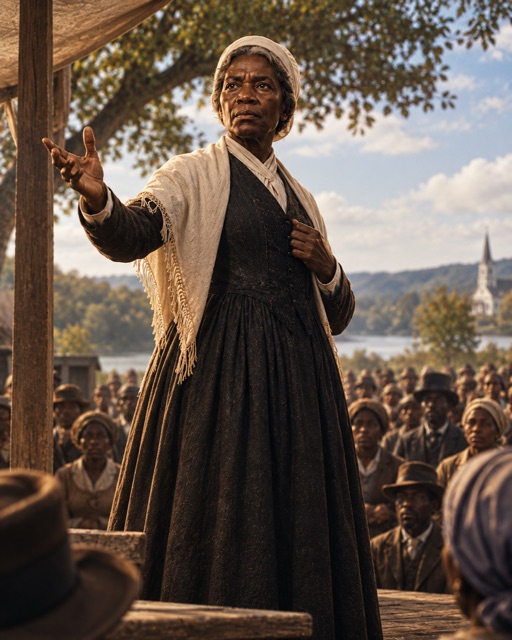
Abolition and Women's Rights · Speech
Later Speeches on Equal Rights
by Sojourner Truth · The Voice of Liberation · Abolition and Women's Rights, c. 1797-1883
Two postwar speeches where Truth presses equal rights for Black women, voting rights, labor, and public voice after emancipation.
- Beginner
- 1867
- ~5 min read
- 2 chapter guides
- Public domain
Start reading · Read the Keeping the Thing Going While Things Are Stirring guide free
Before the text
Editor's Prelude
Freedom Cannot Stop Halfway
In 1867, the end of slavery left a question that legal emancipation could not settle by itself: who would possess the means to act as a free person? At the American Equal Rights Association, Sojourner Truth pressed that question on a movement seeking political rights for both Black Americans and women.
The two separate reports place public liberty close to the body and the household. Work, wages, money and the ballot belong to the same struggle for independence. Truth speaks as someone accustomed to having her labor needed and her authority denied; humor gives her a way to expose that imbalance in front of an audience.
These words come through a movement history published years after the appearances, not through an authorial manuscript or a recording. The reports preserve introductions, laughter and song as well as speech. Within that mediation, Truth’s insistence remains sharp: the people asked to wait for equality must live their lives while they wait.
The opening pages
Keeping the Thing Going While Things Are Stirring
Source Selection
Witness: History of Woman Suffrage, Volume II (1882), edited by Elizabeth Cady Stanton, Susan B. Anthony, and Matilda Joslyn Gage.
Range: The complete 1867 report from Lucretia Mott's introduction of Truth through Truth's promise to “meet you there, too.”
Textual note: The introduction, reported speech, and account of Truth's song belong to this documentary boundary. The report is mediated rather than audio-verbatim.
Mrs. Mott then introduced the venerable Sojourner Truth, who was greeted with loud cheers, after which she said:
My friends, I am rejoiced that you are glad, but I don't know how you will feel when I get through. I come from another field--the country of the slave. They have got their liberty--so much good luck to have slavery partly destroyed; not entirely. I want it root and branch destroyed. Then we will all be free indeed. I feel that if I have to answer for the deeds done in my body just as much as a man, I have a right to have just as much as a man. There is a great stir about colored men getting their rights, but not a word about the colored women; and if colored men get their rights, and not colored women theirs, you see the colored men will be masters over the women, and it will be just as bad as it was before. So I am for keeping the thing going while things are stirring; because if we wait till it is still, it will take a great while to get it going again. White women are a great deal smarter, and know more than colored women, while colored women do not know scarcely anything. They go out washing, which is about as high as a colored woman gets, and their men go about idle, strutting up and down; and when the women come home, they ask for their money and take it all, and then scold because there is no food. I want you to consider on that, chil'n. I call you chil'n; you are somebody's chil'n, and I am old enough to be mother of all that is here. I want women to have their rights. In the courts women have no right, no voice; nobody speaks for them. I wish woman to have her voice there among the pettifoggers. If it is not a fit place for women, it is unfit for men to be there.
Chapter guides · 2
Keeping the Thing Going While Things Are Stirring
Keep The Thing Stirring
Truth warns that freedom can rebuild the old hierarchy if Black women are made to wait.
Freedom without another master
Emancipation has broken slavery only partly, Truth argues, because liberty for Black men can still leave Black women under male power. She refuses the movement's temptation to solve race and sex in separate stages.
Why the wages matter
Truth joins political rights to labor and money. Women work as much, receive less, and then must ask men for what they have earned. Voting is part of a larger claim to voice in courts, wages in one's own pocket, and freedom from domestic mastery.
Change and the surrender of power
The cracked ice describes an opening that could close if the movement loses momentum. The knife wound answers a different difficulty: men accustomed to holding the reins find giving up authority painful. Truth predicts that the hurt will heal. She closes by singing “We are going home.” Rest belongs to heaven, she says; first comes the work still to be done on earth. She promises to meet her listeners there.
While the Water Is Stirring
Voting Is Easier Than Pulling Stumps
A property tax and a road crew turn equal rights into a test anyone can understand.
Questions readers ask
- How long does it take to read Later Speeches on Equal Rights?
- About 5 min in total.
- How difficult is Later Speeches on Equal Rights?
- Beginner. A short speech; about 5 minutes of reading.
- Which edition is this?
- The original English text, first published in 1867. The text follows History of Woman Suffrage, Volume II, 1861-1876 (1882).
- Can I read Later Speeches on Equal Rights for free?
- Later Speeches on Equal Rights is part of Nexus Premium, so reading it needs an account and a Premium subscription. The opening above and one chapter guide on this page are free to read.
- How many chapter guides are there?
- 2 chapter guides, written by the Nexus editors. One opens in full here; the rest show their opening line.
About Sojourner Truth
Sojourner Truth was an abolitionist, speaker, and women's rights advocate who had escaped slavery and became one of the most powerful moral witnesses of the nineteenth century. Her speeches and narrative confront slavery, gender, faith, and human dignity.
“Who gets counted as fully human?”
Truth gives Nexus a voice of moral force rooted in testimony, courage, and spiritual authority.
Source text: public domain. Chapter guides: original Nexus writing. Later Speeches on Equal Rights is part of The Nexus Archive, guided Quests through the great works.