 The Nexus Archive
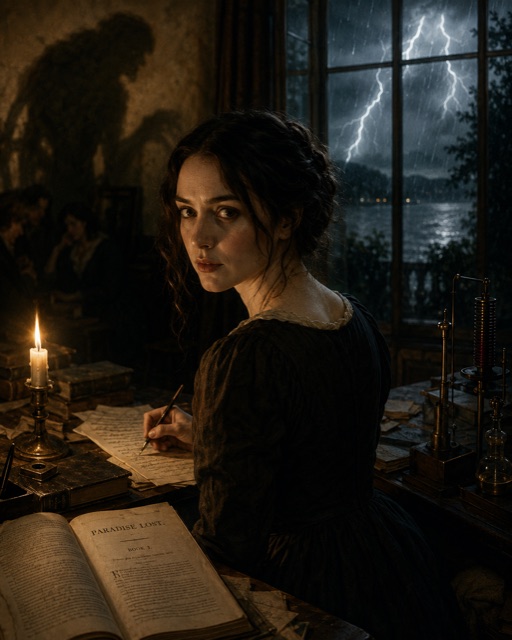
Gothic Fiction · Novel
Mathilda
by Mary Wollstonecraft Shelley
Featuring Mary Shelley
Mary Shelley's Mathilda traces abandonment, incestuous confession, grief, isolation, and the ethics of surviving another person's despair.
- Advanced
- ~2 hr 30 min read
- 2 chapter guides
- Public domain
Start reading · Read the CHAPTER IV guide free
Before the text
Editor's Prelude
The Manuscript That Could Not Be Published
Mary Shelley wrote Mathilda in 1819, but her father William Godwin did not return the manuscript for publication. Its story of a daughter, an emotionally absent father, and a catastrophic confession remained unpublished until 1959.
The novella transforms secrecy into landscape: bleak houses, mountains, illness, theatrical imagination, and solitude all carry what its narrator cannot safely place in ordinary relation. Mathilda writes from near death, shaping her life as both explanation and farewell.
Its deepest pressure concerns responsibility after disclosure—what one person's forbidden desire makes another person bear, and whether sympathy can answer grief without being consumed by it.
The opening pages
CHAPTER I
MATHILDA
CHAP. I
Florence. Nov. 9th 1819
It is only four o’clock; but it is winter and the sun has already set: there are no clouds in the clear, frosty sky to reflect its slant beams, but the air itself is tinged with a slight roseate colour which is again reflected on the snow that covers the ground. I live in a lone cottage on a solitary, wide heath: no voice of life reaches me. I see the desolate plain covered with white, save a few black patches that the noonday sun has made at the top of those sharp pointed hillocks from which the snow, sliding as it fell, lay thinner than on the plain ground: a few birds are pecking at the hard ice that covers the pools—for the frost has been of long continuance.
I am in a strange state of mind. I am alone—quite alone—in the world—the blight of misfortune has passed over me and withered me; I know that I am about to die and I feel happy—joyous.—I feel my pulse; it beats fast: I place my thin hand on my cheek; it burns: there is a slight, quick spirit within me which is now emitting its last sparks. I shall never see the snows of another winter—I do believe that I shall never again feel the vivifying warmth of another summer sun; and it is in this persuasion that I begin to write my tragic history. Perhaps a history such as mine had better die with me, but a feeling that I cannot define leads me on and I am too weak both in body and mind to resist the slightest impulse. While life was strong within me I thought indeed that there was a sacred horror in my tale that rendered it unfit for utterance, and now about to die I pollute its mystic terrors. It is as the wood of the Eumenides none but the dying may enter; and Oedipus is about to die.
What am I writing?—I must collect my thoughts. I do not know that any will peruse these pages except you, my friend, who will receive them at my death. I do not address them to you alone because it will give me pleasure to dwell upon our friendship in a way that would be needless if you alone read what I shall write. I shall relate my tale therefore as if I wrote for strangers. You have often asked me the cause of my solitary life; my tears; and above all of my impenetrable and unkind silence. In life I dared not; in death I unveil the mystery. Others will toss these pages lightly over: to you, Woodville, kind, affectionate friend, they will be dear—the precious memorials of a heart-broken girl who, dying, is still warmed by gratitude towards you: your tears will fall on the words that record my misfortunes; I know they will—and while I have life I thank you for your sympathy.
Chapter guides · 2
CHAPTER IV
A Father Returned, Then Withdrawn
Mathilda's long-imagined reunion brings months of happiness. Her father's sudden coldness ends their intimacy, and she cannot discover what has changed.
The parent she imagined
Mathilda writes in seclusion, expecting to die and leaving her history to Woodville. Her mother died soon after her birth; her father left England, and an austere aunt raised her beside Loch Lomond. Books, solitary rambles and dreams of finding him filled her childhood. His return when she is sixteen seems to answer those dreams. After her aunt's death, father and daughter move to London, where he shares her studies and pleasures.
A distress without explanation
Mathilda dates the change to the disappearance of a young man's visits: her father becomes harsh, avoids her and refuses to explain himself. At his Yorkshire estate he is gentler but still deeply troubled, surrounded by reminders of her mother. Mathilda guesses that he loves an unworthy person; she explicitly calls this an unfounded conjecture. Hoping that sympathy will relieve him, she resolves to win his confidence.
CHAPTER IX
The Secret and the Retreat
Her father's confession and death leave Mathilda determined to disappear. She conceals her survival and withdraws to a heath; after two solitary years, her account turns to the history of her friend Woodville.
Questions readers ask
- How long does it take to read Mathilda?
- About 2 hr 30 min in total.
- How difficult is Mathilda?
- Advanced. A mid-length novel; about 2 hours of reading.
- Which edition is this?
- The original English text, first published in 1959. The text follows Elizabeth Nitchie's edition of Mathilda from Mary Shelley's fair-copy manuscript (Chapel Hill: University of North Carolina Press, 1959), as transcribed by Project Gutenberg (ebook #15238).
- Can I read Mathilda for free?
- Mathilda is part of Nexus Premium, so reading it needs an account and a Premium subscription. The opening above and one chapter guide on this page are free to read.
- How many chapter guides are there?
- 2 chapter guides, written by the Nexus editors. One opens in full here; the rest show their opening line.
About Mary Shelley
Mary Shelley wrote Frankenstein while still very young, drawing on Romantic science, grief, philosophical debate, and gothic storytelling. The novel became one of the foundation texts for modern horror and science fiction.
“Who is responsible for the suffering created by ambition?”
Shelley gives Nexus a monster story with philosophical force: creation becomes ethics, and fear becomes a question of accountability.
Source text: public domain. Chapter guides: original Nexus writing. Mathilda is part of The Nexus Archive, guided Quests through the great works.