 The Nexus Archive
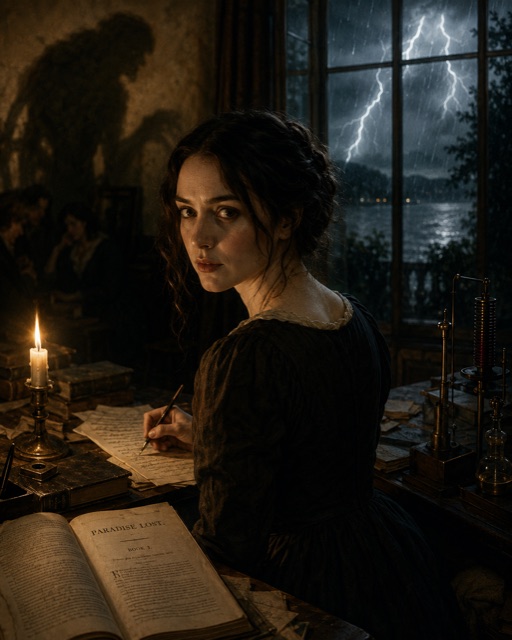
Gothic Fiction · Novel
Frankenstein
by Mary Shelley · The Maker's Witness · British Romanticism, 1797-1851
The gothic novel of creation, abandonment, ambition, revenge, and the maker pursued by what he made.
- Advanced
- 1818
- ~5 hr 15 min read
- 12 chapter guides
- Public domain
Start reading · Read the Letter IV guide free
Before the text
Editor's Prelude
The Creator and the Abandoned
Mary Shelley began Frankenstein at eighteen, after a ghost-story challenge among writers gathered near Geneva in the summer of 1816. Published anonymously in 1818 and dedicated to her father, William Godwin, the novel joins the prospect of scientific discovery to questions of education, dependence and responsibility. Its terror begins with an achievement: a young student succeeds in making a living being, then cannot bear the life before him.
The story opens far from the laboratory. Robert Walton writes to his sister Margaret from an Arctic expedition, eager for discovery and lonely for a friend. A stranger rescued from the ice offers an account of ambition that has gone disastrously wrong. Within that account, the created being tells his own story. Each speaker asks for sympathy, and each controls what another person gets to hear.
This is the original 1818 novel. Its familiar premise leaves much unsettled: the creature can learn, speak and judge, while the man who made him must consider obligations he never prepared to meet. Affection and education matter as much as scientific power. The question of what a maker owes his creation grows into a question of what people owe one another when care, fear and the wish for revenge collide.
The opening pages
Letter I
To Mrs. SAVILLE, England.
St. Petersburgh, Dec. 11th, 17—.
You will rejoice to hear that no disaster has accompanied the commencement of an enterprise which you have regarded with such evil forebodings. I arrived here yesterday; and my first task is to assure my dear sister of my welfare, and increasing confidence in the success of my undertaking.
I am already far north of London; and as I walk in the streets of Petersburgh, I feel a cold northern breeze play upon my cheeks, which braces my nerves, and fills me with delight. Do you understand this feeling? This breeze, which has travelled from the regions towards which I am advancing, gives me a foretaste of those icy climes. Inspirited by this wind of promise, my day dreams become more fervent and vivid. I try in vain to be persuaded that the pole is the seat of frost and desolation; it ever presents itself to my imagination as the region of beauty and delight. There, Margaret, the sun is for ever visible; its broad disk just skirting the horizon, and diffusing a perpetual splendour. There—for with your leave, my sister, I will put some trust in preceding navigators—there snow and frost are banished; and, sailing over a calm sea, we may be wafted to a land surpassing in wonders and in beauty every region hitherto discovered on the habitable globe. Its productions and features may be without example, as the phænomena of the heavenly bodies undoubtedly are in those undiscovered solitudes. What may not be expected in a country of eternal light? I may there discover the wondrous power which attracts the needle; and may regulate a thousand celestial observations, that require only this voyage to render their seeming eccentricities consistent for ever. I shall satiate my ardent curiosity with the sight of a part of the world never before visited, and may tread a land never before imprinted by the foot of man. These are my enticements, and they are sufficient to conquer all fear of danger or death, and to induce me to commence this laborious voyage with the joy a child feels when he embarks in a little boat, with his holiday mates, on an expedition of discovery up his native river. But, supposing all these conjectures to be false, you cannot contest the inestimable benefit which I shall confer on all mankind to the last generation, by discovering a passage near the pole to those countries, to reach which at present so many months are requisite; or by ascertaining the secret of the magnet, which, if at all possible, can only be effected by an undertaking such as mine.
Chapter guides · 12
Letter IV
A Warning Finds Its Listener
Walton recognizes a fellow seeker of discovery in the exhausted stranger.
The rescue
Walton's crew first sees a gigantic traveller crossing the ice, then rescues a different man stranded on a broken sledge. Even before accepting help, the stranger asks where the ship is heading. Walton's growing affection for him answers the wish for a friend expressed in his earlier letters.
A story for his sister
The stranger hears Walton's willingness to risk lives for discovery and offers his own experience as a warning. Walton plans to record the account for Margaret. The story therefore begins through an admiring listener whose ambitions may make the warning difficult to receive.
Volume I, Chapter II
A Teacher Revives Ambition
Waldman's chemistry restores the excitement Krempe's scorn could not extinguish.
From Geneva to Ingolstadt
Agrippa's writings captivate Victor at thirteen, but a lightning-struck oak at fifteen turns him away from the older philosophers. His mother's death delays his departure for Ingolstadt, where Krempe dismisses his reading and tells him to begin his studies again.
Waldman's invitation
Waldman's lecture presents modern chemistry as a source of remarkable powers. Victor visits him that evening, receives advice on books and sees his laboratory. Waldman welcomes him as a disciple and promises use of the equipment when he is ready. Victor remembers this day as the one that decided his future.
Volume I, Chapter V
Creation Becomes Abandonment
Clerval's care returns Victor to a world he shut out during his experiment.
Volume I, Chapter VII
A Confession Forced by Fear
Justine's admission follows conviction and contradicts her account of the crime.
Volume II, Chapter II
The Creature Demands a Hearing
On the glacier, Victor confronts a being who can argue as well as threaten.
Volume II, Chapter III
Learning Without a Guide
The creature remembers a world whose sensations initially had no names.
Volume II, Chapter VI
An Education Shared in Secret
Safie's arrival gives the hidden creature access to language, history and a family's past.
Volume II, Chapter IX
A Companion Promised Under Threat
Victor accepts a bargain whose peaceful outcome depends on claims he cannot verify.
Volume III, Chapter II
The Bargain Leads to a Solitary Workshop
Victor separates from Clerval to resume the work he dreads.
Volume III, Chapter III
Victor Breaks the Second Creation
A being not yet alive becomes the subject of fears about an independent will.
Volume III, Chapter VI
The Threat Reaches the Wedding
Victor's precautions protect him from the attack he imagines, leaving Elizabeth exposed.
Volume III, Chapter VII
The Pursuit Ends in the Ice
Walton must decide what to do with the warnings of a man he admires.
Questions readers ask
- How long does it take to read Frankenstein?
- About 5 hr 15 min in total.
- How difficult is Frankenstein?
- Advanced. A long novel; about 5 hours of reading.
- Which edition is this?
- The original English text, first published in 1818. The text follows Frankenstein; Or, The Modern Prometheus, 1818 edition.
- How many chapter guides are there?
- 12 chapter guides, written by the Nexus editors. Two open in full here; the rest show their opening line.
About Mary Shelley
Mary Shelley wrote Frankenstein while still very young, drawing on Romantic science, grief, philosophical debate, and gothic storytelling. The novel became one of the foundation texts for modern horror and science fiction.
“Who is responsible for the suffering created by ambition?”
Shelley gives Nexus a monster story with philosophical force: creation becomes ethics, and fear becomes a question of accountability.
Source text: public domain. Chapter guides: original Nexus writing. Frankenstein is part of The Nexus Archive, guided Quests through the great works.