 The Nexus Archive
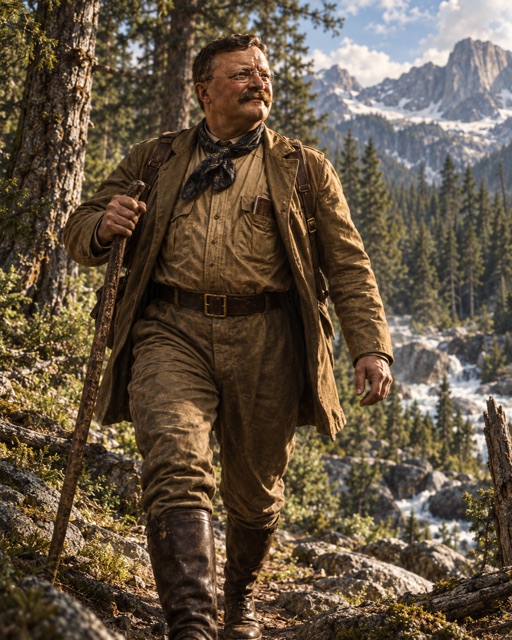
American Progressivism · Memoir
Theodore Roosevelt: An Autobiography
by Theodore Roosevelt · The Strenuous American · Progressive Era, 1858-1919
Roosevelt's own account of his life, formation, public service, and action.
- Advanced
- 1913
- ~16 hr 45 min read
- 17 chapter guides
- Public domain
Start reading · Read the Foreword guide free
Before the text
Editor's Prelude
A Life Told as a Test of Action
Theodore Roosevelt wants character to show itself in action. Courage matters when it meets danger; honesty matters when a powerful friend asks for a favor. He measures himself by the duties he accepts and the uses he makes of strength. The memoir is less a private confession than an account of character being made under pressure.
Writing after his presidency, Roosevelt has a reputation to defend and decisions that remain fiercely contested. He mixes remembered scenes, portraits of friends and opponents, policy arguments, and letters. The appendices continue those public disputes. He gives his reasons for his actions in the voice of a man still eager to argue his case.
That forceful voice also makes room for bird songs, favorite books, children’s games, and jokes at his own expense. Hard work and the joy of living belong together in his picture of a good life. So do personal responsibility and the duty to help others. The human question running through the book is how to combine those claims when ambition, loyalty, power, and affection pull in different directions.
The opening pages
Foreword
Naturally, there are chapters of my autobiography which cannot now be written.
It seems to me that, for the nation as for the individual, what is most important is to insist on the vital need of combining certain sets of qualities, which separately are common enough, and, alas, useless enough. Practical efficiency is common, and lofty idealism not uncommon; it is the combination which is necessary, and the combination is rare. Love of peace is common among weak, short-sighted, timid, and lazy persons; and on the other hand courage is found among many men of evil temper and bad character. Neither quality shall by itself avail. Justice among the nations of mankind, and the uplifting of humanity, can be brought about only by those strong and daring men who with wisdom love peace, but who love righteousness more than peace. Facing the immense complexity of modern social and industrial conditions, there is need to use freely and unhesitatingly the collective power of all of us; and yet no exercise of collective power will ever avail if the average individual does not keep his or her sense of personal duty, initiative, and responsibility. There is need to develop all the virtues that have the state for their sphere of action; but these virtues are as dust in a windy street unless back of them lie the strong and tender virtues of a family life based on the love of the one man for the one woman and on their joyous and fearless acceptance of their common obligation to the children that are theirs. There must be the keenest sense of duty, and with it must go the joy of living; there must be shame at the thought of shirking the hard work of the world, and at the same time delight in the many-sided beauty of life. With soul of flame and temper of steel we must act as our coolest judgment bids us. We must exercise the largest charity towards the wrong-doer that is compatible with relentless war against the wrong-doing. We must be just to others, generous to others, and yet we must realize that it is a shameful and a wicked thing not to withstand oppression with high heart and ready hand. With gentleness and tenderness there must go dauntless bravery and grim acceptance of labor and hardship and peril. All for each, and each for all, is a good motto; but only on condition that each works with might and main to so maintain himself as not to be a burden to others.
Chapter guides · 17
Foreword
Strength and Fairness
Roosevelt argues that useful strength must go with fairness, and a sense of duty must leave room for joy.
Recap
Roosevelt begins by saying that some parts of his life cannot yet be written. He then sets out the qualities he values. Practical skill needs ideals. Courage needs a just purpose. Collective action needs people who accept personal responsibility. He joins public duty to care for a family, and hard work to delight in life. He ends by applying one standard to rich and poor alike: people should be judged by their conduct, rather than their social position.
Chapter I
A Childhood of Learning and Effort
Family, illness, reading, and travel shape Roosevelt. Looking back, he also sees limits in the lessons he learned.
Recap
Roosevelt begins with his Dutch, Pennsylvania, and Southern family histories. His father becomes his model of courage joined to kindness and service. Asthma limits his childhood, while books and collecting specimens give him absorbing interests. Spectacles reveal how much he has been unable to see. Travel, tutors, and Harvard widen his education. He considers a career as an outdoor naturalist, but abandons it when university science centers on laboratory work. He also admits that stronger devotion might have carried him past that obstacle. At the end, he reconsiders his political education. It taught him to work hard and take responsibility for himself. It did too little to teach him that people must also act together to curb abuses of power.
Chapter II
Learning Courage Through Practice
Roosevelt presents courage as a skill that practice and self-control can develop.
Chapter III
Reform Learns to Count Votes
Reform needs honest aims, practical skill, and people who can work together.
Chapter IV
Earning a Place Through Work
On the ranch, Roosevelt learns to value steady work and shared responsibility across differences in wealth and background.
Chapter V
Rules Need People Willing to Enforce Them
Fair rules need practical enforcement and an understanding of the people they serve.
Chapter VI
Honest Policing and Equal Treatment
Roosevelt links honest policing to fair enforcement and practical help for the people of the city.
Chapter VII
Preparedness Meets the Reality of Command
Roosevelt's case for war and readiness becomes a story of supply failures, battlefield uncertainty, courage, and public controversy.
Chapter VIII
The Machine Accepts a Governor It Cannot Own
Roosevelt enters office through party organization, then tries to cooperate with its leaders without surrendering public authority.
Chapter IX
The Private Life Is Also an Argument
Reading, nature, and family life give Roosevelt pleasures he values above public achievement.
Chapter X
The Executive Claims Room to Act
Roosevelt sees the President as a public servant who must act when the country needs help, within the limits of the Constitution and the law.
Chapter XI
Conservation Redefines What Government Can See
Forests, water, soil, minerals, and rural life become one connected problem extending beyond a single term or generation.
Chapter XII
The Square Deal Refuses Two Easy Answers
Government should judge big companies by their conduct and give honest firms fair treatment.
Chapter XIII
Neutrality Changes When Power Is Unequal
Workers need power to bargain together, and the public needs protection when an industrial dispute threatens essential supplies.
Chapter XIV
The Big Stick Faces Its Hardest Case
Roosevelt defends American intervention as a duty to keep order and build the Panama Canal.
Chapter XV
Peace, Strength, and Keeping Promises
Roosevelt argues that peace needs fair agreements, trustworthy promises, and the strength to defend them.
Appendix C to Chapter XV
Roosevelt Ends by Arguing the Record
Roosevelt ends by defending his business policies and correcting accounts of his political choices.
Questions readers ask
- How long does it take to read Theodore Roosevelt: An Autobiography?
- About 16 hr 45 min in total.
- How difficult is Theodore Roosevelt: An Autobiography?
- Advanced. A long memoir; about 17 hours of reading.
- Can I read Theodore Roosevelt: An Autobiography for free?
- Theodore Roosevelt: An Autobiography is part of Nexus Premium, so reading it needs an account and a Premium subscription. The opening above and two chapter guides on this page are free to read.
- How many chapter guides are there?
- 17 chapter guides, written by the Nexus editors. Two open in full here; the rest show their opening line.
About Theodore Roosevelt
Theodore Roosevelt was the twenty-sixth president of the United States, a reformer, soldier, writer, conservationist, and advocate of energetic citizenship. His speeches and books stress action, character, national vigor, and public duty.
“What happens to a people that chooses comfort over courage?”
Roosevelt gives Nexus a figure of restless energy, reform, and public action. His writings are ideal for short, motivating primary texts.
Source text: public domain. Chapter guides: original Nexus writing. Theodore Roosevelt: An Autobiography is part of The Nexus Archive, guided Quests through the great works.