 The Nexus Archive
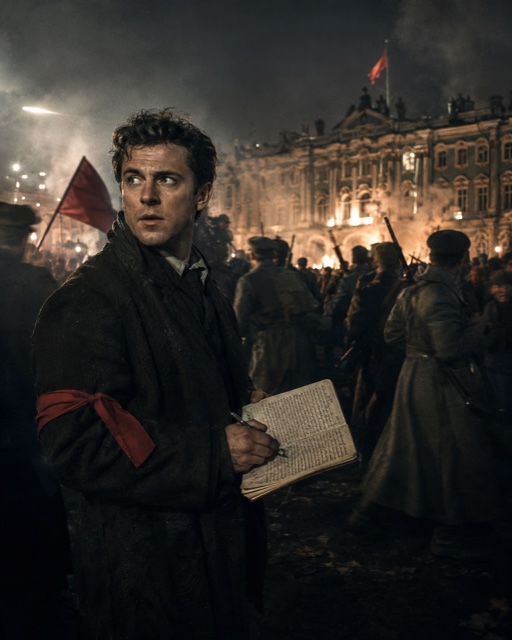
Revolutionary Journalism · History
Ten Days That Shook the World
by Reed · The Reporter of Revolution · Early 20th-century America and Russia, 1887-1920
Reed's full eyewitness account of the Russian Revolution, including preface, explanatory notes, chapters, and appendices from the Project Gutenberg source.
- Advanced
- 1919
- ~9 hr 15 min read
- 18 chapter guides
- Public domain
Start reading · Read the Preface guide free
Before the text
Editor's Prelude
Witness to Revolution
John Reed wrote this history from inside the November Revolution, moving through Petrograd's streets, committee rooms, barracks, newspaper offices, Congress halls, and the Winter Palace while authority was still changing hands. He announces his sympathies in the Preface rather than hiding them: the book asks to be read as the urgent testimony of a committed reporter, not the view from a neutral balcony.
The form is part chronicle, part political crowd scene, and part documentary archive. Reed lets rumor race beside observation, interrupts action with proclamations and speeches, then supplies Notes and Explanations and twelve chapter appendices so the parties, committees, orders, votes, and counterclaims remain visible behind the drama.
Everywhere, the struggle turns on the conversion of motion into power. A patrol can seize a building, but a government must persuade soldiers to obey, workers to keep services running, peasants to accept its land settlement, and distant cities to recognize its decrees. Reed's excitement gives the book its pulse; the resistance, violence, paperwork, and unfinished promises give it its lasting argument.
The opening pages
Notes and Explanations
To the average reader the multiplicity of Russian organisations—political groups, Committees and Central Committees, Soviets, Dumas and Unions—will prove extremely confusing. For this reason I am giving here a few brief definitions and explanations.
Political Parties
In the elections to the Constituent Assembly, there were seventeen tickets in Petrograd, and in some of the provincial towns as many as forty; but the following summary of the aims and composition of political parties is limited to the groups and factions mentioned in this book. Only the essence of their programmes and the general character of their constituencies can be noticed….
1. Monarchists, of various shades, Octobrists, etc. These once-powerful factions no longer existed openly; they either worked underground, or their members joined the Cadets, as the Cadets came by degrees to stand for their political programme. Representatives in this book, Rodzianko, Shulgin.
2. Cadets. So-called from the initials of its name, Constitutional Democrats. Its official name is “Party of the People’s Freedom.” Under the Tsar composed of Liberals from the propertied classes, the Cadets were the great party of political reform, roughly corresponding to the Progressive Party in America. When the Revolution broke out in March, 1917, the Cadets formed the first Provisional Government. The Cadet Ministry was overthrown in April because it declared itself in favour of Allied imperialistic aims, including the imperialistic aims of the Tsar’s Government. As the Revolution became more and more a social economic Revolution, the Cadets grew more and more conservative. Its representatives in this book are: Miliukov, Vinaver, Shatsky.
2a. Group of Public Men. After the Cadets had become unpopular through their relations with the Kornilov counter-revolution, the Group of Public Men was formed in Moscow. Delegates from the Group of Public Men were given portfolios in the last Kerensky Cabinet. The Group declared itself non-partisan, although its intellectual leaders were men like Rodzianko and Shulgin. It was composed of the more “modern” bankers, merchants and manufacturers, who were intelligent enough to realise that the Soviets must be fought by their own weapon—economic organisation. Typical of the Group: Lianozov, Konovalov.
3. Populist Socialists, or Trudoviki (Labour Group). Numerically a small party, composed of cautious intellectuals, the leaders of the Cooperative societies, and conservative peasants. Professing to be Socialists, the Populists really supported the interests of the petty bourgeoisie—clerks, shopkeepers, etc. By direct descent, inheritors of the compromising tradition of the Labour Group in the Fourth Imperial Duma, which was composed largely of peasant representatives. Kerensky was the leader of the Trudoviki in the Imperial Duma when the Revolution of March, 1917, broke out. The Populist Socialists are a nationalistic party. Their representatives in this book are: Peshekhanov, Tchaikovsky.
Chapter guides · 18
Preface
The Witness Declares His Allegiance
Reed supports the Bolsheviks while promising an honest account of what he saw and learned.
A revolution seen from inside
Reed presents the Bolshevik seizure of power as a mass uprising of workers and soldiers. He argues that their demands for peace, land and control of factories explain its success.
An openly committed reporter
He limits this book to events he witnessed or considers reliably supported. He reserves the later peace negotiations and the fate of the Constituent Assembly, a body elected to establish a new political system, for another volume. He ends by admitting his sympathies and declaring his effort to tell the truth.
Notes and Explanations
Russia Has More Than Two Sides
Reed explains the parties and organizations competing to speak for the Russian people.
Parties and councils
The Bolsheviks demand immediate rule by workers. Other socialist parties disagree about timing, cooperation with property owners and the use of force. Soviets are elected councils of workers, soldiers or peasants; Dumas are municipal councils.
Several kinds of power
Unions, factory committees and army committees organize daily work and military life. Their national leaders can disagree with their members. Reed also explains meeting procedures and armed groups.
Dates and evidence
He uses the Western calendar, thirteen days ahead of Russia’s old calendar. He closes by listing his evidence: personal notes, newspapers, proclamations, government orders and diplomatic documents.
Chapter I
Freedom Changes Daily Life
Hunger and old privileges coexist with workers learning to organize and speak for themselves.
Chapter II
The Congress Becomes the Deadline
Government concessions and angry public meetings reveal how close Petrograd is to an uprising.
Chapter III
The Uprising Begins
The argument over Soviet power gives way to arrests and the occupation of key buildings.
Chapter IV
A Seizure Must Become a Mandate
The Congress claims power while opponents organize and troops report their support.
Chapter V
The New Government Faces Resistance
The Congress establishes its government, but railway leaders and armed citizens challenge its authority.
Chapter VI
Soldiers Reject Neutrality
A military vote and a prison investigation test opposing claims about the revolution.
Chapter VII
Counterrevolution Begins
Petrograd prepares its defense while troops outside the city struggle to choose a side.
Chapter VIII
Civil War Enters the Capital
Fighting and negotiations continue until news of Kerensky’s defeat changes the balance.
Chapter IX
Kerensky’s Force Comes Apart
Reed sees victory, confusion and danger together as the fighting moves away from Petrograd.
Chapter X
Moscow Counts the Cost
The revolutionary dead are buried at the Kremlin wall in a public ceremony of grief and hope.
Chapter XI
The State Must Be Run
The Soviet government overcomes armed and administrative resistance while remaking public institutions.
Chapter XII
The Peasant Congress Changes the Balance
A contested agreement joins peasant representatives to the workers’ and soldiers’ councils.
Appendix to Chapter III
Factories and Newspaper Offices
Plans for workers’ control stand beside rival demands to stop the Bolsheviks.
Appendix to Chapter VII
Control of Print and Force
The new government regulates newspapers and arms workers, while financial support sustains its opponents.
Appendix to Chapter X
What Moscow Lost
Reed describes damage he inspected, then gives the orders governing access to bank money.
Appendix to Chapter XII
Peasants Take Local Power
Land administration and a changing peasant congress close Reed’s account.
Questions readers ask
- How long does it take to read Ten Days That Shook the World?
- About 9 hr 15 min in total.
- How difficult is Ten Days That Shook the World?
- Advanced. A long history; about 9 hours of reading.
- How many chapter guides are there?
- 18 chapter guides, written by the Nexus editors. Two open in full here; the rest show their opening line.
About Reed
John Reed was an American journalist and political writer whose Ten Days That Shook the World became a famous eyewitness account of the Russian Revolution. Nexus stages him as the route's first witness: a reporter inside the confusion and force of revolutionary seizure.
“What does revolution look like from the ground as power changes hands?”
Reed's account is one of the most influential English-language witness texts about the October Revolution and helps anchor the proposed public-domain tyranny/testimony route.
Source text: public domain. Chapter guides: original Nexus writing. Ten Days That Shook the World is part of The Nexus Archive, guided Quests through the great works.