 The Nexus Archive
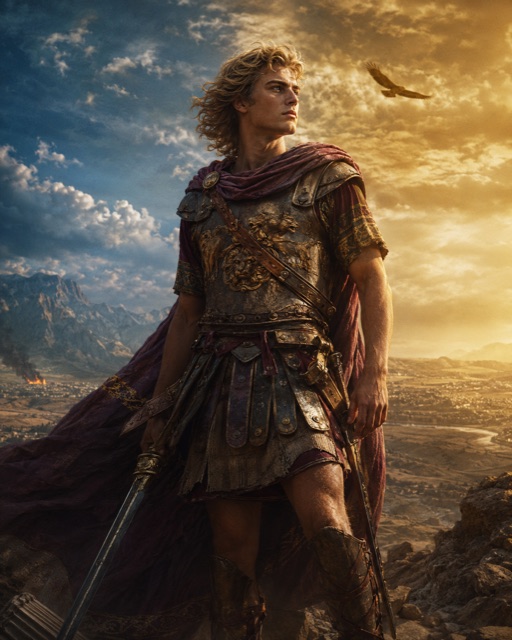
Macedonian Conquest · Biography
Life of Alexander
by Plutarch · The Judge of Character · Greco-Roman World, c. 46-after 119
Featuring Alexander the Great
Plutarch's moral biography of Alexander's ambition, greatness, and excess.
- Intermediate
- c. 100 CE
- ~2 hr 30 min read
- 16 chapter guides
- Public domain
Start reading · Read the Signs, Birth, and Early Character guide free
Before the text
Editor's Prelude
The Measure of Conquest
Prepared by the Nexus Editors
Plutarch begins with a warning about form: this is a life, not a campaign history. Battles matter, but a phrase, a jest, or a moment of self-command may reveal Alexander more clearly than an army does. The result is both portrait and judgment, written centuries after the conquests but alert to the intimate habits that make power admirable or dangerous.
Alexander enters as a young man who cannot imagine a scale large enough for his ambition. He can notice what experienced men miss, risk himself before everyone else, reward courage generously, and master fear with astonishing speed. Those same gifts carry their own pressure: glory becomes appetite, friendship must survive kingship, and an expanding empire changes the person at its center.
Plutarch holds admiration and unease together. The story moves from Bucephalas and Aristotle through Persia and India to grief, suspicion, and mortality, asking whether greatness can keep its measure when the world repeatedly yields.
The opening pages
Signs, Birth, and Early Character
It is the life of Alexander the king, and of Caesar, who overthrew Pompey, that I am writing in this book, and the multitude of the deeds to be treated is so great that I shall make no other preface than to entreat my readers, in case I do not tell of all the famous actions of these men, nor even speak exhaustively at all in each particular case, but in epitome for the most part, not to complain. For it is not Histories that I am writing, but Lives; and in the most illustrious deeds there is not always a manifestation of virtue or vice, nay, a slight thing like a phrase or a jest often makes a greater revelation of character than battles when thousands fall, or the greatest armaments, or sieges of cities. Accordingly, just as painters get the likenesses in their portraits from the face and the expression of the eyes, wherein the character shows itself, but make very little account of the other parts of the body, so I must be permitted to devote myself rather to the signs of the soul in men, and by means of these to portray the life of each, leaving to others the description of their great contests.
As for the lineage of Alexander, on his father's side he was a descendant of Heracles through Caranus, and on his mother's side a descendant of Aeacus through Neoptolemus; this is accepted without any question. And we are told that Philip, after being initiated into the mysteries of Samothrace at the same time with Olympias, he himself being still a youth and she an orphan child, fell in love with her and betrothed himself to her at once with the consent of her brother, Arymbas. Well, then, the night before that on which the marriage was consummated, the bride dreamed that there was a peal of thunder and that a thunder-bolt fell upon her womb, and that thereby much fire was kindled, which broke into flames that travelled all about, and then was extinguished. At a later time, too, after the marriage, Philip dreamed that he was putting a seal upon his wife's womb; and the device of the seal, as he thought, was the figure of a lion. The other seers, now, were led by the vision to suspect that Philip needed to put a closer watch upon his marriage relations; but Aristander of Telmessus said that the woman was pregnant, since no seal was put upon what was empty, and pregnant of a son whose nature would be bold and lion-like. Moreover, a serpent was once seen lying stretched out by the side of Olympias as she slept, and we are told that this, more than anything else, dulled the ardour of Philip's attentions to his wife, so that he no longer came often to sleep by her side, either because he feared that some spells and enchantments might be practised upon him by her, or because he shrank from her embraces in the conviction that she was the partner of a superior being.
Chapter guides · 16
Signs, Birth, and Early Character
Plutarch Sets the Test
Alexander enters as a moral problem, not just a military subject.
What just happened
Plutarch opens by telling us how he wants to be read. He is not trying to record every campaign detail. He wants the small signs that reveal Alexander's soul: ambition, self-command, pride, and the hunger for great action.
Why it matters
This opening is the key to the whole life. Plutarch will admire Alexander, but he will also keep asking what kind of character can carry so much power.
How it ends
The opening ends with Alexander's teachers. Stern Leonidas oversees his upbringing, while Lysimachus wins favour by calling Alexander Achilles, Philip Peleus, and himself Phoenix. Heroic comparison is already part of the boy's education.
Bucephalas, Aristotle, and Youthful Ambition
Talent Learns Its Direction
The young Alexander is taught, tested, and pulled toward heroic greatness.
What just happened
Alexander masters Bucephalas, studies under Aristotle, reads Homer intensely, and shows courage before he has the throne. His father's new marriage then provokes a violent family quarrel, and fear over the succession drives Alexander to interfere in another marriage negotiation. Education and heroic ambition give way to conflict inside the royal household.
Why it matters
The point is not that Alexander is simply gifted. His gifts already have a direction. He wants glory, heroic comparison, and a kind of excellence that ordinary success cannot satisfy.
How it ends
Plutarch reports that, when Pausanias kills Philip, suspicion falls on Olympias and also touches Alexander. He follows the accusation with Alexander's punishment of those involved and his anger at his mother's savage treatment of Cleopatra.
The Young King and the Greek Crisis
Speed Becomes Rule
Alexander answers a fragile succession with force, theatre, and confidence.
Granicus and the Opening of Asia
The Campaign Opens in Danger
Granicus turns Alexander's daring into a public fact.
Illness, Issus, and Darius's Family
Victory Tests Restraint
Alexander wins a battle and then has to decide what kind of victor he will be.
Self-Command and Persian Wealth
Discipline Against Luxury
Alexander's self-command becomes a political instrument.
Tyre, Egypt, and Divine Signs
Conquest Becomes Myth
Tyre and Egypt draw Alexander deeper into heroic and divine meaning.
Gaugamela and the Fall of Persia
The Empire Breaks Open
Gaugamela gives Alexander the Persian world, but not peace.
Babylon, Susa, and Persepolis
Power Enters the Palaces
The Persian capitals reveal both Alexander's grandeur and his vulnerability to excess.
Generosity, Luxury, and the Pursuit of Darius
Greatness Under Strain
Alexander can still rebuke luxury, but his world is becoming harder to govern.
Eastern Kingship and Court Suspicion
The Court Changes Shape
Alexander tries to hold empire together by becoming more than a Macedonian king.
Cleitus, Callisthenes, and the Cost of Power
Greatness Turns Dangerous
Plutarch shows the court becoming a place where anger and suspicion can kill.
India and the Battle with Porus
The Edge of Courage
India gives Alexander another heroic victory, but the limit is getting closer.
The Army's Limit and the Indian Sages
The Army Says No
Alexander's men finally place a boundary around his desire to go farther.
Return, Discipline, and the Mixed Empire
Empire Needs Repair
Alexander returns from India and tries to discipline, merge, and stabilize what he has won.
Babylon, Illness, and Aftermath
Greatness Meets Mortality
The life ends with grief, omens, illness, and the uncertainty of succession.
Questions readers ask
- How long does it take to read Life of Alexander?
- About 2 hr 30 min in total.
- How difficult is Life of Alexander?
- Intermediate. A mid-length biography; about 2 hours of reading.
- Which translation is this?
- The Bernadotte Perrin translation from the Ancient Greek. The text follows Plutarch's Lives, Volume VII, Loeb Classical Library (1919).
- Can I read Life of Alexander for free?
- Life of Alexander is part of Nexus Premium, so reading it needs an account and a Premium subscription. The opening above and two chapter guides on this page are free to read.
- How many chapter guides are there?
- 16 chapter guides, written by the Nexus editors. Two open in full here; the rest show their opening line.
About Alexander the Great
Alexander III of Macedon conquered the Persian Empire and created one of the largest empires of the ancient world before his death at thirty-two. He left no major writings of his own, so Nexus treats him through ancient sources such as Arrian and Plutarch.
“What happens when ambition outruns every boundary?”
Alexander becomes one of history's great tests of ambition. He changes war, empire, culture, and the imagination of greatness.
Source text: public domain. Chapter guides: original Nexus writing. Life of Alexander is part of The Nexus Archive, guided Quests through the great works.