 The Nexus Archive
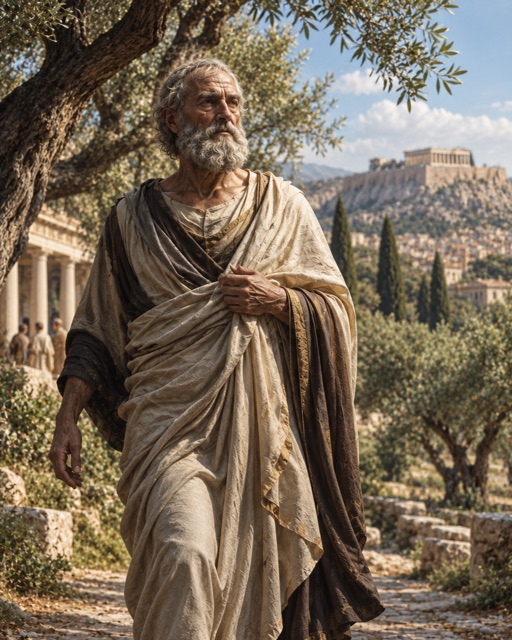
Platonism · Dialogue
Timaeus
by Plato · The Architect of Ideals · Classical Greece, c. 428-348 BC
- Brutal
- ~2 hr 30 min read
- 14 chapter guides
- Public domain
Start reading · Read the The Guests Reassemble guide free
Before the text
Editor's Prelude
A World for Human Life
Socrates has described a city whose citizens are trained for their appointed work. Now he wants to see that city in action: how would its people speak and behave when faced with war and neighbouring powers? His companions owe him a return for the previous day’s conversation. Among them is Timaeus of Locris, introduced as a man experienced in public office and philosophy who has made the universe his special study.
That civic occasion opens into a much larger undertaking. Before human beings can inhabit the proposed city, Timaeus is asked to account for the world in which they live and for their own creation. The heavens, bodily life, perception and the education of desire belong to the same inquiry. A person’s struggle to think clearly is placed within an account of order that extends beyond the individual or the city.
Timaeus speaks as a mortal explaining a changing world. He distinguishes a probable account from the certainty he associates with unchanging being, and repeatedly acknowledges the limits of his undertaking. His explanations use ancient mathematics, medicine and ideas about divine craftsmanship; they also carry judgments about the relative worth of different lives. The question running through them is how intelligence and proportion can shape beings exposed to motion, need and disorder.
The opening pages
The Guests Reassemble
PERSONS OF THE DIALOGUE: Socrates, Critias, Timaeus, Hermocrates.
SOCRATES: One, two, three; but where, my dear Timaeus, is the fourth of those who were yesterday my guests and are to be my entertainers to-day?
TIMAEUS: He has been taken ill, Socrates; for he would not willingly have been absent from this gathering.
SOCRATES: Then, if he is not coming, you and the two others must supply his place.
TIMAEUS: Certainly, and we will do all that we can; having been handsomely entertained by you yesterday, those of us who remain should be only too glad to return your hospitality.
SOCRATES: Do you remember what were the points of which I required you to speak?
TIMAEUS: We remember some of them, and you will be here to remind us of anything which we have forgotten: or rather, if we are not troubling you, will you briefly recapitulate the whole, and then the particulars will be more firmly fixed in our memories?
SOCRATES: To be sure I will: the chief theme of my yesterday’s discourse was the State—how constituted and of what citizens composed it would seem likely to be most perfect.
TIMAEUS: Yes, Socrates; and what you said of it was very much to our mind.
SOCRATES: Did we not begin by separating the husbandmen and the artisans from the class of defenders of the State?
TIMAEUS: Yes.
SOCRATES: And when we had given to each one that single employment and particular art which was suited to his nature, we spoke of those who were intended to be our warriors, and said that they were to be guardians of the city against attacks from within as well as from without, and to have no other employment; they were to be merciful in judging their subjects, of whom they were by nature friends, but fierce to their enemies, when they came across them in battle.
TIMAEUS: Exactly.
SOCRATES: We said, if I am not mistaken, that the guardians should be gifted with a temperament in a high degree both passionate and philosophical; and that then they would be as they ought to be, gentle to their friends and fierce with their enemies.
TIMAEUS: Certainly.
SOCRATES: And what did we say of their education? Were they not to be trained in gymnastic, and music, and all other sorts of knowledge which were proper for them?
TIMAEUS: Very true.
SOCRATES: And being thus trained they were not to consider gold or silver or anything else to be their own private property; they were to be like hired troops, receiving pay for keeping guard from those who were protected by them—the pay was to be no more than would suffice for men of simple life; and they were to spend in common, and to live together in the continual practice of virtue, which was to be their sole pursuit.
Chapter guides · 14
The Guests Reassemble
A City Waiting for Action
Socrates asks his companions to show the citizens of his imagined state facing a real kind of political test.
Yesterday’s arrangement
Socrates recalls a city with specialised occupations and guardians trained in courage and philosophy. Their property and family life are held in common, and rulers direct pairings and the placement of children. These are the proposed institutions his companions have agreed to consider, not a description of Athens as it exists.
The picture must move
He compares the city at rest to beautiful animals he would like to see in action. War and dealings with neighbouring states would show whether its education produces fitting words and deeds. He asks for an account of that test, rather than another list of institutions.
Who can tell it?
Socrates credits Timaeus, Critias and Hermocrates with experience of both public life and philosophy. Hermocrates says Critias recalled an old tradition during their preparations. Timaeus agrees that Critias should repeat it to Socrates.
Atlantis and Ancient Athens
Atlantis Enters Through Memory
Critias offers a story of ancient Athens whose authority passes through an Egyptian priest, Solon and his own grandfather.
Records across repeated destruction
In Critias’s account, the priest tells Solon that catastrophes repeatedly destroy Greek communities and their written records. Egyptian temples preserve a much longer memory. The claim explains, within the story, why Greeks might not know the greatest deeds attributed to their ancestors.
The city that resisted Atlantis
The priest’s ancient Athens defeats an invading power from Atlantis and liberates other peoples. Earthquakes and floods later engulf its warriors and the island. Critias presents this as history, heard at about ten from his grandfather, then nearly ninety; Socrates later welcomes it as fact.
A place for the proposed citizens
Critias recognises a resemblance between the old story and Socrates’s imagined city. Their plan is for Timaeus first to describe the world and human beings, after which Critias will take those people into his civic account. Cosmology is introduced as one part of the company’s promised entertainment. Socrates closes by inviting Timaeus to invoke the gods and begin.
A Likely Account of the Cosmos
The Cosmos Begins as a Copy
Timaeus marks his account as probable, then reasons from a good maker to one ordered living world.
The World Soul
Harmony Becomes a Soul
The world soul is formed through proportions and intersecting circles, and is explicitly made prior to its body.
Time and the Heavenly Gods
Time Moves as an Image
The soul’s revolutions enable judgment, while the heavenly bodies give visible measures of time.
Mortal Souls Enter Bodies
Immortal Order Meets Mortal Life
The younger gods join an immortal principle to bodies exposed to sensation, passion and continual change.
Sight, Sound, and Necessity
The Senses Can Serve Intelligence
Timaeus distinguishes the physical workings of sight and hearing from the good he believes they make possible.
The Receptacle and Becoming
A Third Kind Must Be Named
The distinction between eternal pattern and changing copy is joined by the receptacle in which becoming occurs.
The Geometry of the Elements
Matter Takes Geometric Form
Timaeus constructs the elements from triangles and revises his earlier account of their transformation.
Motion, Sensation, and Qualities
Qualities Become Relations
Heat, weight, taste, smell, sound, colour, pleasure and pain are explained through bodily interactions.
Mortal Soul and Body
The Body Houses More Than Reason
Timaeus assigns different kinds of soul to different bodily regions, then explains the body’s protections and vulnerabilities.
The Body’s Channels
Nourishment and Its Reversal
The body’s channels sustain growth, while disordered elements and tissues generate the illnesses Timaeus describes.
Disease of Body and Mind
Illness, Blame and Education
Timaeus connects disorders of soul with bodily conditions and upbringing, then argues for proportionate care of body and mind.
Care of Soul and Living Kinds
The Living Whole Is Completed
The closing movement joins the cultivation of reason to an account of how the different living kinds arise.
Questions readers ask
- How long does it take to read Timaeus?
- About 2 hr 30 min in total.
- How difficult is Timaeus?
- Brutal. A mid-length dialogue; about 2 hours of reading.
- Which translation is this?
- The Benjamin Jowett translation from the Greek. The text follows Timaeus, Benjamin Jowett translation.
- Can I read Timaeus for free?
- Timaeus is part of Nexus Premium, so reading it needs an account and a Premium subscription. The opening above and two chapter guides on this page are free to read.
- How many chapter guides are there?
- 14 chapter guides, written by the Nexus editors. Two open in full here; the rest show their opening line.
About Plato
Born into an Athenian family during political upheaval, Plato became a student of Socrates and later founded the Academy. His dialogues transformed his teacher's public questioning into a vast investigation of justice, knowledge, education, politics, and reality.
“What is justice?”
Plato gives Western thought one of its central temptations: the belief that politics, education, beauty, and the soul can be judged by a reality higher than opinion.
Source text: public domain. Chapter guides: original Nexus writing. Timaeus is part of The Nexus Archive, guided Quests through the great works.