 The Nexus Archive
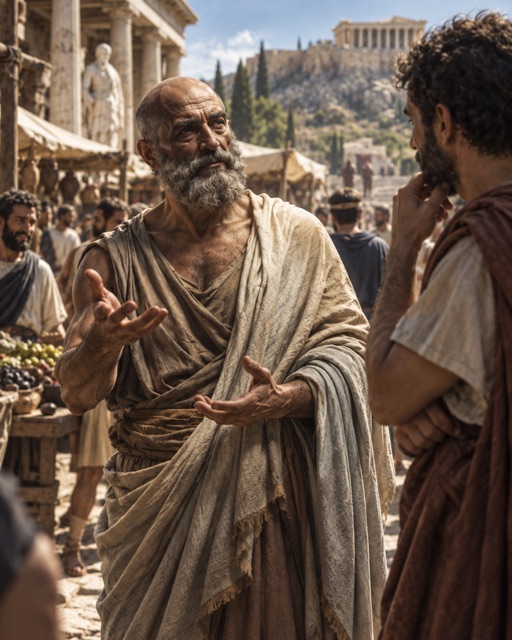
Socratic Texts · Dialogue
Phaedo
by Plato · The Architect of Ideals · Classical Greece, c. 428-348 BC
Featuring Socrates
- Advanced
- ~2 hr read
- 12 chapter guides
- Public domain
Start reading · Read the The Last Day Opens guide free
Before the text
Editor's Prelude
The Last Day
Socrates is in prison in Athens, condemned to death. A religious observance has delayed the sentence: the city permits no public executions while its sacred mission to Delos is away. When his friends hear that the ship has returned, they arrange to meet very early the next morning. The time that remains can still be spent together, but its limit is now certain.
Phaedo recounts that meeting later, at Phlius, to Echecrates, who has heard about the trial but knows little of the death. He speaks as a companion who was present, with admiration for Socrates and a vivid memory of his own mixed pleasure and pain. Plato places philosophical discussion inside this remembered human occasion, where affection, grief and the wish to understand are inseparable.
The question of what death means bears directly on the conversation. Socrates’s confidence draws on a view of the soul, the body and the work of philosophy; his friends need reasons that can withstand doubt. They must consider whether the life of thought they have shared gives grounds for hope beyond bodily life. The discussion asks what can be argued, what remains uncertain, and how people who care for one another can speak truthfully when reassurance is urgently desired.
The opening pages
The Last Day Opens
PERSONS OF THE DIALOGUE:
Phaedo, who is the narrator of the dialogue to Echecrates of Phlius. Socrates, Apollodorus, Simmias, Cebes, Crito and an Attendant of the Prison.
SCENE: The Prison of Socrates.
PLACE OF THE NARRATION: Phlius.
ECHECRATES: Were you yourself, Phaedo, in the prison with Socrates on the day when he drank the poison?
PHAEDO: Yes, Echecrates, I was.
ECHECRATES: I should so like to hear about his death. What did he say in his last hours? We were informed that he died by taking poison, but no one knew anything more; for no Phliasian ever goes to Athens now, and it is a long time since any stranger from Athens has found his way hither; so that we had no clear account.
PHAEDO: Did you not hear of the proceedings at the trial?
ECHECRATES: Yes; some one told us about the trial, and we could not understand why, having been condemned, he should have been put to death, not at the time, but long afterwards. What was the reason of this?
PHAEDO: An accident, Echecrates: the stern of the ship which the Athenians send to Delos happened to have been crowned on the day before he was tried.
ECHECRATES: What is this ship?
PHAEDO: It is the ship in which, according to Athenian tradition, Theseus went to Crete when he took with him the fourteen youths, and was the saviour of them and of himself. And they were said to have vowed to Apollo at the time, that if they were saved they would send a yearly mission to Delos. Now this custom still continues, and the whole period of the voyage to and from Delos, beginning when the priest of Apollo crowns the stern of the ship, is a holy season, during which the city is not allowed to be polluted by public executions; and when the vessel is detained by contrary winds, the time spent in going and returning is very considerable. As I was saying, the ship was crowned on the day before the trial, and this was the reason why Socrates lay in prison and was not put to death until long after he was condemned.
ECHECRATES: What was the manner of his death, Phaedo? What was said or done? And which of his friends were with him? Or did the authorities forbid them to be present--so that he had no friends near him when he died?
Chapter guides · 12
The Last Day Opens
The Last Morning in Prison
The sacred ship’s return ends the delay of Socrates’s execution, and his friends gather for another conversation.
Phaedo remembers a divided feeling
Phaedo tells Echecrates at Phlius what he witnessed in the prison. He remembers Socrates as fearless and blessed, yet describes his own experience as a mixture of pleasure and pain. The account preserves a companion’s admiration alongside the grief of impending separation.
A respite has ended
Athens forbids executions during the sacred mission to Delos. Having heard of the ship’s return the previous evening, the friends arrive early and find Socrates released from his chains. He explains his recent poetry as obedience to a recurring dream, uncertain whether its command meant philosophy or music in the ordinary sense.
Willingness and the divine summons
Socrates distinguishes readiness for death from permission to take one’s life: human beings belong to the gods. Cebes asks why a wise person should gladly leave such good guardians. Socrates answers with hope of good company beyond death, while distinguishing his confidence about gods from his lesser certainty about departed people. Crito relays a warning that talking may hinder the poison; Socrates dismisses it and says another dose can be prepared if needed.
Philosophy Practices Death
Preparing the Soul for Knowledge
Socrates defines death as separation and asks whether philosophy has trained the soul to seek truth without bodily interference.
Separation as a philosophical practice
Socrates defines death as the separation of soul and body. He connects philosophy with a partial separation during life, as the thinker tries to withdraw from appetite, sensation and distraction. On this account, death promises a fuller release into the knowledge the philosopher seeks.
What thought tries to apprehend
Justice, beauty, goodness and other absolute realities cannot be seen or touched in themselves. Socrates argues that the mind approaches them most clearly when it gathers itself away from bodily interference. His claims about the body’s demands and disturbances explain why he treats purification as an intellectual discipline.
Wisdom as the true currency
Ordinary courage may face danger from fear of a worse evil, and ordinary temperance may surrender one pleasure to preserve another. Socrates calls wisdom the true currency of virtue. His defense of calmness before death depends on that different basis for choice and on his hope of joining good gods and people.
Life from Death
Two Directions of Change
If opposites arise from opposites, Socrates argues, death must participate in a cycle that returns life.
Recollection Before Birth
Recollection Reaches Before Birth
Imperfect equal things seem to awaken knowledge of equality itself, which the senses never supplied in pure form.
The Soul's Affinity
Kinship with the Unseen
The soul resembles what is unseen, intelligible, and stable; the body resembles what is visible and changing.
Harmony and the Weaver
Two Objections Change the Burden
Harmony could be invisible yet perish with its instrument; a soul could outlast many bodies and still finally wear out.
When Arguments Fall
Confidence and the Risk of Misology
Socrates responds to defeat by examining how confidence fails, not by demanding loyalty to his conclusion.
Harmony Refuted
The Soul Leads the Strings
The harmony theory conflicts with recollection, with moral difference, and with the soul's power to oppose bodily impulses.
The Search for Causes
Searching for a Sufficient Cause
A failed search through material explanations leads Socrates to ask what makes a thing be what it is.
Life Does Not Admit Death
Life Cannot Admit Death
Whatever the soul possesses becomes alive; Socrates argues that the bearer of life cannot admit life's opposite.
The True Earth and Judgment
The Geography of Judgment
The true-earth tale turns the care of the soul into geography, judgment, punishment, purification, and hope.
The Poison Cup
Care, Grief and the Last Debt
After every account of the soul, Plato makes the friends confront the body of the person who gave it.
Questions readers ask
- How long does it take to read Phaedo?
- About 2 hr in total.
- How difficult is Phaedo?
- Advanced. A mid-length dialogue; about 2 hours of reading.
- Which translation is this?
- The Benjamin Jowett translation from the Greek. The text follows Phaedo, Benjamin Jowett translation.
- Can I read Phaedo for free?
- Yes. Phaedo is free to read with a Nexus account.
- How many chapter guides are there?
- 12 chapter guides, written by the Nexus editors. Two open in full here; the rest show their opening line.
About Socrates
Socrates spent his life questioning citizens in the public spaces of Athens. He wrote nothing himself; what survives comes mainly through Plato and other students. Convicted of impiety and corrupting the young, he refused escape and died by drinking hemlock.
“What do you mean by that?”
Socrates makes thinking dangerous. He shows that a civilization can be powerful, cultured, and still unable to answer basic questions about justice, virtue, and the good life.
Source text: public domain. Chapter guides: original Nexus writing. Phaedo is part of The Nexus Archive, guided Quests through the great works.