 The Nexus Archive
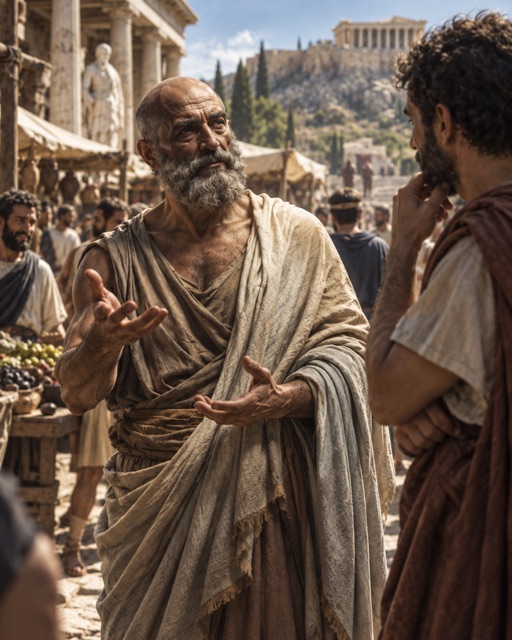
Socratic Texts · Dialogue
Crito
by Plato · The Architect of Ideals · Classical Greece, c. 428-348 BC
Featuring Socrates
- Intermediate
- ~25 min read
- 2 chapter guides
- Public domain
Start reading · Read the Before Dawn guide free
Before the text
Editor's Prelude
Before the Ship Returns
A friend enters Socrates’ prison before dawn. Athens has condemned Socrates to death, but the sacred ship’s return controls the remaining time. Crito brings an escape plan backed by money, willing friends and an offer of refuge. His urgency makes delay itself feel like a decision.
Crito’s appeal is larger than fear of death. Friendship, the future of Socrates’ children and the reputation of those who might save him all press upon the conversation. Socrates asks whether an action that preserves a life can nevertheless damage what makes that life worth preserving.
Plato places this conflict in a cell, not an abstract debate about the state. The arguments must bear the weight of a particular person’s loyalties and history. Different voices enter the reasoning, and agreement between the two friends is never simply the same thing as relief from the danger.
The opening pages
Before Dawn
PERSONS OF THE DIALOGUE: Socrates, Crito.
SCENE: The Prison of Socrates.
SOCRATES: Why have you come at this hour, Crito? it must be quite early.
CRITO: Yes, certainly.
SOCRATES: What is the exact time?
CRITO: The dawn is breaking.
SOCRATES: I wonder that the keeper of the prison would let you in.
CRITO: He knows me because I often come, Socrates; moreover, I have done him a kindness.
SOCRATES: And are you only just arrived?
CRITO: No, I came some time ago.
SOCRATES: Then why did you sit and say nothing, instead of at once awakening me?
CRITO: I should not have liked myself, Socrates, to be in such great trouble and unrest as you are--indeed I should not: I have been watching with amazement your peaceful slumbers; and for that reason I did not awake you, because I wished to minimize the pain. I have always thought you to be of a happy disposition; but never did I see anything like the easy, tranquil manner in which you bear this calamity.
SOCRATES: Why, Crito, when a man has reached my age he ought not to be repining at the approach of death.
CRITO: And yet other old men find themselves in similar misfortunes, and age does not prevent them from repining.
SOCRATES: That is true. But you have not told me why you come at this early hour.
CRITO: I come to bring you a message which is sad and painful; not, as I believe, to yourself, but to all of us who are your friends, and saddest of all to me.
SOCRATES: What? Has the ship come from Delos, on the arrival of which I am to die?
CRITO: No, the ship has not actually arrived, but she will probably be here to-day, as persons who have come from Sunium tell me that they have left her there; and therefore to-morrow, Socrates, will be the last day of your life.
SOCRATES: Very well, Crito; if such is the will of God, I am willing; but my belief is that there will be a delay of a day.
CRITO: Why do you think so?
SOCRATES: I will tell you. I am to die on the day after the arrival of the ship?
CRITO: Yes; that is what the authorities say.
SOCRATES: But I do not think that the ship will be here until to-morrow; this I infer from a vision which I had last night, or rather only just now, when you fortunately allowed me to sleep.
Chapter guides · 2
Before Dawn
Escape Is Not the Only Question
Crito has assembled every practical reason to save Socrates; Socrates asks what justice permits.
Crito makes the humane case
Escape is affordable, friends are ready to accept the risk, Thessaly offers safety, and Socrates' children still need a father. Crito also fears that people will think the friends valued money over Socrates' life. His case combines love with the social world of reputation and obligation.
Socrates changes the standard
The crowd can kill, but it cannot decide what makes a soul better or worse. Just as an athlete should listen to the knowledgeable trainer rather than every spectator, a person deciding about justice must answer to reason and truth. Survival therefore cannot be the highest measure; the question is whether the life preserved would still be good and just.
The agreed prohibition on retaliation
Socrates and Crito reaffirm that one must never answer injury with injury. Socrates asks whether leaving prison against the Athenians’ will would wrong those whom he ought least to wrong or abandon their agreed principles. Crito answers that he does not know.
The Laws Answer
The Laws Claim a Life
The imagined Laws appeal to nurture, consent, persuasion, and the integrity of a teaching carried all the way to death.
Questions readers ask
- How long does it take to read Crito?
- About 25 min in total.
- How difficult is Crito?
- Intermediate. A short dialogue; about 25 minutes of reading.
- Which translation is this?
- The Benjamin Jowett translation from the Greek. The text follows Crito, Benjamin Jowett translation.
- Can I read Crito for free?
- Yes. Crito is free to read with a Nexus account.
- How many chapter guides are there?
- 2 chapter guides, written by the Nexus editors. One opens in full here; the rest show their opening line.
About Socrates
Socrates spent his life questioning citizens in the public spaces of Athens. He wrote nothing himself; what survives comes mainly through Plato and other students. Convicted of impiety and corrupting the young, he refused escape and died by drinking hemlock.
“What do you mean by that?”
Socrates makes thinking dangerous. He shows that a civilization can be powerful, cultured, and still unable to answer basic questions about justice, virtue, and the good life.
Source text: public domain. Chapter guides: original Nexus writing. Crito is part of The Nexus Archive, guided Quests through the great works.