 The Nexus Archive
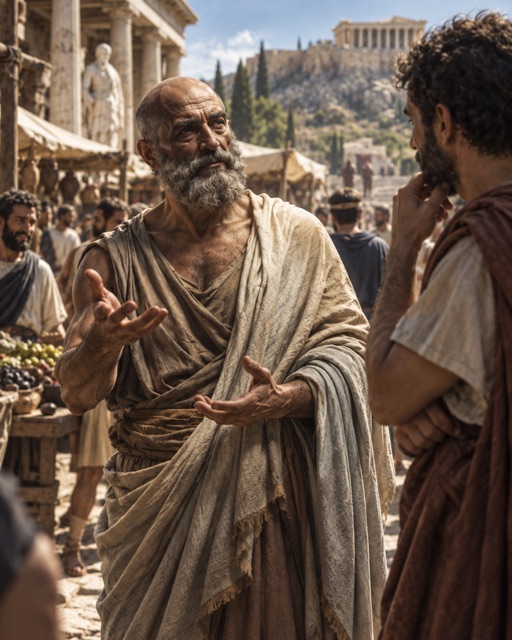
Socratic Texts · Dialogue
Apology
by Plato · The Architect of Ideals · Classical Greece, c. 428-348 BC
Featuring Socrates
Socrates defends his life of questioning before the Athenian jury.
- Intermediate
- c. 399 BCE
- ~50 min read
- 6 chapter guides
- Public domain
Start reading · Read the Socrates Answers the Old Accusers guide free
Before the text
Editor's Prelude
Socrates Before The Jury
Plato's Apology is a defense speech, not an expression of regret. In 399 BCE, Socrates stands before an Athenian jury charged with impiety and corrupting the young, while older rumors portray him as a sophist and investigator of forbidden things.
Athens had endured war, defeat, oligarchic violence, and a restored democracy. Socrates answers the city's suspicion in the same way that helped create it: by separating knowledge from confidence, questioning an accuser, and refusing to treat reputation or survival as the highest good.
The speech moves through defense, verdict, proposed penalty, and final address. Its center is a claim about how to live: fear of death cannot excuse wrongdoing, and a life devoted to examining oneself and the city cannot be abandoned merely because it has become dangerous.
The opening pages
Socrates Answers the Old Accusers
How you, O Athenians, have been affected by my accusers, I cannot tell; but I know that they almost made me forget who I was—so persuasively did they speak; and yet they have hardly uttered a word of truth. But of the many falsehoods told by them, there was one which quite amazed me;—I mean when they said that you should be upon your guard and not allow yourselves to be deceived by the force of my eloquence. To say this, when they were certain to be detected as soon as I opened my lips and proved myself to be anything but a great speaker, did indeed appear to me most shameless—unless by the force of eloquence they mean the force of truth; for if such is their meaning, I admit that I am eloquent. But in how different a way from theirs! Well, as I was saying, they have scarcely spoken the truth at all; but from me you shall hear the whole truth: not, however, delivered after their manner in a set oration duly ornamented with words and phrases. No, by heaven! but I shall use the words and arguments which occur to me at the moment; for I am confident in the justice of my cause (Or, I am certain that I am right in taking this course.): at my time of life I ought not to be appearing before you, O men of Athens, in the character of a juvenile orator—let no one expect it of me. And I must beg of you to grant me a favour:—If I defend myself in my accustomed manner, and you hear me using the words which I have been in the habit of using in the agora, at the tables of the money-changers, or anywhere else, I would ask you not to be surprised, and not to interrupt me on this account. For I am more than seventy years of age, and appearing now for the first time in a court of law, I am quite a stranger to the language of the place; and therefore I would have you regard me as if I were really a stranger, whom you would excuse if he spoke in his native tongue, and after the fashion of his country:—Am I making an unfair request of you? Never mind the manner, which may or may not be good; but think only of the truth of my words, and give heed to that: let the speaker speak truly and the judge decide justly.
Read it in a Quest
The birthplace of disciplined questioning, where virtue and justice become life's central tests.
Chapter guides · 6
Socrates Answers the Old Accusers
Socrates Refuses Courtroom Theater
Socrates opens by rejecting polished legal performance and asking the jury to listen for truth.
What just happened
Socrates begins by separating two kinds of accusation. The official charges are new, but the older rumors are more dangerous because they have shaped Athens for years. He denies being a natural philosopher, a clever sophist, or a paid teacher.
Why it matters
The old stories make his denial difficult: he must answer a reputation built before the trial. He ends with Callias, who names Evenus as a teacher of human and political virtue charging five minae. Socrates says that he would be proud to possess such knowledge, but that he does not.
The Oracle and the Search for Wisdom
The Oracle Turns Into A Mission
Socrates explains why he began testing people who claimed to be wise.
What just happened
Socrates says the oracle at Delphi named him the wisest man. Since he knows he is not wise in any ordinary sense, he treats the oracle as a riddle. He tests politicians, poets, and artisans, looking for someone wiser than himself.
Why it matters
This is the source of the famous Socratic idea: wisdom begins by recognizing one's own ignorance. Socrates does not present himself as a master. He becomes dangerous because he exposes false confidence in others. Young men copy these examinations, and those exposed blame him. He names Meletus with the poets, Anytus with craftsmen and politicians, and Lycon with the rhetoricians as the accusers who bring that hostility into court.
Meletus Is Examined
Meletus Cannot Hold The Charge Together
Socrates questions his accuser and turns the indictment into a contradiction.
The Gadfly's Mission
Socrates Defends His Post
Socrates joins his philosophical mission to a record of refusing injustice in public and private life.
The Verdict and Sentence
The Penalty Debate
After a narrow guilty verdict, Socrates refuses to describe his life's work as something deserving punishment.
The Final Address
Death Does Not End The Question
Socrates addresses his condemners and his friends without claiming knowledge he does not possess.
Questions readers ask
- How long does it take to read Apology?
- About 50 min in total.
- How difficult is Apology?
- Intermediate. A short dialogue; about 50 minutes of reading.
- Can I read Apology for free?
- Yes. Apology is free to read with a Nexus account.
- How many chapter guides are there?
- 6 chapter guides, written by the Nexus editors. Two open in full here; the rest show their opening line.
About Socrates
Socrates spent his life questioning citizens in the public spaces of Athens. He wrote nothing himself; what survives comes mainly through Plato and other students. Convicted of impiety and corrupting the young, he refused escape and died by drinking hemlock.
“What do you mean by that?”
Socrates makes thinking dangerous. He shows that a civilization can be powerful, cultured, and still unable to answer basic questions about justice, virtue, and the good life.
Source text: public domain. Chapter guides: original Nexus writing. Apology is part of The Nexus Archive, guided Quests through the great works.