 The Nexus Archive
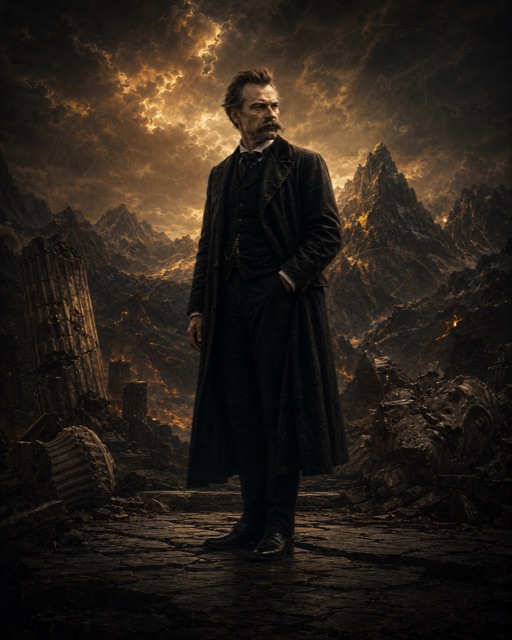
Genealogy · Aphorisms
Twilight of the Idols
by Nietzsche · The Hammer · Modernity, 1844-1900
- Advanced
- 1888
- ~2 hr 15 min read
- 9 chapter guides
- Public domain
Start reading · Read the Maxims and Missiles guide free
Before the text
Editor's Prelude
Testing The Idols By Ear
Nietzsche composed this compact late book during the charged summer of 1888, first calling it Idle Hours of a Psychologist before choosing a title that announced both an ending and an experiment. He was writing at extraordinary speed. In his Preface, he presents the book as recreation amid the heavy task of revaluing values and as a declaration of war on the idols Europe treats as permanent.
The hammer here is closer to a tuning fork than a weapon of demolition. A Preface and forty-four maxims prepare the ear; numbered attacks then move through Socrates, philosophical “reason,” morality, causation, German culture, art, freedom, modernity, and the ancient Greeks. The closing words borrowed from Zarathustra turn hardness from an attitude into a demand made upon creators.
Each strike has a particular target, from a philosopher’s diagnosis of life to a culture’s account of its own progress. Nietzsche moves quickly between diagnosis, historical claim, mockery, and self-portrait, and his most quotable sentences can become new idols when detached from that movement. The book asks for something more exacting than agreement: the courage to listen for what is hollow, including in the critic's own voice.
The opening pages
Maxims and Missiles
1.
Idleness is the parent of all psychology. What? Is psychology then a—vice?
2.
Even the pluckiest among us has but seldom the courage of what he really knows.
3.
Aristotle says that in order to live alone, a man must be either an animal or a god. The third alternative is lacking: a man must be both—a philosopher.
4.
“All truth is simple.”—Is not this a double lie?
5.
Once for all I wish to be blind to many things.—Wisdom sets bounds even to knowledge.
6.
A man recovers best from his exceptional nature—his intellectuality—by giving his animal instincts a chance.
7.
Which is it? Is man only a blunder of God? Or is God only a blunder of man?
8.
From the military school of life.—That which does not kill me, makes me stronger.
9.
Help thyself, then everyone will help thee. A principle of neighbour-love.
10.
A man should not play the coward to his deeds. He should not repudiate them once he has performed them. Pangs of conscience are indecent.
11.
Can a donkey be tragic?—To perish beneath a load that one can neither bear nor throw off? This is the case of the Philosopher.
12.
If a man knows the wherefore of his existence, then the manner of it can take care of itself. Man does not aspire to happiness; only the Englishman does that.
13.
Man created woman—out of what? Out of a rib of his god,—of his “ideal.”
14.
What? Art thou looking for something? Thou wouldst fain multiply thyself tenfold, a hundredfold? Thou seekest followers? Seek ciphers!
15.
Posthumous men, like myself, are not so well understood as men who reflect their age, but they are heard with more respect. In plain English: we are never understood—hence our authority.
16.
Among women.—“Truth? Oh, you do not know truth! Is it not an outrage on all our pudeurs?”—
17.
There is an artist after my own heart, modest in his needs: he really wants only two things, his bread and his art—panem et Circem.
18.
He who knows not how to plant his will in things, at least endows them with some meaning: that is to say, he believes that a will is already present in them. (A principle of faith.)
19.
What? Ye chose virtue and the heaving breast, and at the same time ye squint covetously at the advantages of the unscrupulous.—But with virtue ye renounce all “advantages” ... (to be nailed to an Antisemite’s door).
Chapter guides · 9
Maxims and Missiles
The Ear Is Tuned
Forty-four maxims turn familiar judgments about knowledge, virtue, art, and conscience against themselves.
What changed
The opening maxims move through knowledge, virtue, women, system-building, art, conscience, and self-command. Some are arguments in miniature; others are provocations whose force depends on an unstated target.
Why it matters
Their speed establishes the book's method. Nietzsche does not merely announce conclusions: he makes inherited phrases collide, then listens for the assumption exposed by the impact.
The closing movement
The final maxims ask questions of conscience: does one run ahead as a shepherd or an exception, is one genuine or only an actor, and does one join the work or merely look on? Nietzsche ends by defining his happiness through a Yes, a No, a straight line, and a goal. The rapid attacks finish with a compact statement of his own direction.
The Problem of Socrates
Socrates Becomes A Symptom
Nietzsche recasts the triumph of reason and dialectic as evidence of a culture struggling with decline.
What changed
The agreement of the sages that life is worthless does not persuade Nietzsche; it makes him suspect a shared sickness. He reads Socrates' ugliness, dialectical combat, and demand for reason at any price as responses to instincts that could no longer govern themselves.
Why it matters
The argument changes the level of the dispute. Nietzsche is less interested in disproving a Socratic proposition than in asking what condition made extreme rational control feel like salvation.
The closing movement
Nietzsche ends by proposing that Socrates wanted death because life itself had become his illness. He imagines the hemlock as Socrates’ cure and his final admission of that illness. The philosopher who made reason a remedy thus becomes, in Nietzsche’s interpretation, evidence of the decline he tried to overcome.
How the “True World” Became a Fable
The True World Fades At Noon
Six stages strip the “true world” of its authority, until its apparent opposite disappears too.
Morality as the Enemy of Nature
War On Passion Turns Against Life
Nietzsche contrasts the spiritual transformation of desire with moral systems that try to amputate it.
The Four Great Errors
Responsibility Loses Its Imaginary Causes
Nietzsche dismantles four habits that make moral blame look like an explanation.
Things the Germans Lack
Culture Requires Practice
Nietzsche argues that Germany’s political strength and expanding education have not produced a higher culture.
Skirmishes: Struggle, Beauty, and Art
Art Is A Sign Of Abundance
Nietzsche tests struggle, beauty, and art as expressions of strength, then turns to the cost of putting experience into words.
Skirmishes: Strength, Culture, and Goethe
Freedom Requires Form
Nietzsche links cultivation to organized instincts, praises Goethe’s wholeness, and ends by claiming durability for his own writing.
The Hammer Speaketh
The Hammer Demands Creation
Zarathustra’s short closing address makes hardness a condition of creating values that can endure.
Questions readers ask
- How long does it take to read Twilight of the Idols?
- About 2 hr 15 min in total.
- How difficult is Twilight of the Idols?
- Advanced. A mid-length book of aphorisms; about 2 hours of reading.
- Which translation is this?
- The Anthony M. Ludovici translation from the German, first published in 1889. The text follows The Twilight of the Idols; or, How to Philosophise with the Hammer, in The Complete Works of Friedrich Nietzsche, Volume Sixteen (1911).
- Can I read Twilight of the Idols for free?
- Twilight of the Idols is part of Nexus Premium, so reading it needs an account and a Premium subscription. The opening above and two chapter guides on this page are free to read.
- How many chapter guides are there?
- 9 chapter guides, written by the Nexus editors. Two open in full here; the rest show their opening line.
About Nietzsche
Friedrich Nietzsche became a professor of classical philology at twenty-four, then left academic life because of severe illness. He wrote as an independent and increasingly isolated critic of morality, religion, and modern culture before suffering a mental collapse in 1889.
“What values survive after their foundations collapse?”
Nietzsche makes modernity explain where its values come from and whether they can survive without God.
Source text: public domain. Chapter guides: original Nexus writing. Twilight of the Idols is part of The Nexus Archive, guided Quests through the great works.