 The Nexus Archive
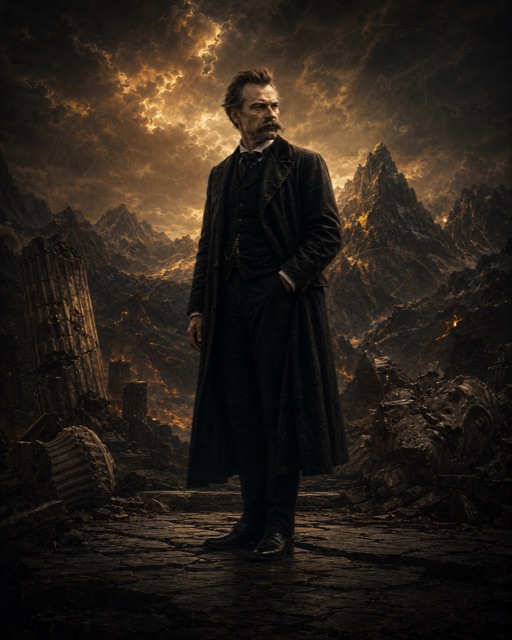
Genealogy · Aphorisms
Thus Spoke Zarathustra
by Nietzsche · The Hammer · Modernity, 1844-1900
- Brutal
- 1883-1885
- ~6 hr 45 min read
- 24 chapter guides
- Public domain
Start reading · Read the Zarathustra's Prologue guide free
Before the text
Editor's Prelude
When A Teacher Must Outgrow His Followers
Nietzsche wrote Thus Spoke Zarathustra between 1883 and 1885, giving philosophy the voice of a wandering prophet rather than the order of a treatise. Zarathustra descends from ten years of solitude carrying a teaching about human self-overcoming, only to discover that speaking is never the same as being heard. The book follows the pressure this puts on both the message and the messenger.
Its form is part sermon, part parable, part dramatic journey, and part lyric song. Images return with changed force: mountains and marketplaces, animals and children, noon and midnight, dancing and gravity. Nietzsche often lets a speech sound biblical while turning familiar religious expectations inside out. The repeated phrase “Thus spake Zarathustra” can close a lesson, but it can also expose how provisional, theatrical, or lonely that lesson remains.
The book's deepest question is not simply what one should believe. It is what kind of person could affirm life without needing to punish the past, flee the earth, or turn freedom into another form of obedience.
The opening pages
Zarathustra's Prologue
First Part · Zarathustra's Discourses
1.
When Zarathustra was thirty years old, he left his home and the lake of his home, and went into the mountains. There he enjoyed his spirit and solitude, and for ten years did not weary of it. But at last his heart changed,—and rising one morning with the rosy dawn, he went before the sun, and spake thus unto it:
Thou great star! What would be thy happiness if thou hadst not those for whom thou shinest!
For ten years hast thou climbed hither unto my cave: thou wouldst have wearied of thy light and of the journey, had it not been for me, mine eagle, and my serpent.
But we awaited thee every morning, took from thee thine overflow and blessed thee for it.
Lo! I am weary of my wisdom, like the bee that hath gathered too much honey; I need hands outstretched to take it.
I would fain bestow and distribute, until the wise have once more become joyous in their folly, and the poor happy in their riches.
Therefore must I descend into the deep: as thou doest in the evening, when thou goest behind the sea, and givest light also to the nether-world, thou exuberant star!
Like thee must I GO DOWN, as men say, to whom I shall descend.
Bless me, then, thou tranquil eye, that canst behold even the greatest happiness without envy!
Bless the cup that is about to overflow, that the water may flow golden out of it, and carry everywhere the reflection of thy bliss!
Lo! This cup is again going to empty itself, and Zarathustra is again going to be a man.
Thus began Zarathustra’s down-going.
2.
Zarathustra went down the mountain alone, no one meeting him. When he entered the forest, however, there suddenly stood before him an old man, who had left his holy cot to seek roots. And thus spake the old man to Zarathustra:
“No stranger to me is this wanderer: many years ago passed he by. Zarathustra he was called; but he hath altered.
Then thou carriedst thine ashes into the mountains: wilt thou now carry thy fire into the valleys? Fearest thou not the incendiary’s doom?
Yea, I recognise Zarathustra. Pure is his eye, and no loathing lurketh about his mouth. Goeth he not along like a dancer?
Altered is Zarathustra; a child hath Zarathustra become; an awakened one is Zarathustra: what wilt thou do in the land of the sleepers?
Chapter guides · 24
Zarathustra's Prologue
A Teacher Finds the Wrong Audience
Zarathustra leaves his mountain to teach people to surpass themselves. The crowd wants something else.
The crowd chooses comfort
After ten years alone, Zarathustra returns to people. He calls humanity a bridge toward the Superman, a being beyond present humanity. The crowd laughs. When he warns against the last man, who wants comfort without ambition, they ask to become that man.
A dangerous crossing
A buffoon leaps over a rope-dancer, who falls. Zarathustra comforts the dying man and carries his body away. He later shelters the corpse in a hollow tree and sleeps.
Companions instead of believers
On waking, Zarathustra decides he needs living companions who will create values with him. He leaves the dead man behind. An eagle with a serpent coiled around its neck appears overhead; he calls them the proudest and wisest animals, wishes he were as wise as his serpent, and asks his pride to stay with his wisdom. So his down-going begins.
IV. The Despisers of the Body
The Body Does the Thinking
Zarathustra argues that the conscious mind is one part of a larger bodily life.
A larger reason
To Zarathustra, the body is not merely something the mind owns. Zarathustra calls it a great reason: many forces working together. The conscious mind is a smaller reason and a tool of the body.
The Self behind the ego
The ego says I. Behind it stands what Zarathustra calls the Self, which directs sensations, thoughts and judgments. Even contempt for the body comes from the body itself.
A will that turns against life
He tells the despisers of the body that their Self wants to perish because it can no longer create beyond itself. Their anger at life, he concludes, keeps them from becoming bridges toward the Superman.
VIII. The Tree on the Hill
The Danger of Growing Higher
A troubled young man fears the isolation and darker impulses that come with his ambition.
XII. The Flies in the Market-Place
The Noise of the Marketplace
Zarathustra contrasts quiet creation with public performance and the small injuries of daily company.
XVI. Neighbour-Love
Closeness Can Become an Escape
Zarathustra questions a love of neighbours that depends on avoiding oneself.
XIX. The Bite of the Adder
A Small Revenge and a Difficult Gift
The adder’s bite leads Zarathustra to question revenge, benevolence and punishment.
XXII. The Bestowing Virtue
The Teacher Sends His Followers Away
Part I ends by making separation a condition of genuine discipleship.
XXVI. The Priests
The Priests Are Prisoners Too
Zarathustra opposes the priests while recognizing suffering and kinship in them.
XXX. The Famous Wise Ones
Wisdom That Serves the Crowd
Zarathustra separates famous public wisdom from the freedom to question what a people holds sacred.
XXXIV. Self-Surpassing
Life Must Surpass Itself
Zarathustra connects the search for truth, the exercise of power and the creation of values.
XXXVIII. Scholars
The Scholar’s Ceiling
Zarathustra leaves a community of scholars whose learning has become a barrier to his own work.
XLI. The Soothsayer
Weariness Enters a Dream
The soothsayer’s despair troubles Zarathustra and enters a dream of death.
XLIV. The Stillest Hour
A Voice Demands What the Teacher Withholds
An inward encounter sends Zarathustra away from his friends again.
XLVIII. Before Sunrise
A Sky Without an Imposed Purpose
Before dawn, Zarathustra addresses the sky as a silent companion.
LII. The Apostates
Former Rebels Return to Belief
Zarathustra sees people abandoning the freedom they once celebrated.
LVI. Old and New Tables
Making New Tables of Value
Thirty sections join Zarathustra’s attacks on inherited commands with demands on future creators.
LX. The Seven Seals
Seven Vows to Eternity
Zarathustra ends Part III with repeated declarations of love for eternity.
LXIV. The Leech
One Small Field of Certain Knowledge
Zarathustra finds a wounded specialist who refuses to claim more knowledge than he has earned.
LXVIII. The Voluntary Beggar
The Beggar Seeks Peace Among Cows
A man who has given up wealth tells Zarathustra why he also turned away from the poor.
LXXII. The Supper
Even the Higher Men Need Supper
Hunger interrupts the gathering, and Zarathustra puts his guests to work preparing a meal.
LXXIII. The Higher Man
The Higher Men Must Learn to Laugh
Zarathustra challenges his guests to act on their own strength and bear the risk of failure.
LXXVI. Among Daughters of the Desert
The Shadow Sings of Desert Daughters
A comic song offers the guests relief from the heavy mood in the cave.
LXXIX. The Drunken Song
Joy Wants Life Again
Outside the cave, a joyful day leads into Zarathustra’s midnight song.
LXXX. The Sign
Zarathustra Leaves at Dawn
The lion and doves bring a sign while the higher men are still asleep.
Questions readers ask
- How long does it take to read Thus Spoke Zarathustra?
- About 6 hr 45 min in total.
- How difficult is Thus Spoke Zarathustra?
- Brutal. A long book of aphorisms; about 7 hours of reading.
- Which translation is this?
- The Thomas Common translation from the German, first published in 1883. The text follows Thus Spake Zarathustra: A Book for All and None, translated by Thomas Common (1909).
- Can I read Thus Spoke Zarathustra for free?
- Thus Spoke Zarathustra is part of Nexus Premium, so reading it needs an account and a Premium subscription. The opening above and two chapter guides on this page are free to read.
- How many chapter guides are there?
- 24 chapter guides, written by the Nexus editors. Two open in full here; the rest show their opening line.
About Nietzsche
Friedrich Nietzsche became a professor of classical philology at twenty-four, then left academic life because of severe illness. He wrote as an independent and increasingly isolated critic of morality, religion, and modern culture before suffering a mental collapse in 1889.
“What values survive after their foundations collapse?”
Nietzsche makes modernity explain where its values come from and whether they can survive without God.
Source text: public domain. Chapter guides: original Nexus writing. Thus Spoke Zarathustra is part of The Nexus Archive, guided Quests through the great works.