 The Nexus Archive
Physics and Natural Philosophy · Treatise
A Treatise of the System of the World
by Newton · The Analyst of Light · Scientific Revolution, 1642-1727
Newton's compact cosmological account of planetary motion, tides, comets, and the system held together by centripetal force.
- Advanced
- 1728
- ~2 hr 15 min read
- 10 chapter guides
- Public domain
Start reading · Read the Ancient Systems and the Need for Force guide free
Before the text
Editor's Prelude
The Heavens Become One Problem
Newton drafted this treatise while he was finding his way toward the Principia, then left it unpublished. When it appeared after his death in 1728, readers encountered a more direct road into his celestial argument: begin with the motions people can see, and ask what force could make planets, moons, tides, and comets belong to one system.
The pressure of the work comes from scale. A projected stone curves toward Earth; a moon falls around a planet; the sea answers to the moon and sun; a comet crosses the familiar planetary paths and still submits to geometry. Newton keeps changing the object under examination while refusing to change the governing question. How far can one law reach?
The proof accumulates through tables, ratios, historical observations and diagrams. It moves from visible motions to forces directed toward centers, then to mutual attraction, tides and the reconstruction of a comet's trajectory. The final test is exacting: a path calculated from a few sightings must answer to observations elsewhere along its course.
The opening pages
Ancient Systems and the Need for Force
It was the ancient opinion of not a few, in the earliest ages of philosophy, that the fixed stars stood immoveable in the highest parts of the world; that under the fixed stars the planets were carried about the sun; that the earth, as one of the planets, described an annual course about the sun, while by a diurnal motion it was in the mean time revolved about its own axis; and that the sun, as the common fire which served to warm the whole, was fixed in the centre of the universe.
This was the philosophy taught of old by Philolaus, Aristarchus of Samos, Plato in his riper years, and the whole sect of the Pythagoreans; and this was the judgment of Anaximander, more ancient than any of them; and of that wise king of the Romans, Numa Pompilius, who, as a symbol of the figure of the world with the sun in the centre, erected a temple in honour of Vesta, of a round form, and ordained perpetual fire to be kept in the middle of it.
The Egyptians were early observers of the heavens; and from them, probably, this philosophy was spread abroad among other nations; for from them it was, and the nations about them, that the Greeks, a people of themselves more addicted to the study of philology than of nature, derived their first, as well as soundest, notions of philosophy; and in the vestal ceremonies we may yet trace the ancient spirit of the Egyptians; for it was their way to deliver their mysteries, that is, their philosophy of things above the vulgar way of thinking, under the veil of religious rites and hieroglyphic symbols.
It is not to be denied but that Anaxagoras, Democritus, and others, did now and then start up, who would have it that the earth possessed the centre of the world, and that the stars of all sorts were revolved towards the west about the earth quiescent in the centre, some at a swifter, others at a slower rate.
However, it was agreed on both sides that the motions of the celestial bodies were performed in spaces altogether free and void of resistance. The whim of solid orbs was of a later date, introduced by Eudoxus, Calippus, and Aristotle; when the ancient philosophy began to decline, and to give place to the new prevailing fictions of the Greeks.
But, above all things, the phænomena of comets can by no means consist with the notion of solid orbs. The Chaldeans, the most learned astronomers of their time, looked upon the comets (which of ancient times before had been numbered among the celestial bodies) as a particular sort of planets, which, describing very eccentric orbits, presented themselves to our view only by turns, viz., once in a revolution, when they descended into the lower parts of their orbits.
Chapter guides · 10
Ancient Systems and the Need for Force
A Stone Opens The Heavens
Newton turns projectile motion into a model for orbit before naming the force behind it.
What changed
Newton begins with his account of ancient sun-centered systems moving through free, unresisting heavens, then asks what force bends the planets from straight paths into orbits. He studies that force mathematically without deciding its physical cause. A stone projected fast enough from a mountain continually falls past Earth and travels around it.
Why it matters
The thought experiment makes celestial motion continuous with terrestrial motion. An orbit is not a body escaping gravity; it is a body perpetually falling under it while its forward motion carries it around the center.
How it ends
Newton closes by showing how a projectile can return to its starting point with its original speed. Because its radius sweeps equal areas in equal times, the same speed returns at the same distance, allowing the body to repeat its circuit.
The Inverse-Square Pattern
Period And Distance Reveal The Law
Satellite and planetary observations expose the inverse-square pattern.
What changed
Newton compares orbital distances with periods for Jupiter's satellites and the planets. The tables support the claim that the force directed toward each center weakens in the duplicate, or inverse-square, proportion of distance.
Why it matters
This is the first major inference from measured motion to an unseen force law. The tables are not background data; they are evidence that the same mathematical relation holds across different systems.
How it ends
Newton ends with the very slow motion of the orbital apsides, the points of greatest and least distance from a center. Their near stability supplies another argument for the inverse-square law, alongside the comparisons of periods and distances.
Matter, Weight, and Attraction
Attraction Becomes Mutual
Pendulums, planets, and the third law bring both bodies into the same interaction.
The Sun and the Common Center
The Sun Also Moves
A common center of gravity replaces the picture of an absolutely fixed Sun.
The Motion of the Tides
The Sea Receives The Same Force
The lunar and solar pulls become a changing figure of the ocean.
Tide Calculations and Lunar Density
Tides Become Measurements
Canals, observed heights, and lunar density make the tidal argument quantitative.
Fixed Stars and Nearby Comets
Comets Enter The Planetary Region
Parallax, brightness, and changing speed place comets near the Sun rather than among the fixed stars.
The Matter of Comet Tails
A Tail Becomes Matter In Motion
Newton rejects optical illusion and treats the tail as rarefied material rising from the comet.
Comets in Conic Paths
Comets Submit To Conic Paths
Visibility, timing, and parabolic tables turn a wandering light into an orbit.
Finding a Comet's Trajectory
Observation Can Recover The Path
The closing lemmas turn scattered sightings into a self-correcting trajectory.
Questions readers ask
- How long does it take to read A Treatise of the System of the World?
- About 2 hr 15 min in total.
- How difficult is A Treatise of the System of the World?
- Advanced. A mid-length treatise; about 2 hours of reading.
- Which translation is this?
- The Anonymous English translator (traditionally attributed to Andrew Motte) translation from the Latin, first published in 1728. The text follows Newton's Principia: The Mathematical Principles of Natural Philosophy, first American edition, carefully revised and corrected — A Treatise of the System of the World (1846).
- Can I read A Treatise of the System of the World for free?
- A Treatise of the System of the World is part of Nexus Premium, so reading it needs an account and a Premium subscription. The opening above and two chapter guides on this page are free to read.
- How many chapter guides are there?
- 10 chapter guides, written by the Nexus editors. Two open in full here; the rest show their opening line.
About Newton
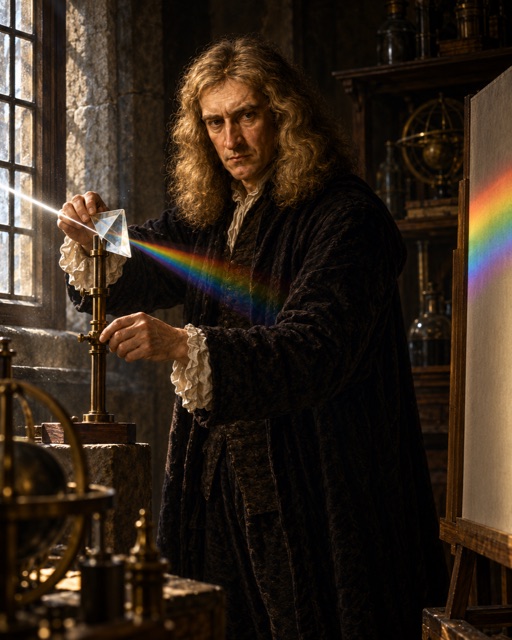
Isaac Newton was an English mathematician, physicist, astronomer, and natural philosopher. In Opticks he investigated light, color, reflection, refraction, and the experimental method that helped define modern science.
“What can experiment reveal when ordinary sight is not enough?”
Newton gives Nexus a scientific reader path where experiment, mathematical discipline, and open questions work together rather than merely reporting discovery.
Source text: public domain. Chapter guides: original Nexus writing. A Treatise of the System of the World is part of The Nexus Archive, guided Quests through the great works.