 The Nexus Archive
Physics and Natural Philosophy · Treatise
Opticks
by Newton · The Analyst of Light · Scientific Revolution, 1642-1727
Newton's experimental inquiry into light, color, refraction, reflection, and the questions left open by optical science.
- Advanced
- 1704
- ~7 hr 30 min read
- 38 chapter guides
- Public domain
Start reading · Read the Advertisements and First Principles guide free
Before the text
Editor's Prelude
When Light Enters the Witness Box
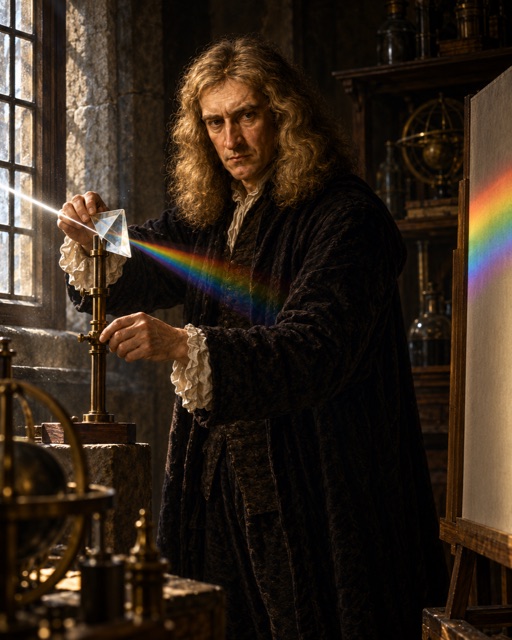
Newton begins Opticks by refusing to make light obey a theory in advance. A darkened room, a hole in a shutter, a prism, a lens, a measured distance: these become instruments of cross-examination. The famous spectrum matters, but so does the discipline around it—Newton turns the prism, isolates a ray, and alters one condition to see whether the result survives.
The book grew across a lifetime. Newton dates its first advertisement to 1704, but says part of the inquiry had been written for the Royal Society in 1675 and other portions assembled later from scattered papers. This 1730 fourth edition carries his corrections, an enlarged sequence of Queries, and a candid warning that Book III remained unfinished. What looks monumental is also deliberately open: completed demonstrations stand beside problems handed to future experimenters.
The form changes with the inquiry. Book I argues through definitions, axioms, propositions, and controlled trials; Book II turns rings, bubbles, thin plates, and tables into evidence about colour and matter; Book III moves from diffraction observations into questions about vision, heat, attraction, chemistry, particles, and method. The diagrams and measurements are part of the reasoning. The Queries are not settled doctrine—they are Newton showing exactly where proof ends and disciplined speculation begins.
The opening pages
Advertisements and First Principles
SIR ISAAC NEWTON'S ADVERTISEMENTS
Advertisement I
Part of the ensuing Discourse about Light was written at the Desire of some Gentlemen of the Royal-Society, in the Year 1675, and then sent to their Secretary, and read at their Meetings, and the rest was added about twelve Years after to complete the Theory; except the third Book, and the last Proposition of the Second, which were since put together out of scatter'd Papers. To avoid being engaged in Disputes about these Matters, I have hitherto delayed the printing, and should still have delayed it, had not the Importunity of Friends prevailed upon me. If any other Papers writ on this Subject are got out of my Hands they are imperfect, and were perhaps written before I had tried all the Experiments here set down, and fully satisfied my self about the Laws of Refractions and Composition of Colours. I have here publish'd what I think proper to come abroad, wishing that it may not be translated into another Language without my Consent.
The Crowns of Colours, which sometimes appear about the Sun and Moon, I have endeavoured to give an Account of; but for want of sufficient Observations leave that Matter to be farther examined. The Subject of the Third Book I have also left imperfect, not having tried all the Experiments which I intended when I was about these Matters, nor repeated some of those which I did try, until I had satisfied my self about all their Circumstances. To communicate what I have tried, and leave the rest to others for farther Enquiry, is all my Design in publishing these Papers.
In a Letter written to Mr. Leibnitz in the year 1679, and published by Dr. Wallis, I mention'd a Method by which I had found some general Theorems about squaring Curvilinear Figures, or comparing them with the Conic Sections, or other the simplest Figures with which they may be compared. And some Years ago I lent out a Manuscript containing such Theorems, and having since met with some Things copied out of it, I have on this Occasion made it publick, prefixing to it an Introduction, and subjoining a Scholium concerning that Method. And I have joined with it another small Tract concerning the Curvilinear Figures of the Second Kind, which was also written many Years ago, and made known to some Friends, who have solicited the making it publick.
Read it in a Quest
A revelation of nature through observation, experiment, evidence, and transformed scale.
Chapter guides · 38
Advertisements and First Principles
Newton Shows The Seams
Three advertisements explain how the book grew before Newton defines its working terms.
What just happened
Newton tells you that parts of the inquiry date to 1675, other parts were assembled later from scattered papers, and Book III remained unfinished. The fourth-edition notice then explains that this text carries corrections left in his own hand before the definitions begin.
Why it matters
These notices are a reading key, not spare publishing history. They separate finished demonstrations from open questions and show why the book can sound both commanding and unfinished.
The ending
After the edition notices, Newton defines rays and their optical properties and lays down his first axioms. The section ends with geometrical constructions showing how rays pass through water, a prism, and a lens.
Book I, Part I: Axioms on Images and Focus
The Rules Before The Prism
Newton begins by making light precise enough to test.
What just happened
Newton explains how lenses and mirrors form images, how the eye receives them, and why an object seen in a mirror or through glass appears where its rays seem to come from. These are the accepted optical rules from which his investigation starts.
Why it matters
This opening is not decoration. Newton wants the reader to see that color can be handled by measurement, geometry, and repeatable conditions.
The ending
Newton finishes with rules for apparent size and magnification. He accepts these familiar principles as his starting point and turns to the further properties of light he intends to discover.
Book I, Part I: Testing Unequal Refraction
The Spectrum Becomes Evidence
The stretched image of sunlight starts to carry Newton's main proof.
Book I, Part I: Separating the Rays
The Rays Are Sorted
Newton narrows the beam so different parts of the spectrum can be tested separately.
Book I, Part I: The Constant Rays
The Rays Keep Their Character
Newton presses the experiment until color looks stable instead of accidental.
Book I, Part I: Reflexibility and Separation
Reflection Also Separates
Newton extends the pattern from refraction to reflexibility.
Book I, Part I: Homogeneal Light
Uniform Light Behaves Regularly
Homogeneal light gives Newton the clean case his theory needs.
Book I, Part I: Telescopes and Colour
Optics Meets Instrument Design
Newton turns color theory into a problem for telescopes.
Book I, Part I: Limits of Telescopes
A Mirror Offers Another Route
Newton turns the colour problem into a case for reflecting telescopes.
Book I, Part I: Reflecting Instruments
A Shorter Reflecting Telescope
A mirror and an internally reflecting prism fold the telescope's light path.
Book I, Part II: Colours Unchanged
Colour Is Not Newly Made
Part II begins by challenging the idea that prisms modify light into colour.
Book I, Part II: Separating One Colour
Each Colour Has Its Measure
Newton measures the relation between colour and refrangibility.
Book I, Part II: Mixing Coloured Rays
Mixtures Can Imitate Colours
Newton distinguishes a colour's appearance from the light that composes it.
Book I, Part II: Toward White Light
White Light As A Mixture
The experiments begin to show white as a compound result.
Book I, Part II: The Colour Circle
Newton Maps The Mixture
The colour circle turns mixed light into a calculable relation.
Book I, Part II: The Rainbow Problem
The Rainbow Becomes An Optical Problem
Newton applies his colour theory to one of nature's most visible phenomena.
Book I, Part II: Bodies in Homogeneal Light
Natural Colour Under Test
Selected and recombined rays test why bodies appear coloured.
Book II, Part I: Rings Between Glasses
Thin Bodies Add A New Puzzle
Book II opens with colours made by bubbles, plates, and glass surfaces.
Book II, Part I: Measuring the Rings
The Rings Become Measurements
Newton turns delicate color rings into numbered evidence.
Book II, Part II: Thickness and Colour
Thickness Orders The Colours
Newton begins turning the ring observations into a scale of thickness.
Book II, Part II: Obliquity and Order
Thin Bodies, Ordered Colours
The rings become a theory of thickness, reflection, and transmission.
Book II, Part III: Permanent Colours
Permanent Colours Need A Cause
Newton turns from thin plates to the colours of ordinary bodies.
Book II, Part III: Corpuscles and Transparency
Small Parts Shape Appearance
Corpuscles, density, and transparency become part of the colour theory.
Book II, Part III: Reflection and Opacity
Reflection Without A Collision
Newton challenges the idea that light simply strikes solid particles and rebounds.
Book II, Part III: Colour and Refraction
One Power, Different Effects
Newton links reflection and refraction as related actions on light.
Book II, Part III: Fits and Consequences
Fits And The Hidden Pattern
Newton gives light a repeating rhythm of reflection and transmission.
Book II, Part IV: Rings by Reflection
Reflection Makes New Rings
Part IV tests ring phenomena through thick polished plates.
Book II, Part IV: Plate Thickness
The Plate Explains The Rings
Newton connects the new rings to the thickness and surfaces of the glass.
Book II, Part IV: New Rings and Transmission
A Second Set Of Rings
Newton tests the same pattern through reflection and transmission.
Book III: Fringes and Shadows
Fringes Make Shadows Complicated
Newton measures bright and dark borders near shadows.
Book III: Inflection of Light
Edges Bend The Light
Newton studies fringes and shadows, then admits the inquiry is unfinished.
Book III: Queries on Light and Heat
The Queries Begin At The Edge Of Proof
Newton turns the unfinished diffraction work into questions about light, heat, and bodies.
Book III: Queries on Vision and Medium
Vision Becomes A Physical Question
Newton asks how light, nerves, colour, and a possible medium might be connected.
Book III: Queries on Sides of Light
Light May Have More Properties
Island crystal gives Newton a reason to ask about sides and hidden structure in rays.
Book III: Queries Against Hypotheses
Against A Dense Sea Of Matter
Newton tests rival accounts of light against shadows, crystals, and planetary motion.
Book III: Chemical Attractions
Attraction Enters Chemistry
Newton asks whether small particles act on one another by forces.
Book III: Cohesion and Small Particles
Cohesion Looks Like A Hidden Force
Newton uses chemical and material examples to keep testing the attraction question.
Book III: Analysis and Natural Philosophy
A Method For Nature
Newton ends with a way of doing science, not only a theory of light.
Questions readers ask
- How long does it take to read Opticks?
- About 7 hr 30 min in total.
- How difficult is Opticks?
- Advanced. A long treatise; about 8 hours of reading.
- Can I read Opticks for free?
- Opticks is part of Nexus Premium, so reading it needs an account and a Premium subscription. The opening above and two chapter guides on this page are free to read.
- How many chapter guides are there?
- 38 chapter guides, written by the Nexus editors. Two open in full here; the rest show their opening line.
About Newton
Isaac Newton was an English mathematician, physicist, astronomer, and natural philosopher. In Opticks he investigated light, color, reflection, refraction, and the experimental method that helped define modern science.
“What can experiment reveal when ordinary sight is not enough?”
Newton gives Nexus a scientific reader path where experiment, mathematical discipline, and open questions work together rather than merely reporting discovery.
Source text: public domain. Chapter guides: original Nexus writing. Opticks is part of The Nexus Archive, guided Quests through the great works.