 The Nexus Archive
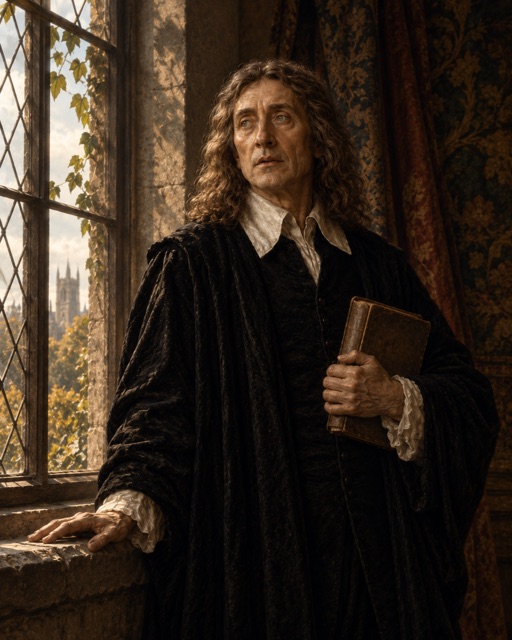
English Christian Epic · Play
Samson Agonistes
by John Milton · The Poet of Rebellion and Fall · Seventeenth-Century England, 1608-1674
Milton's closet drama follows blinded Samson through defeat, temptation, inward struggle, and catastrophic final action.
- Brutal
- ~1 hr read
- 4 chapter guides
- Public domain
Start reading · Read the On Dramatic Poetry guide free
Before the text
Editor's Prelude
Blind in Gaza
Strength has survived where freedom, sight, and confidence have failed. In Samson Agonistes, Israel's captive champion must live with his own part in the loss of a calling he believed came from God. Physical power can no longer tell him what he ought to do.
Milton calls the work a dramatic poem rather than a play for the public stage. Its action is largely encounter and argument: visitors offer Samson pity, reproach, temptation, theology, and political opportunity. Even care can become a struggle over who has the right to direct another life.
The biblical story takes the form of Greek tragedy, with a Chorus that shares Samson's religious hopes without possessing complete knowledge. Claims of duty and inward prompting come from wounded, interested voices. The pressure falls on judgment: how can a fallen man distinguish renewed responsibility from the desire to prove himself powerful again?
The opening pages
On Dramatic Poetry
SAMSON AGONISTES
A
DRAMATIC POEM.
The Author
JOHN MILTON.
Aristot. Poet. Cap. 6.
Τραγωδία μίμησις πράξεως σπουδαίας, &c.
Tragœdia est imitatio actionis seriæ, &c. Per misericordiam & metum perficiens talium affectuum lustrationem.
Of that sort of Dramatic Poem which is call'd Tragedy.
TRAGEDY, as it was antiently compos'd, hath been ever held the gravest, moralest, and most profitable of all other Poems: therefore said by Aristotle to be of power by raising pity and fear, or terror, to purge the mind of those and such like passions, that is to temper and reduce them to just measure with a kind of delight, stirr'd up by reading or seeing those passions well imitated. Nor is Nature wanting in her own effects to make good his assertion: for so in Physic things of melancholic hue and quality are us'd against melancholy, sowr against sowr, salt to remove salt humours. Hence Philosophers and other gravest Writers, as Cicero, Plutarch and others, frequently cite out of Tragic Poets, both to adorn and illustrate thir discourse. The Apostle Paul himself thought it not unworthy to insert a verse of Euripides into the Text of Holy Scripture, 1 Cor. 15. 33. and Paræus commenting on the Revelation, divides the whole Book as a Tragedy, into Acts distinguisht each by a Chorus of Heavenly Harpings and Song between. Heretofore Men in highest dignity have labour'd not a little to be thought able to compose a Tragedy. Of that honour Dionysius the elder was no less ambitious, then before of his attaining to the Tyranny. Augustus Cæsar also had begun his Ajax, but unable to please his own judgment with what he had begun, left it unfinisht. Seneca the Philosopher is by some thought the Author of those Tragedies (at lest the best of them) that go under that name. Gregory Nazianzen a Father of the Church, thought it not unbeseeming the sanctity of his person to write a Tragedy, which he entitl'd, Christ suffering.
This is mention'd to vindicate Tragedy from the small esteem, or rather infamy, which in the account of many it undergoes at this day with other common Interludes; hap'ning through the Poets error of intermixing Comic stuff with Tragic sadness and gravity; or introducing trivial and vulgar persons, which by all judicious hath bin counted absurd; and brought in without discretion, corruptly to gratifie the people. And though antient Tragedy use no Prologue, yet using sometimes, in case of self defence, or explanation, that which Martial calls an Epistle; in behalf of this Tragedy coming forth after the antient manner, much different from what among us passes for best, thus much before-hand may be Epistl'd; that Chorus is here introduc'd after the Greek manner, not antient only but modern, and still in use among the Italians. In the modelling therefore of this Poem, with good reason, the Antients and Italians are rather follow'd, as of much more authority and fame. The measure of Verse us'd in the Chorus is of all sorts, call'd by the Greeks Monostrophic, or rather Apolelymenon, without regard had to Strophe, Antistrophe or Epod, which were a kind of Stanza's fram'd only for the Music, then us'd with the Chorus that sung; not essential to the Poem, and therefore not material; or being divided into Stanza's or Pauses, they may be call'd Allœostropha. Division into Act and Scene referring chiefly to the Stage (to which this work never was intended) is here omitted.
Chapter guides · 4
On Dramatic Poetry
Passion brought to measure
Milton defends tragedy as a serious pleasure through which pity and fear can be felt and brought into proportion.
Feeling as an instrument
In Milton's account of Aristotle, tragedy tempers passion by arousing it through imitation. His comparison with medicine makes the apparent paradox concrete: melancholy can be treated with something of the same quality. The delight of reading or seeing grief represented is part of its moral usefulness, rather than an escape from feeling.
A disputed dignity
Examples from philosophy, Scripture, rulers, and churchmen support Milton's defense of tragedy against its contemporary infamy. He blames that disrepute on poets who mix comic material with tragic gravity to gratify an audience. His defense therefore also sets a demanding standard: popularity cannot by itself establish the worth of a dramatic poem.
Form and judgment
The Greek chorus, varied choral measures, and action confined to a single day establish the kind of discipline Milton values. He omits divisions into acts and scenes because the work was not intended for the stage. Yet he still asks that the disposition of its story answer to probability and decorum, with the ancient tragic poets as the measure of achievement.
The Persons
Deliverance imagined in advance
The Argument places the hope of ransom beside Samson’s inward persuasion, while the cast gathers those who will speak to him and report his fate.
Visitors to a prisoner
Samson begins captive, blind, and temporarily released from labor by a Philistine festival. The Argument organizes his story around visits: friends offer consolation, his father seeks ransom, and an officer requires his strength as entertainment. These are different claims on a man whose power has become the property and spectacle of his enemies.
An inward persuasion
The Argument describes Samson first refusing the summons and then yielding, persuaded within himself that it comes from God. The plot sets his inward conviction beside the officer’s threats, making his decision both an answer to coercion and a claim to divine guidance. Divine purpose and a prisoner's response to coercion are brought together without becoming the same thing.
The distance of report
Manoa's joyful expectation of deliverance is interrupted, in the announced plot, by news of a catastrophe. A messenger's first confused report becomes more distinct. With the scene fixed outside the prison, the Argument makes hearing and interpretation central to the action: hope, intention, and knowledge of what happened reach the assembled characters by different routes. The cast ends by naming the Chorus as Danites and fixing the scene before the prison in Gaza.
The Drama — Part 1
The struggle to judge a fallen strength
Samson’s visitors turn captivity into a dispute over repentance, loyalty, and the uses of a power he no longer trusts himself to govern.
The Drama — Part 2
A death claimed as deliverance
Samson leaves prison for a public display, and those left behind must understand his last act through its sounds and an eyewitness’s report.
Questions readers ask
- How long does it take to read Samson Agonistes?
- About 1 hr in total.
- How difficult is Samson Agonistes?
- Brutal. A mid-length play; about an hour of reading.
- Can I read Samson Agonistes for free?
- Samson Agonistes is part of Nexus Premium, so reading it needs an account and a Premium subscription. The opening above and two chapter guides on this page are free to read.
- How many chapter guides are there?
- 4 chapter guides, written by the Nexus editors. Two open in full here; the rest show their opening line.
About John Milton
John Milton was an English poet, polemicist, and republican writer. Paradise Lost retells rebellion, creation, temptation, fall, and promised redemption with the argumentative force of theology, politics, and epic poetry.
“What does freedom become when it refuses rightful order?”
Milton gives Nexus one of the strongest English meditations on liberty and obedience, where cosmic rebellion and human choice meet in poetry.
Source text: public domain. Chapter guides: original Nexus writing. Samson Agonistes is part of The Nexus Archive, guided Quests through the great works.