 The Nexus Archive
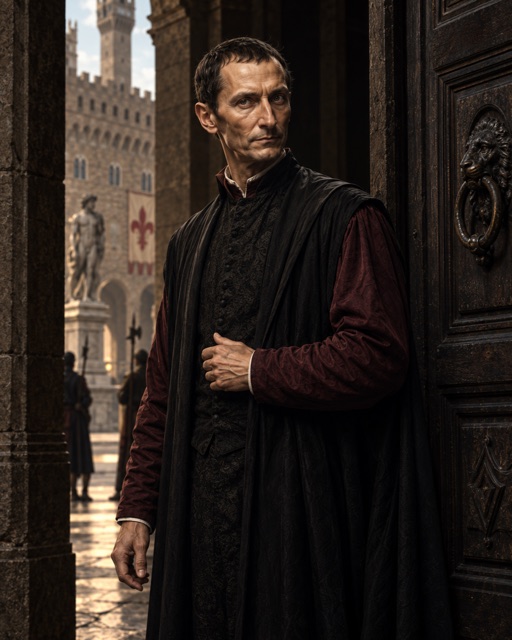
Political Realism · Treatise
The Prince
by Machiavelli · The Honest Advisor of Power · Renaissance, 1469-1527
A compact and unsettling analysis of political survival and power.
- Intermediate
- 1513
- ~2 hr 15 min read
- 10 chapter guides
- Public domain
Start reading · Read the Chapters I–III guide free
Before the text
Editor's Prelude
The Price of Seeing Clearly
In 1512 Florence's republic fell, the Medici returned, and Niccolò Machiavelli lost the public office he had held for fourteen years. His work had taken him into diplomatic negotiations and military campaigns, where promises were tested by the armies behind them. Imprisoned and tortured in 1513 on suspicion of conspiracy, he was released and withdrew to his country home. There he began turning his experience of government into a book for a ruler. The dedication addresses Lorenzo de' Medici, grandson of the famous Lorenzo: the former servant of the republic offers his knowledge to the family that displaced it.
Italy was divided among republics, principalities, and the territories of the Church, while French and Spanish armies contested its lands. A small state's survival could depend on an ally whose help made it less independent. Machiavelli had watched rulers gain cities they could not hold, soldiers serve the ambitions of their commanders, and governments collapse when circumstances changed. His ancient examples stand beside these recent events, giving him different cases against which to test an explanation.
The word “prince” here means a ruler, whether hereditary or newly established. Machiavelli asks what allows such a ruler to keep a state, even when the conduct required brings moral disgrace. He does not assume that a reputation for goodness guarantees good consequences, or that every successful use of force deserves honour. His unsettling judgments grow out of particular choices: whom to trust, whose support matters, what an injury will set in motion. The book begins with a man outside power offering to explain it to a man within.
The opening pages
Chapters I–III: Forms of Rule and Mixed Monarchies
CHAPTER I
THE VARIOUS KINDS OF GOVERNMENT AND THE WAYS BY WHICH THEY ARE ESTABLISHED
All states and dominions which hold or have held sway over mankind are either republics or monarchies. Monarchies are either hereditary ones, in which the rulers have been for many years of the same family, or else they are those of recent foundation. The newly founded ones are either entirely new, as was Milan to Francesco Sforza, or else they are, as it were, new members grafted on to the hereditary possessions of the prince that annexes them, as is the kingdom of Naples to the King of Spain. The dominions thus acquired have either been previously accustomed to the rule of another prince, or else have been free states, and they are annexed either by force of arms of the prince, or of others, or else fall to him by good fortune or merit.
CHAPTER II
OF HEREDITARY MONARCHIES
I will not here speak of republics, having already treated of them fully in another place. I will deal only with monarchies, and will show how the various kinds described above can be governed and maintained. In the first place, in hereditary states accustomed to the reigning family the difficulty of maintaining them is far less than in new monarchies; for it is sufficient not to exceed the ancestral usages, and to accommodate one's self to accidental circumstances; in this way such a prince, if of ordinary ability, will always be able to maintain his position, unless some very exceptional and excessive force deprives him of it; and even if he be thus deprived of it, on the slightest misfortune happening to the new occupier, he will be able to regain it.
We have in Italy the example of the Duke of Ferrara, who was able to withstand the assaults of the Venetians in the year '84, and of Pope Julius in the year '10, for no other reason than because of the antiquity of his family in that dominion. In as much as the legitimate prince has less cause and less necessity to give offence, it is only natural that he should be more loved; and, if no extraordinary vices make him hated, it is only reasonable for his subjects to be naturally attached to him, the memories and causes of innovations being forgotten in the long period over which his rule has existed; whereas one change always leaves the way prepared for the introduction of another.
Read it in a Quest
A direct encounter with power when justice, fear, and rule lose their illusions.
Chapter guides · 10
Chapters I–III
The Map of Rule
A new possession brings people, loyalties, and grievances that victory alone cannot settle.
The costs of a new ruler
Machiavelli first separates republics from monarchies, then distinguishes inherited states from new acquisitions. Habit gives an established dynasty an advantage. A conqueror starts with a harder problem: he injures some inhabitants by taking their country and disappoints others who helped him because they expected improvement. Military strength still needs local support.
Making a conquest last
His remedies depend on the territory. Shared laws and customs make annexation easier; elsewhere, residence lets a ruler detect trouble early. Colonies cost less than garrisons because they dispossess a smaller, scattered group—an argument that openly calculates how little power the injured will have to retaliate. Louis XII's losses in Italy show the wider danger: in Machiavelli's account, the king strengthened powerful rivals while weakening the lesser allies who needed him.
Chapters IV–V
Conquest Is Not Possession
A kingdom's distribution of authority helps determine both how it can be invaded and how it can resist afterward.
The allies who remain rivals
Machiavelli compares the Ottoman ruler's dependent officials with France's hereditary nobles, who have subjects attached to their own families. Independent barons can help an invader enter France, then become centres of resistance to him. A more unified monarchy is harder to defeat, but once its ruling family is eliminated, fewer independent claimants remain. This is his explanation for the survival of Alexander's conquests under his successors.
The memory of liberty
A city accustomed to governing itself presents a different obstacle. Its former liberty supplies a name and cause around which resistance can return, despite time or benefits received. Machiavelli considers residence, a dependent local government, and destruction; his preference for destroying such cities exposes how far the conqueror's security can conflict with the life of the conquered community.
Chapters VI–VII
Power Must Become Your Own
The founder needs an opportunity; the ruler raised by another's power needs foundations that can outlast his patron.
Chapters VIII–IX
Crime, Glory, and Popular Support
Machiavelli separates the ability to seize power from the honour of doing so, then asks whom a civic ruler depends on.
Chapters X–XI
Foundations and Exceptions
The ability to survive a siege and the durability of Church rule reveal different sources of security.
Chapters XII–XIV
The Danger of Borrowed Arms
Soldiers can fail their employer by losing a war—or deprive him of independence by winning it.
Chapters XV–XVIII
Virtue, Reputation, and Consequences
Machiavelli separates the qualities people praise from the effects those qualities can have in government.
Chapter XIX
Whose Hatred Can Ruin a Ruler?
Popular goodwill can discourage conspiracy, but Rome's emperors also had to reckon with soldiers powerful enough to make and kill them.
Chapters XX–XXIII
Defences, Reputation, and Counsel
Fortresses and advisers are useful only when the prince understands what each can—and cannot—secure.
Chapters XXIV–XXVI
Fortune and the Appeal to Italy
Machiavelli ends by turning his analysis of failed rule into an appeal to the Medici house.
Questions readers ask
- How long does it take to read The Prince?
- About 2 hr 15 min in total.
- How difficult is The Prince?
- Intermediate. A mid-length treatise; about 2 hours of reading.
- Which translation is this?
- The Luigi Ricci translation from the Italian, first published in 1532. The text follows The Prince, Luigi Ricci translation (Humphrey Milford/Oxford University Press) (1909).
- Can I read The Prince for free?
- The Prince is part of Nexus Premium, so reading it needs an account and a Premium subscription. The opening above and two chapter guides on this page are free to read.
- How many chapter guides are there?
- 10 chapter guides, written by the Nexus editors. Two open in full here; the rest show their opening line.
About Machiavelli
Machiavelli served the Florentine Republic as a diplomat and civil servant during an age of invasion and political instability. After the Medici returned to power, he was imprisoned, tortured, and pushed out of public life, where he wrote his most famous works.
“What does power actually demand?”
Machiavelli forces political thought to confront the gap between private virtue and public survival.
Source text: public domain. Chapter guides: original Nexus writing. The Prince is part of The Nexus Archive, guided Quests through the great works.