 The Nexus Archive
Daoism · Aphorisms
Tao Te Ching
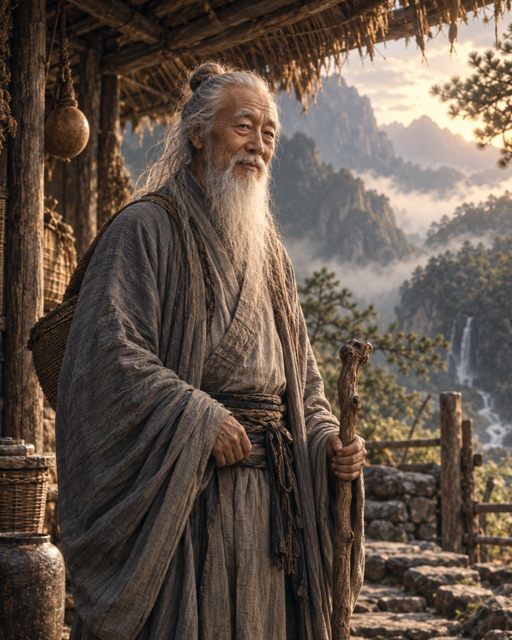
by Laozi · The Keeper of the Way · Ancient China, trad. 6th century BC
A compact poetic classic on the Way, power, humility, actionless action, and governing without forcing.
- Intermediate
- c. 4th c. BCE
- ~45 min read
- 9 chapter guides
- Public domain
Start reading · Read the Chapters 1-5 guide free
Before the text
Editor's Prelude
The Way That Will Not Be Held
The eighty-one short chapters that came down under Laozi's name speak to people trying to govern a state, preserve a life, or find their bearings amid ambition and conflict. Laozi means ‘Old Master’. The collection speaks from ancient Chinese debates about order, authority, and how human beings should live.
The chapters work by reversal. The high looks precarious, the low becomes a place of power, and emptiness turns out to be useful. The Tao, or Way, gives life without claiming possession of what it makes. Its recurring counsel is wu wei, often translated as non-action: a restraint on deliberate interference, grasping, and excessive effort. This counsel reaches from bodily discipline to the conduct of rulers. Gentleness and care sit beside proposals to keep subjects ignorant and content; the book's political simplicity can be severe.
James Legge's 1891 translation moves between prose and rhymed verse. His supplied phrases in parentheses make his interpretation of the compressed Chinese visible. ‘Tao’ names the Way; its ‘attributes’ express the sustaining power commonly called de. The sage is the exemplary person through whom these relations become conduct. Short sayings, recurring images, and abrupt contradictions give this teaching its form: a ruler's authority and a person's self-command are repeatedly tested against what they try to possess.
The opening pages
Chapters 1-5: The Way and Its First Reversals
Part I
Chapter 1
1. The Tao that can be trodden is not the enduring and unchanging Tao. The name that can be named is not the enduring and unchanging name.
2. (Conceived of as) having no name, it is the Originator of heaven and earth; (conceived of as) having a name, it is the Mother of all things.
3.Always without desire we must be found,
If its deep mystery we would sound;
But if desire always within us be,
Its outer fringe is all that we shall see.
4. Under these two aspects, it is really the same; but as development takes place, it receives the different names. Together we call them the Mystery. Where the Mystery is the deepest is the gate of all that is subtle and wonderful.
Chapter 2
1. All in the world know the beauty of the beautiful, and in doing this they have (the idea of) what ugliness is; they all know the skill of the skilful, and in doing this they have (the idea of) what the want of skill is.
2. So it is that existence and non-existence give birth the one to (the idea of) the other; that difficulty and ease produce the one (the idea of) the other; that length and shortness fashion out the one the figure of the other; that (the ideas of) height and lowness arise from the contrast of the one with the other; that the musical notes and tones become harmonious through the relation of one with another; and that being before and behind give the idea of one following another.
3. Therefore the sage manages affairs without doing anything, and conveys his instructions without the use of speech.
4. All things spring up, and there is not one which declines to show itself; they grow, and there is no claim made for their ownership; they go through their processes, and there is no expectation (of a reward for the results). The work is accomplished, and there is no resting in it (as an achievement).
The work is done, but how no one can see;
'Tis this that makes the power not cease to be.
Chapter 3
1. Not to value and employ men of superior ability is the way to keep the people from rivalry among themselves; not to prize articles which are difficult to procure is the way to keep them from becoming thieves; not to show them what is likely to excite their desires is the way to keep their minds from disorder.
Read it in a Quest
A quieter discipline of strategy, restraint, attention, and liberation from craving.
Chapter guides · 9
Chapters 1-5
The First Reversal
Naming, desire, and authority are unsettled together in the opening five chapters.
Names and opposites
A name cannot fully describe the Way. Beauty and ugliness, ease and difficulty, being and nonbeing arise in relation to one another. The sage acts within these relations without claiming the growth he makes possible or treating an achievement as his possession.
The ruler and his people
Promoting the talented breeds rivalry, and prizing rare goods breeds thieves. The sage instead fills people’s bellies while emptying their minds and weakening their wills. This political order depends on keeping ambition and knowledge in check.
An empty source
The Way resembles an empty vessel; the passage warns against fullness. Heaven and Earth treat creatures as grass dogs, and the sage treats people in the same way. Legge explains the grass dogs as straw figures used in rites and discarded afterward. The bellows offers another model of emptiness, sustaining movement without needing to be filled.
Chapters 6-15
Strength Looks Low
Valley, water, and empty space give strength a different shape in Chapters 6–15.
What receives and nourishes
Yielding can be a source of lasting strength. The valley and the mysterious female name a generative power that does not spend itself. Water benefits other things while occupying places others disdain. These images connect yielding with endurance; the warnings against overflowing a vessel, sharpening too far, and amassing wealth show how excess puts achievement at risk.
The use of what is absent
A wheel needs the empty center of its hub, a vessel its hollow interior, and a room its doors and windows. What is present supplies the structure; what is absent permits its use. The counsel on appetite follows the same distinction: costly objects and sensory excitement can obstruct the life they seem to enrich.
Masters without display
The Way eludes sight, hearing, and grasp. Its ancient practitioners are described through comparisons rather than definitions: cautious at a winter stream, yielding like melting ice, plain like unworked wood. Muddy water clears when left still, and steady movement gradually brings rest. Their reserve keeps them from hardening into a finished, self-sufficient form.
Chapters 16-25
Return to Stillness
Chapters 16–25 join a return to the root with a radical critique of cultivated distinction.
Chapters 26-37
Rule Without Forcing
Chapters 26–37 measure authority through self-command, restraint in war, and the refusal to possess.
Chapters 38-44
After the Way Is Lost
Chapters 38–44 distinguish sustaining virtue from conduct that must insist on its own virtue.
Chapters 45-52
Less Deliberate Doing
Chapters 45–52 connect diminished interference with care that does not claim ownership.
Chapters 53-61
Governing with Simplicity
Chapters 53–61 make conspicuous wealth and restless regulation signs of political failure.
Chapters 62-70
Simple Does Not Mean Easy
Chapters 62–70 place gentleness beside demanding—and sometimes restrictive—forms of rule.
Chapters 71-81
Giving Without Hoarding
Chapters 71–81 close with the limits of punishment, the burden of taxation, and an austere political ideal.
Questions readers ask
- How long does it take to read Tao Te Ching?
- About 45 min in total.
- How difficult is Tao Te Ching?
- Intermediate. A short book of aphorisms; about 45 minutes of reading.
- Which translation is this?
- The James Legge translation from the Classical Chinese. The text follows The Texts of Taoism, Part I, Sacred Books of the East, Volume 39 (1891).
- Can I read Tao Te Ching for free?
- Tao Te Ching is part of Nexus Premium, so reading it needs an account and a Premium subscription. The opening above and two chapter guides on this page are free to read.
- How many chapter guides are there?
- 9 chapter guides, written by the Nexus editors. Two open in full here; the rest show their opening line.
About Laozi
Laozi is the traditional author associated with the Tao Te Ching, a brief poetic classic of Daoist thought. The text explores the Way, virtue, humility, softness, non-coercive action, and the limits of ambitious control.
“What happens when we stop trying to force the world into obedience?”
Laozi gives the archive a counterpoint to conquest, mastery, and political force: order through restraint, simplicity, and receptivity.
Source text: public domain. Chapter guides: original Nexus writing. Tao Te Ching is part of The Nexus Archive, guided Quests through the great works.