 The Nexus Archive
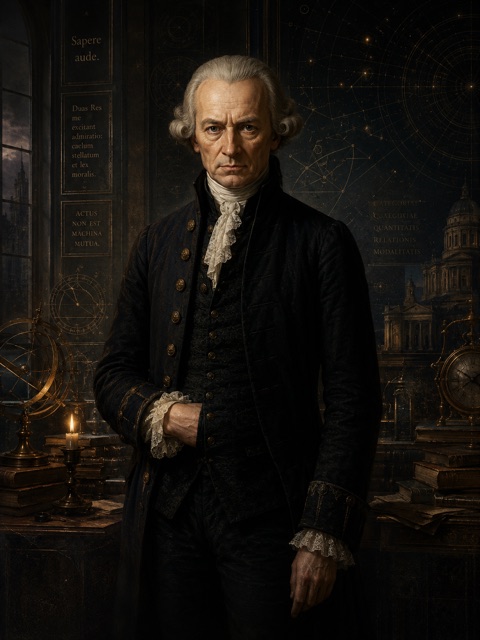
German Idealism · Treatise
Critique of Practical Reason
by Kant · The Judge of Reason · Enlightenment, 1724-1804
Kant turns from what reason can know to what reason can command.
- Brutal
- 1788
- ~4 hr 30 min read
- 19 chapter guides
- Public domain
Start reading · Read the Introduction guide free
Before the text
Editor's Prelude
The Law That Makes Freedom Visible
In 1788, Immanuel Kant returned to a problem his first Critique had left suspended. Reason could not prove freedom, God or immortality as objects of knowledge. Yet ordinary moral obligation seemed to address us as beings who could choose. The question was what reason can command, and what that command reveals about the person who hears it.
Kant's answer is deliberately severe. Pleasure, sympathy, reputation, reward and even the hope of happiness cannot supply a moral law. Each depends on what a particular person happens to want. A free will must act from a principle it can give to itself as a law for every rational being. Freedom becomes visible when reason can bind the will without borrowing authority from appetite.
This is a sustained argument about the demands we make on ourselves. Its distinctions concern familiar pressures: the advantage gained by a lie, the pride of doing good, the wish to be happy. Kant gives duty priority over the hope of reward. His difficult question is how a person subject to nature's causes can still answer for a choice.
The opening pages
Principles I–II: Maxims, Rules, and Law
FIRST PART — ELEMENTS OF PURE PRACTICAL REASON.
BOOK I. The Analytic of Pure Practical Reason.
CHAPTER I. Of the Principles of Pure Practical Reason.
I. DEFINITION.
Practical principles are propositions which contain a general determination of the will, having under it several practical rules. They are subjective, or maxims, when the condition is regarded by the subject as valid only for his own will, but are objective, or practical laws, when the condition is recognized as objective, that is, valid for the will of every rational being.
REMARK.
Supposing that pure reason contains in itself a practical motive, that is, one adequate to determine the will, then there are practical laws; otherwise all practical principles will be mere maxims. In case the will of a rational being is pathologically affected, there may occur a conflict of the maxims with the practical laws recognized by itself. For example, one may make it his maxim to let no injury pass unrevenged, and yet he may see that this is not a practical law, but only his own maxim; that, on the contrary, regarded as being in one and the same maxim a rule for the will of every rational being, it must contradict itself. In natural philosophy the principles of what happens, (e.g., the principle of equality of action and reaction in the communication of motion) are at the same time laws of nature; for the use of reason there is theoretical and determined by the nature of the object. In practical philosophy, i.e., that which has to do only with the grounds of determination of the will, the principles which a man makes for himself are not laws by which one is inevitably bound; because reason in practical matters has to do with the subject, namely, with the faculty of desire, the special character of which may occasion variety in the rule. The practical rule is always a product of reason, because it prescribes action as a means to the effect. But in the case of a being with whom reason does not of itself determine the will, this rule is an imperative, i.e., a rule characterized by "shall," which expresses the objective necessitation of the action and signifies that, if reason completely determined the will, the action would inevitably take place according to this rule. Imperatives, therefore, are objectively valid, and are quite distinct from maxims, which are subjective principles. The former either determine the conditions of the causality of the rational being as an efficient cause, i.e., merely in reference to the effect and the means of attaining it; or they determine the will only, whether it is adequate to the effect or not. The former would be hypothetical imperatives, and contain mere precepts of skill; the latter, on the contrary, would be categorical, and would alone be practical laws. Thus maxims are principles, but not imperatives. Imperatives themselves, however, when they are conditional (i.e., do not determine the will simply as will, but only in respect to a desired effect, that is, when they are hypothetical imperatives), are practical precepts but not laws. Laws must be sufficient to determine the will as will, even before I ask whether I have power sufficient for a desired effect, or the means necessary to produce it; hence they are categorical: otherwise they are not laws at all, because the necessity is wanting, which, if it is to be practical, must be independent of conditions which are pathological and are therefore only contingently connected with the will. …
Chapter guides · 19
Introduction
The Critique Runs In The Opposite Direction
Kant asks whether reason can guide a choice without depending on what someone wants.
Reason as a guide to action
Practical reason concerns the will: our ability to choose and try to bring something about. Kant asks whether pure reason can determine the will by itself. Pure here means independent of experience and the desires it teaches us.
The order of the inquiry
He contrasts this task with theoretical reason's search for knowledge. If pure reason can guide action, it supplies the standard for judging claims made by desire. The argument therefore begins with principles, moves to the objects of choice, and then considers feeling. Kant ends by placing a law grounded in freedom first; that law determines the objects to which it applies.
Principle III
Pleasure Cannot Become Law
Even the most refined pleasure depends on the person who feels it.
A pleasure is still a pleasure
Kant calls a principle material when a desired object supplies its motive. Intellectual enjoyment may be finer than bodily enjoyment. But if expected pleasure determines the choice, both depend on feeling. Neither can supply a law binding every rational being.
Why happiness gives advice
He illustrates the point with people abandoning a book, a speech or a conversation for other pleasures. Everyone wants happiness, but its contents vary between people and across a person's life. Even agreement about those contents would be a contingent fact. Kant ends by distinguishing useful counsels and personal maxims from laws that reason makes universally necessary.
Principles VII–VIII
The Moral Law Reveals Freedom
A moral law must guide everyone's will, while leaving each person responsible for the choice.
Deduction
The Law Establishes Freedom
For Kant, the moral law establishes freedom rather than receiving proof from it.
Reason's Practical Extension
Extension Without Speculative Knowledge
Reason can justify a use of freedom in action without describing what lies beyond experience.
Objects
Good Follows Law
Moral good concerns the principle of an action, rather than how pleasant its result feels.
Categories of Freedom and the Typic
Nature Supplies A Type, Not A Moral Cause
The form of a natural law gives Kant a model for judging a moral choice.
Motive I
Respect Is Reason's Effect On Feeling
Respect is a feeling produced by the moral law, rather than a feeling that creates it.
Motive II
Duty Refuses Moral Theater
Kind feelings can accompany a good action, but Kant makes respect for duty its moral ground.
Analytic Reviewed: Morality and Happiness
The Analytic Starts From Law
Kant reviews why moral inquiry begins with a law and keeps happiness distinct from duty.
Analytic Reviewed: Freedom Within Causality
One Action, Two Standpoints
Kant considers the same action as an event in nature and as a choice for which a person answers.
Analytic Reviewed: The Intelligible Self
Freedom Opens The Supersensible From Within
Kant defends freedom by keeping a person's existence in time distinct from their existence in themselves.
Dialectic
Virtue And Happiness Pull Apart
Kant's highest good joins virtue with fitting happiness, but their connection creates a conflict.
The Antinomy Resolved
The Highest Good Becomes Practically Possible
The conflict changes once Kant allows that sensible nature is not the whole of reality.
God as a Practical Postulate
God Enters Through Moral Hope
Kant connects belief in God with hope for the highest good, while grounding duty in reason itself.
Postulates and Reason's Extension
Practical Certainty Keeps Its Limits
Kant gives the postulates practical standing while refusing claims to know their objects' nature.
Rational Belief and Human Limits
Belief Protects Freedom From Calculation
Kant treats rational faith as a voluntary assent, while explaining why certainty could weaken moral motives.
Methodology I
Moral Education Begins With Judgment
Kant asks how moral judgment can become a lasting influence on someone's choices.
Conclusion
Awe Must Become Method
Awe can begin inquiry, but Kant makes careful method the path to practical wisdom.
Questions readers ask
- How long does it take to read Critique of Practical Reason?
- About 4 hr 30 min in total.
- How difficult is Critique of Practical Reason?
- Brutal. A long treatise; about 4 hours of reading.
- Can I read Critique of Practical Reason for free?
- Critique of Practical Reason is part of Nexus Premium, so reading it needs an account and a Premium subscription. The opening above and two chapter guides on this page are free to read.
- How many chapter guides are there?
- 19 chapter guides, written by the Nexus editors. Two open in full here; the rest show their opening line.
About Kant
Immanuel Kant spent nearly his entire life in Königsberg, teaching and writing with remarkable regularity. His mature work attempted to explain the powers and limits of reason, while grounding morality in freedom, duty, and human autonomy.
“What must the mind contribute for experience to be possible?”
Kant changes the center of philosophy by asking not just what we know, but how knowing is possible.
Source text: public domain. Chapter guides: original Nexus writing. Critique of Practical Reason is part of The Nexus Archive, guided Quests through the great works.