 The Nexus Archive
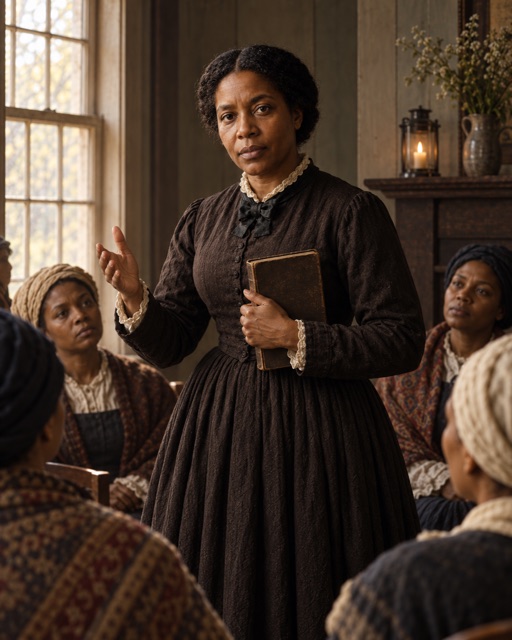
Abolitionist Autobiography · Memoir
Incidents in the Life of a Slave Girl
by Harriet Jacobs · The Hidden Witness · Abolition and Civil War America, 1813-1897
Jacobs's first-person narrative of slavery, sexual coercion, concealment, motherhood, escape, and freedom under the name Linda Brent.
- Advanced
- 1861
- ~6 hr 15 min read
- 15 chapter guides
- Public domain
Start reading · Read the III. The Slaves’ New Year’s Day. guide free
Before the text
Editor's Prelude
What a Mother Could Not Own
Harriet Jacobs begins with a family: a grandmother who earns and saves, parents who love their children, and a girl learning to read. None of that care can give an enslaved person a secure claim to home or kin. Another person's will, debt, or anger can decide where a child lives. Jacobs asks what it means to be a daughter, and later a mother, under that power.
Published in 1861 under the name Linda Brent, her account speaks especially to women who could expect their homes to shelter them. Jacobs describes dangers many of those readers were taught to leave unspoken, including a master's sexual pursuit of an enslaved girl. She writes about love, shame, faith, and resistance from inside the choices slavery allowed her, without asking to be judged as though she had been free to choose otherwise.
Jacobs says the events are true although she has disguised names and places. Lydia Maria Child helped arrange and edit the manuscript and introduces it in her own voice; the life that follows is Jacobs's testimony. Its intimate scenes carry a public challenge: a country that praises family and Christian duty has made both precarious for the people it holds as property.
The opening pages
I. Childhood
I was born a slave; but I never knew it till six years of happy childhood had passed away. My father was a carpenter, and considered so intelligent and skilful in his trade, that, when buildings out of the common line were to be erected, he was sent for from long distances, to be head workman. On condition of paying his mistress two hundred dollars a year, and supporting himself, he was allowed to work at his trade, and manage his own affairs. His strongest wish was to purchase his children; but, though he several times offered his hard earnings for that purpose, he never succeeded. In complexion my parents were a light shade of brownish yellow, and were termed mulattoes. They lived together in a comfortable home; and, though we were all slaves, I was so fondly shielded that I never dreamed I was a piece of merchandise, trusted to them for safe keeping, and liable to be demanded of them at any moment. I had one brother, William, who was two years younger than myself—a bright, affectionate child. I had also a great treasure in my maternal grandmother, who was a remarkable woman in many respects. She was the daughter of a planter in South Carolina, who, at his death, left her mother and his three children free, with money to go to St. Augustine, where they had relatives. It was during the Revolutionary War; and they were captured on their passage, carried back, and sold to different purchasers. Such was the story my grandmother used to tell me; but I do not remember all the particulars. She was a little girl when she was captured and sold to the keeper of a large hotel. I have often heard her tell how hard she fared during childhood. But as she grew older she evinced so much intelligence, and was so faithful, that her master and mistress could not help seeing it was for their interest to take care of such a valuable piece of property. She became an indispensable personage in the household, officiating in all capacities, from cook and wet nurse to seamstress.
She was much praised for her cooking; and her nice crackers became so famous in the neighborhood that many people were desirous of obtaining them. In consequence of numerous requests of this kind, she asked permission of her mistress to bake crackers at night, after all the household work was done; and she obtained leave to do it, provided she would clothe herself and her children from the profits. Upon these terms, after working hard all day for her mistress, she began her midnight bakings, assisted by her two oldest children. The business proved profitable; and each year she laid by a little, which was saved for a fund to purchase her children. Her master died, and the property was divided among his heirs. The widow had her dower in the hotel, which she continued to keep open. My grandmother remained in her service as a slave; but her children were divided among her master’s children. As she had five, Benjamin, the youngest one, was sold, in order that each heir might have an equal portion of dollars and cents. There was so little difference in our ages that he seemed more like my brother than my uncle. He was a bright, handsome lad, nearly white; for he inherited the complexion my grandmother had derived from Anglo-Saxon ancestors. Though only ten years old, seven hundred and twenty dollars were paid for him. …
Read it in a Quest
A witness path through freedom, dignity, law, and the unfinished demand for equality.
Chapter guides · 15
III. The Slaves’ New Year’s Day.
New Year's Day Is a Market
A holiday gives enslaved families no respite from hiring and sale.
Two days of reckoning
Jacobs sets a free family's New Year beside an enslaved family's. January 1 brings hiring decisions; on January 2, people must report to new masters. Sale may follow. Parents and children cannot count on remaining together from one year to the next.
The mother at auction
Jacobs recalls seeing a woman whose seven children were sold away from her while she was sold nearby. The scene gives the calendar its human cost: the mother survives in the same town, with no way to gather her family again.
V. The Trials Of Girlhood.
Girlhood Under Threat
In her fifteenth year, Linda faces Dr. Flint's pursuit without protection from the law that makes her his daughter's property.
Flint's claim
Dr. Flint speaks to Linda in sexual terms, threatens her, and insists that ownership entitles him to obedience. His daughter legally owns her, but that distinction does nothing to curb his power in the household.
The silence he exploits
Linda cannot bring herself to tell her grandmother what he says. She fears the hurt and danger disclosure might bring, even as her grandmother's presence offers some protection. Jacobs widens the account to other enslaved girls, asking Northern women to recognize a danger that respectable silence helps conceal.
X. A Perilous Passage In The Slave Girl’s Life.
The Choice Flint Did Not Control
Linda turns to Mr. Sands as Flint prepares a secluded cottage for her, then faces her grandmother with the news of her pregnancy.
XIV. Another Link To Life.
Two Children, Neither Secure
Flint threatens Linda's son, and the birth of her daughter makes the danger of sexual exploitation newly personal.
XVII. The Flight.
Flight Begins Without Safety
Linda leaves the plantation before the Flints can bring her children there, and the search reaches her grandmother's door.
XX. New Perils.
No Safe Place to Stay
With a helper's house under suspicion, Linda moves through disguise, a boat, and Snaky Swamp toward her grandmother's home.
XXII. Christmas Festivities.
The Loophole Is Not Freedom
Linda can see her children through an opening in the garret wall, but must let them believe she is far away.
XXVII. New Destination For The Children.
Ellen Goes North Without Her Mother
Mr. Sands promises protection, but Linda still has no proof that her children's freedom is secure.
XXIX. Preparations For Escape.
A Passage Opens
Peter finds a vessel after nearly seven years of concealment, while Linda and another fugitive face separate dangers.
XXXII. The Meeting Of Mother And Daughter.
Ellen Is Not Being Schooled
Linda finds her daughter in Brooklyn and learns what the promised northern placement has meant in practice.
XXXVI. The Hairbreadth Escape.
The Letter Ellen Found
Ellen finds a torn letter addressed to Flint that gives Linda's New York address; fearing a copy has been sent, Linda leaves with her daughter.
XXXIX. The Confession.
What Ellen Already Knew
As Ellen leaves for school, Linda tries to tell her about her father and learns how much the child has carried alone.
XL. The Fugitive Slave Law.
Law Reopens the Hunt
The Fugitive Slave Law makes Linda's New York work and ordinary walks occasions for vigilance.
XLI. Free At Last.
Freedom With a Cost
Mrs. Bruce ends the Dodges' legal claim, while Jacobs refuses to call the sale of her person a just price for freedom.
Appendix
The Witnesses Speak
Amy Post recalls the labor and pain of Jacobs's writing; George W. Lowther attests to events he knew.
Questions readers ask
- How long does it take to read Incidents in the Life of a Slave Girl?
- About 6 hr 15 min in total.
- How difficult is Incidents in the Life of a Slave Girl?
- Advanced. A long memoir; about 6 hours of reading.
- Which edition is this?
- The original English text, first published in 1861. The text follows Incidents in the Life of a Slave Girl, Written by Herself (1861).
- Can I read Incidents in the Life of a Slave Girl for free?
- Incidents in the Life of a Slave Girl is part of Nexus Premium, so reading it needs an account and a Premium subscription. The opening above and two chapter guides on this page are free to read.
- How many chapter guides are there?
- 15 chapter guides, written by the Nexus editors. Two open in full here; the rest show their opening line.
About Harriet Jacobs
Harriet Jacobs escaped slavery and wrote Incidents in the Life of a Slave Girl under the name Linda Brent. Her narrative exposes sexual exploitation, family separation, confinement, and the courage required to claim freedom under a system built to deny it.
“What does freedom cost when oppression reaches into the home and the body?”
Jacobs gives Nexus an indispensable first-person account of slavery's intimate violence and the moral force of testimony.
Source text: public domain. Chapter guides: original Nexus writing. Incidents in the Life of a Slave Girl is part of The Nexus Archive, guided Quests through the great works.