 The Nexus Archive
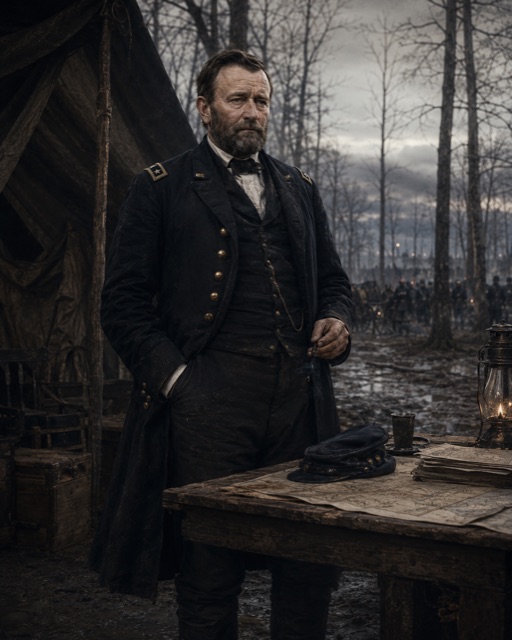
American Unionism · Memoir
Personal Memoirs of U. S. Grant
by Ulysses S. Grant · The Silent Commander · Civil War and Reconstruction, 1822-1885
Grant's plainspoken account of war, command, and memory.
- Advanced
- ~18 hr 15 min read
- 21 chapter guides
- Public domain
Start reading · Read the Preface guide free
Before the text
Editor's Prelude
A Clear Voice Against the Clock
Ulysses S. Grant began these memoirs after financial ruin had left him living on borrowed money. Then came the diagnosis of terminal throat cancer. He wrote through relentless pain because the book had become his last campaign: a way to leave his family secure. The race against death gives the calm sentences an extraordinary pressure. Grant rarely announces the drama of his own position, but it stands behind every page.
This is a soldier's memoir, built from terrain, supply lines, orders, mistakes, and the character of people under strain. Grant asked his sons to help check the record, yet he never pretends that the judgments are anyone's but his own. A road washed out by rain or a train carrying food can decide what an army is able to do. His portraits of commanders are just as practical: courage matters, but so do trust, speed and the care of exhausted men.
The voice is calm enough to make difficult choices sound simple. Beneath that calm are arguments about blame, slavery and the human cost of victory. Grant can praise a former enemy, defend a disputed order, or admit that he once treated another general unfairly. His memory has a side, and his plain sentences give that side unusual force.
The opening pages
Chapter I
ANCESTRY—BIRTH—BOYHOOD.
My family is American, and has been for generations, in all its branches, direct and collateral.
Mathew Grant, the founder of the branch in America, of which I am a descendant, reached Dorchester, Massachusetts, in May, 1630. In 1635 he moved to what is now Windsor, Connecticut, and was the surveyor for that colony for more than forty years. He was also, for many years of the time, town clerk. He was a married man when he arrived at Dorchester, but his children were all born in this country. His eldest son, Samuel, took lands on the east side of the Connecticut River, opposite Windsor, which have been held and occupied by descendants of his to this day.
I am of the eighth generation from Mathew Grant, and seventh from Samuel. Mathew Grant's first wife died a few years after their settlement in Windsor, and he soon after married the widow Rockwell, who, with her first husband, had been fellow-passengers with him and his first wife, on the ship Mary and John, from Dorchester, England, in 1630. Mrs. Rockwell had several children by her first marriage, and others by her second. By intermarriage, two or three generations later, I am descended from both the wives of Mathew Grant.
In the fifth descending generation my great grandfather, Noah Grant, and his younger brother, Solomon, held commissions in the English army, in 1756, in the war against the French and Indians. Both were killed that year.
My grandfather, also named Noah, was then but nine years old. At the breaking out of the war of the Revolution, after the battles of Concord and Lexington, he went with a Connecticut company to join the Continental army, and was present at the battle of Bunker Hill. He served until the fall of Yorktown, or through the entire Revolutionary war. He must, however, have been on furlough part of the time—as I believe most of the soldiers of that period were—for he married in Connecticut during the war, had two children, and was a widower at the close. Soon after this he emigrated to Westmoreland County, Pennsylvania, and settled near the town of Greensburg in that county. He took with him the younger of his two children, Peter Grant. The elder, Solomon, remained with his relatives in Connecticut until old enough to do for himself, when he emigrated to the British West Indies.
Not long after his settlement in Pennsylvania, my grandfather, Captain Noah Grant, married a Miss Kelly, and in 1799 he emigrated again, this time to Ohio, and settled where the town of Deerfield now stands. He had now five children, including Peter, a son by his first marriage. My father, Jesse R. Grant, was the second child—oldest son, by the second marriage.
Chapter guides · 21
Preface
Why Grant writes
Financial ruin brings Grant to a task he had long refused.
A new source of income
After a fall confines him to the house, Grant loses his money through a partner’s fraud and falling securities. He borrows money for his family and begins writing magazine articles. The work proves rewarding, and he agrees to write his memoirs.
Facts and judgments
Grant’s sons help check the facts against records. He takes responsibility for the comments and judgments himself. He also admits that two volumes cannot record every deserving act, and points to commanders’ reports for fuller accounts.
Writing through illness
Much of the book was already written when a serious illness nearly stopped him. He closes the Preface at Mount MacGregor in July 1885, asking for no special favor in the judgment of his work.
Chapter VII
Grant’s first battles
Palo Alto and Resaca de la Palma turn an anxious young officer into a combat veteran.
Two battles
Taylor marches to relieve the threatened American fort on the Rio Grande. Artillery dominates the open ground at Palo Alto. At Resaca de la Palma, thick brush breaks up the fighting. Grant briefly commands his company, then captures a wounded Mexican officer after the battle has moved past him.
Taylor’s example
Grant admires Taylor’s plain manners and willingness to work with the means he has. The older narrator also makes fun of his own small part in victories that the newspapers celebrated.
Supplying the advance
The chapter ends with preparations to move inland from Camargo. Grant becomes regimental quartermaster and commissary, responsible for equipment and food. Skilled Mexican packers help load the mules because there are too few wagons.
Chapter XVI
Civilian failure and national division
Grant’s struggle to support his family leads into his account of secession.
Chapter XX
Fighting out of Belmont
A successful attack leaves Grant’s troops in danger of being surrounded.
Chapter XXII
The fight for Fort Donelson
A Confederate attempt to escape gives Grant the chance to turn the battle.
Chapter XXV
What Shiloh changes
Grant defends the battle’s outcome and revises judgments about the men who fought it.
Chapter XXX
An army loses its supplies
The destruction of the Holly Springs depot forces Grant to change how he feeds his troops.
Chapter XXXVIII
Vicksburg surrenders
Grant changes his terms to bring the siege to an end.
Chapter XXXIX
After Vicksburg
Victory leads to new demands on Grant’s army and a serious personal injury.
Chapter XL
An army near starvation
Grant takes charge at Chattanooga, where food and transport are running out.
Chapter XLIV
Breaking the siege of Chattanooga
Attacks on the flanks help open the way for the Union center.
Chapter XLVI
Taking command of all the armies
Grant’s promotion brings a new responsibility and a choice to remain in the East.
Chapter L
Fighting in the Wilderness
Dense woods hide both danger and opportunity during two days of battle.
Chapter LV
Cold Harbor and responsibility
Grant’s failed assault is followed by a delayed effort to recover the wounded.
Chapter LIX
Sherman’s march to Savannah
Sherman gives up his long supply line and takes his army through Georgia.
Chapter LXIV
The Petersburg defenses break
Five Forks gives Grant the opening for an assault on Lee’s lines.
Chapter LXVII
The surrender at Appomattox
Grant meets Lee and writes terms intended to let the defeated soldiers go home.
Chapter LXVIII
Victory and the struggle over reunion
Lincoln’s death ends Grant’s hope that peace will be guided by the President’s generosity.
Chapter LXX
The armies return to Washington
A public celebration gives way to Grant’s final judgments of the people who led the war.
Conclusion
The nation Grant hopes to leave
Grant links the war’s cause to slavery and its possible future to peace.
Appendix
The final campaign in Grant’s report
The official report follows the last operations through the surrender of the remaining armies.
Questions readers ask
- How long does it take to read Personal Memoirs of U. S. Grant?
- About 18 hr 15 min in total.
- How difficult is Personal Memoirs of U. S. Grant?
- Advanced. A long memoir; about 18 hours of reading.
- Which edition is this?
- The original English text, first published in 1885. The text follows Personal Memoirs of U. S. Grant, in Two Volumes (1885).
- Can I read Personal Memoirs of U. S. Grant for free?
- Personal Memoirs of U. S. Grant is part of Nexus Premium, so reading it needs an account and a Premium subscription. The opening above and two chapter guides on this page are free to read.
- How many chapter guides are there?
- 21 chapter guides, written by the Nexus editors. Two open in full here; the rest show their opening line.
About Ulysses S. Grant
Ulysses S. Grant was the Union general who led the defeat of the Confederacy and later served as the eighteenth president of the United States. His memoirs are among the finest presidential and military writings in American history.
“What does duty look like when there is no glamour left?”
Grant gives Nexus a model of plainspoken command and unromantic greatness. His memoirs make war readable without making it pretty.
Source text: public domain. Chapter guides: original Nexus writing. Personal Memoirs of U. S. Grant is part of The Nexus Archive, guided Quests through the great works.