 The Nexus Archive
Astronomy and Natural Philosophy · Treatise
Two New Sciences
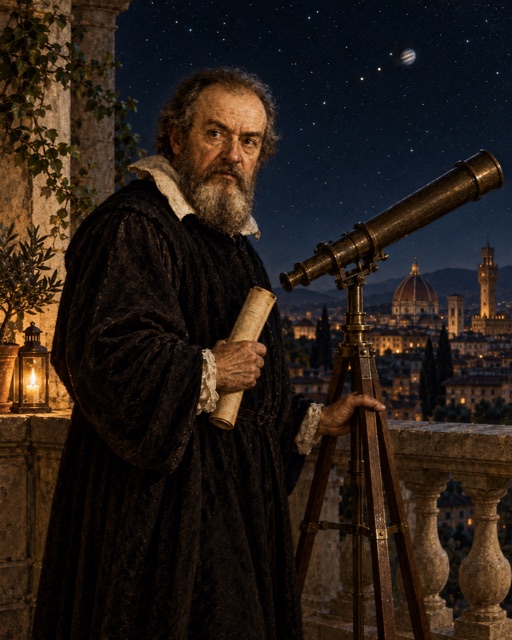
by Galileo · The Witness of the Telescope · Scientific Revolution, 1564-1642
Galileo's late dialogue on strength, scale, motion, and mathematical proof, with source figures preserved near the argument.
- Brutal
- 1638
- ~8 hr read
- 14 chapter guides
- Public domain
Start reading · Read the First Day guide free
Before the text
Editor's Prelude
The Workshop Where Modern Motion Takes Shape
Prepared by the NEXUS Editors
Galileo's last great book begins not beneath the stars but in the Venetian Arsenal, among ropes, beams, ships, pumps, and the hard-earned knowledge of craftsmen. By 1638 he was confined at Arcetri after his trial, blind, and near the end of his life. The manuscript traveled beyond Italy and appeared at Leiden, where the Elzevir press could publish the arguments that gathered decades of work into one audacious conversation.
Three speakers carry that conversation. Salviati develops Galileo's case, Simplicio presses inherited objections, and Sagredo keeps asking what a thoughtful witness should believe. Their first new science asks why structures change their strength when their scale changes. Their second asks how motion can be defined, measured, decomposed, and proved. The detours through infinity, music, vacuum, pendulums, and falling bodies are not idle ornaments: they show a mind testing which familiar experiences can bear mathematical weight.
The figures carry the argument alongside the conversation. Galileo often lets an example awaken the question, then changes pace when a diagram or proportion must do the proving. The deepest drama is methodological. A workshop observation becomes a claim; the claim survives objections; and geometry turns it into something another reader can inspect. Across four days, ordinary motion is made strange enough to become a science.
The opening pages
The Publisher to the Reader
THE PUBLISHER TO THE READER
Since society is held together by the mutual services which men render one to another, and since to this end the arts and sciences have largely contributed, investigations in these fields have always been held in great esteem and have been highly regarded by our wise forefathers. The larger the utility and excellence of the inventions, the greater has been the honor and praise bestowed upon the inventors. Indeed, men have even deified them and have united in the attempt to perpetuate the memory of their benefactors by the bestowal of this supreme honor.
Praise and admiration are likewise due to those clever intellects who, confining their attention to the known, have discovered and corrected fallacies and errors in many and many a proposition enunciated by men of distinction and accepted for ages as fact. Although these men have only pointed out falsehood and have not replaced it by truth, they are nevertheless worthy of commendation when we consider the well-known difficulty of discovering fact, a difficulty which led the prince of orators to exclaim: Utinam tam facile possem vera reperire, quam falsa convincere. And indeed, these latest centuries merit this praise because it is during them that the arts and sciences, discovered by the ancients, have been reduced to so great and constantly increasing perfection through the investigations and experiments of clear-seeing minds. This development is particularly evident in the case of the mathematical sciences. Here, without mentioning various men who have achieved success, we must without hesitation and with the unanimous approval of scholars assign the first place to Galileo Galilei, Member of the Academy of the Lincei. This he deserves not only because he has effectively demonstrated fallacies in many of our current conclusions, as is amply shown by his published works, but also because by means of the telescope (invented in this country but greatly perfected by him) he has discovered the four satellites of Jupiter, has shown us the true character of the Milky Way, and has made us acquainted with spots on the Sun, with the rough and cloudy portions of the lunar surface, with the threefold nature of Saturn, with the phases of Venus and with the physical character of comets. These matters were entirely unknown to the ancient astronomers and philosophers; so that we may truly say that he has restored to the world the science of astronomy and has presented it in a new light.
Chapter guides · 14
First Day
The Arsenal Changes The Question
A workshop problem becomes a law about scale.
What just happened
Salviati begins with craftsmen who already know that a large machine cannot simply be a small machine enlarged. Beams, ships, animals, and plants all meet new limits when their dimensions grow.
Why it matters
Galileo is separating similarity of shape from similarity of strength. Length, area, and volume do not increase at the same rate, so scale itself becomes a physical cause rather than a cosmetic change.
Where the discussion ends
The discussion closes with the rope. Twisting its fibres increases their friction and makes them hold together, so a pull can break the fibres before drawing them apart. Salviati turns this familiar construction into a question about cohesion: how separate parts acquire a strength they do not have when loose.
First Day, Part 4
A Wheel Opens Onto Infinity
The argument about cohesion turns into a daring account of indivisibles.
What just happened
Galileo uses rotating polygons and concentric circles to argue that a continuous line can be understood as composed of infinitely many indivisible points, while the smaller circle's path contains infinitely many indivisible gaps.
The argument at the close
Salviati compares a circle with a circular ring of equal area, using a cone and a cylinder hollowed by a hemisphere. He then pushes the construction to its limiting case: a point on one side and a circle’s rim on the other. At the close, he insists that no finite collection of indivisible parts can form a continuous magnitude; their number must be infinite.
First Day, Continued
Aristotle Meets The Falling Stones
Galileo attacks a proportional law by asking what an experiment would actually show.
First Day, Continued, Part 5
Similarity Has A Breaking Point
Surface and weight change at different rates; pendulums supply another measurable ratio.
Second Day
The Second Day Builds A Science Of Beams
The lever becomes a tool for measuring resistance to fracture.
Second Day, Part 5
A Beam Becomes A Curve
Equal strength requires material to follow the changing stress.
Third Day: Uniform Motion
Motion Gets A Vocabulary
The Third Day begins by defining uniform motion before attempting acceleration.
Third Day: Naturally Accelerated Motion
Acceleration Must Fit Nature
Galileo chooses a definition because its consequences agree with observed fall.
Third Day: Naturally Accelerated Motion, Part 3
The Odd Numbers Reveal The Fall
Equal times produce distances in the sequence 1, 3, 5, 7.
Third Day: Naturally Accelerated Motion, Part 7
Geometry Finds Equal Times
A diagram locates different segments that a falling body crosses in the same time.
Fourth Day: Projectile Motion
Two Motions Make A Parabola
Projectile motion is decomposed into uniform horizontal travel and accelerated vertical fall.
Fourth Day: Projectile Motion, Part 4
Momentum Gets A Resultant
Perpendicular components are joined by the geometry of a right triangle.
Fourth Day, Continued
Proof Turns Toward The Gunner
The parabola becomes a table of ranges, elevations, and terminal speeds.
Fourth Day, Conclusion
The Dialogue Ends With Work Unfinished
A sagging cord points beyond the four completed days.
Questions readers ask
- How long does it take to read Two New Sciences?
- About 8 hr in total.
- How difficult is Two New Sciences?
- Brutal. A long treatise; about 8 hours of reading.
- Which translation is this?
- The Henry Crew and Alfonso de Salvio translation from the Italian / Latin, first published in 1638. The text follows Dialogues Concerning Two New Sciences (1914).
- Can I read Two New Sciences for free?
- Two New Sciences is part of Nexus Premium, so reading it needs an account and a Premium subscription. The opening above and two chapter guides on this page are free to read.
- How many chapter guides are there?
- 14 chapter guides, written by the Nexus editors. Two open in full here; the rest show their opening line.
About Galileo
Galileo Galilei was an Italian astronomer, mathematician, physicist, and writer whose telescopic observations and arguments for heliocentrism became central to the Scientific Revolution. His work joined experiment, mathematics, rhetoric, and institutional conflict.
“What changes when the eye is armed with an instrument?”
Galileo gives Nexus a vivid science profile where discovery, method, rhetoric, and authority collide.
Source text: public domain. Chapter guides: original Nexus writing. Two New Sciences is part of The Nexus Archive, guided Quests through the great works.