 The Nexus Archive
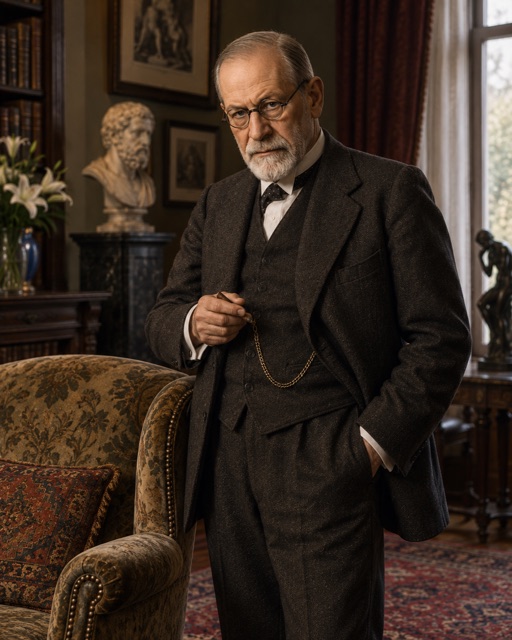
Psychoanalysis · Psychology
Three Contributions to the Theory of Sex
by Freud · The Excavator of the Unconscious · Modern Europe, 1856-1939
Freud's three essays propose a developmental account of sexuality and repeatedly revise its difficult claims.
- Brutal
- ~2 hr 30 min read
- 4 chapter guides
- Public domain
Start reading · Read the 1. DEVIATION IN REFERENCE TO THE SEXUAL OBJECT guide free
Before the text
Editor's Prelude
The Adult Self Has a Childhood
A symptom, a forgotten attachment, a pleasure whose force seems out of proportion: Freud asks how much of adult life is being shaped by a past that memory cannot freely recover. The question unsettles the idea that desire is simple, transparent to its owner, or born fully formed at puberty.
Its disruptive claim is developmental: adult sexuality cannot be understood without infantile life, partial drives, changing objects, and the transformations of puberty.
A. A. Brill’s translation presents a theory still being revised, with prefaces and notes that sometimes qualify the text they accompany. Freud moves between clinical interpretation, observation and conjecture; the distance between them matters. His challenge to familiar certainties coexists with judgments about normality, women and same-sex desire that carry the assumptions of his period. The work’s enduring pressure lies in the difficulty of explaining how a person becomes who they are, without mistaking an ingenious explanation for the whole of a life.
The opening pages
I: THE SEXUAL ABERRATIONS
I
THE SEXUAL ABERRATIONS
The fact of sexual need in man and animal is expressed in biology by the assumption of a "sexual impulse." This impulse is made analogous to the impulse of taking nourishment, and to hunger. The sexual expression corresponding to hunger not being found colloquially, science uses the expression "libido."
Popular conception makes definite assumptions concerning the nature and qualities of this sexual impulse. It is supposed to be absent during childhood and to commence about the time of and in connection with the maturing process of puberty; it is supposed that it manifests itself in irresistible attractions exerted by one sex upon the other, and that its aim is sexual union or at least such actions as would lead to union.
But we have every reason to see in these assumptions a very untrustworthy picture of reality. On closer examination they are found to abound in errors, inaccuracies and hasty conclusions.
If we introduce two terms and call the person from whom the sexual attraction emanates the sexual object, and the action towards which the impulse strives the sexual aim, then the scientifically examined experience shows us many deviations in reference to both sexual object and sexual aim, the relations of which to the accepted standard require thorough investigation.
1. DEVIATION IN REFERENCE TO THE SEXUAL OBJECT
The popular theory of the sexual impulse corresponds closely to the poetic fable of dividing the person into two halves—man and woman—who strive to become reunited through love. It is therefore very surprising to hear that there are men for whom the sexual object is not woman but man, and that there are women for whom it is not man but woman. Such persons are called contrary sexuals, or better, inverts; the condition, that of inversion. The number of such individuals is considerable though difficult of accurate determination.
A. Inversion
The Behavior of Inverts.—The above-mentioned persons behave in many ways quite differently.
(a) They are absolutely inverted; i.e., their sexual object must be always of the same sex, while the opposite sex can never be to them an object of sexual longing, but leaves them indifferent or may even evoke sexual repugnance. As men they are unable, on account of this repugnance, to perform the normal sexual act or miss all pleasure in its performance.
(b) They are amphigenously inverted (psychosexually hermaphroditic); i.e., their sexual object may belong indifferently to either the same or to the other sex. The inversion lacks the character of exclusiveness.
Chapter guides · 4
1. DEVIATION IN REFERENCE TO THE SEXUAL OBJECT
The object is not given with the impulse
Freud questions why desire should be assumed to arrive already directed toward one kind of person.
Two terms that separate a familiar certainty
The sexual object is the person toward whom attraction is directed; the aim is the activity toward which the impulse strives. Freud begins by separating them. The familiar story of two complementary halves seeking reunion does not explain the diversity of attachments that his clinical literature describes.
A classification that fails to settle the cause
Under the historical term inversion, Freud distinguishes exclusive, mixed and occasional same-sex attachments, with different beginnings, durations and attitudes toward the desire itself. He rejects a blanket diagnosis of degeneration and finds neither an entirely innate nor an entirely acquired explanation sufficient. Anatomical variation cannot simply explain a person’s chosen object, and a supposed female brain in a male body only gives the unanswered question another name.
The limits of the comparison
The section also includes adults’ abuse of children and sexual acts with animals among deviations of object. Freud argues that these behaviors cannot be assigned solely to the insane, since he finds related variations among people he otherwise regards as normal. He ends by arguing that the impulse can persist across widely differing objects: for him, the constant element lies in the impulse rather than in a particular object.
EXPLANATION OF THE MANIFEST PREPONDERANCE OF SEXUAL PERVERSIONS IN THE PSYCHONEUROSES
An impulse with several components
Freud connects variations in sexual aims with his account of repression and neurotic symptoms.
Variation and fixation
Touching, looking and other intermediate pleasures can accompany the sexual act Freud treats as normal. He therefore resists making every departure from that norm a disease in itself. Exclusiveness and fixation matter to his distinction: a component may cease to be one part of a larger activity and become its indispensable substitute. Fetishism gives him one example; paired active and passive aims give another.
Symptoms as an indirect expression
In Freud’s account of psychoanalysis, wishes prevented from reaching consciousness can find expression in symptoms. Calling neurosis the negative of perversion means that tendencies acted out in one person may operate through repression in another. His explanation turns on repression and conversion: blocked wishes find expression in bodily symptoms. Looking, being looked at and cruelty become components of an impulse that is no longer treated as a single, simple force.
A redirected current
The prominence of these tendencies in his patients need not, Freud argues, prove an exceptionally strong original predisposition. A blocked current may fill its side channels: frustration and repression could intensify alternative forms of satisfaction. He retains constitutional differences too, making disposition and experience cooperating factors. The particular relation between such differences and the form of illness remains, by his own admission, uninvestigated.
THE SEXUAL AIM OF THE INFANTILE SEXUALITY
Childhood enters the theory
Freud turns from adult symptoms toward the beginnings of pleasure, memory and inhibition.
THE PRIMACY OF THE GENITAL ZONES AND THE FORE-PLEASURE
Development is an organization of pleasures
Freud complicates his account of childhood, then asks how earlier satisfactions enter the sexual life of puberty.
Questions readers ask
- How long does it take to read Three Contributions to the Theory of Sex?
- About 2 hr 30 min in total.
- How difficult is Three Contributions to the Theory of Sex?
- Brutal. A mid-length work of psychology; about 3 hours of reading.
- Which translation is this?
- The A. A. Brill translation from the German, first published in 1905. The text follows Three Contributions to the Theory of Sex, authorized translation by A. A. Brill, second edition, second reprinting (New York and Washington: Nervous and Mental Disease Publishing Co., 1920).
- Can I read Three Contributions to the Theory of Sex for free?
- Three Contributions to the Theory of Sex is part of Nexus Premium, so reading it needs an account and a Premium subscription. The opening above and two chapter guides on this page are free to read.
- How many chapter guides are there?
- 4 chapter guides, written by the Nexus editors. Two open in full here; the rest show their opening line.
About Freud
Sigmund Freud was an Austrian neurologist and the founder of psychoanalysis. Nexus currently stages him through the public-domain English lecture route A General Introduction to Psychoanalysis while further source candidates remain deferred.
“What hidden motives shape thought, speech, and suffering?”
Freud changed psychology, literature, criticism, and modern self-understanding, even where later readers reject or revise him.
Source text: public domain. Chapter guides: original Nexus writing. Three Contributions to the Theory of Sex is part of The Nexus Archive, guided Quests through the great works.