 The Nexus Archive
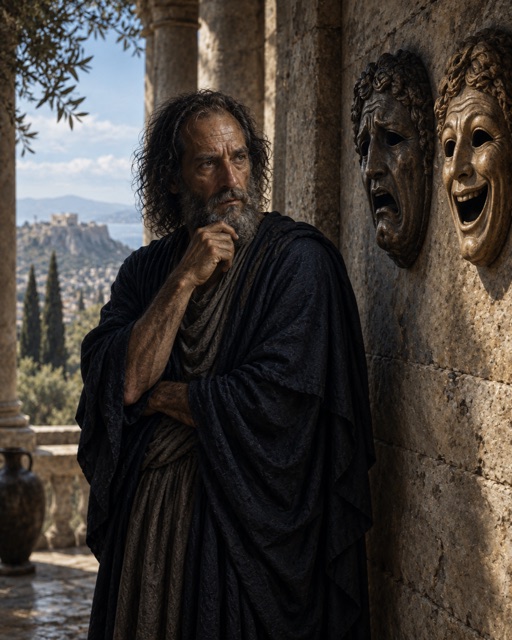
Greek Tragedy · Play
The Alcestis of Euripides
by Euripides · The Unsettler of the Stage · Classical Athens, c. 480-406 BCE
Alcestis gives her life for Admetus, and Euripides tests hospitality, grief, substitution, and the cost of miraculous return.
- Advanced
- ~1 hr read
- 2 chapter guides
- Public domain
Start reading · Read the Introduction guide free
Before the text
Editor's Prelude
The Life Another Gives
A king has been promised escape from death if someone else will die for him. Only his wife has consented. Euripides begins with the bargain already made: Admetus can live, but Alcestis must leave the sunlight, her home and their children. What looks like a gift from the gods has made the household a place of approaching loss.
The play sets the language of devotion beside the demands that love makes on another life. Gratitude, grief and self-preservation can inhabit the same person. Alcestis has wishes of her own, and the children and servants belong to a household whose suffering cannot be measured by the king's alone.
Gilbert Murray's rhyming translation gives the speeches a formal music without making their feelings orderly. Gods and mortals share the stage; mourning stands close to the obligations of hospitality. The uneasiness comes from virtues that do not settle easily together: keeping faith with a guest, caring for a family, and facing the cost of being saved.
The opening pages
Title Page
THE ALCESTIS
OF
EURIPIDES
TRANSLATED INTO ENGLISH RHYMING VERSE
WITH EXPLANATORY NOTES BY
GILBERT MURRAY
LL.D., D.LITT., F.B.A.
REGIUS PROFESSOR OF GREEK IN THE UNIVERSITY OF OXFORD
1915
Characters of the Play
ADMÊTUS, King of Pherae in Thessaly.
ALCESTIS, daughter of Pelias, his wife.
PHERÊS, his father, formerly King but now in retirement.
TWO CHILDREN, his son and daughter.
A MANSERVANT in his house.
A HANDMAID.
The Hero HERACLES.
The God APOLLO.
THÁNATOS or DEATH.
CHORUS, consisting of Elders of Pherae.
"The play was first performed when Glaukînos was Archon, in the 2nd year of the 85th Olympiad (438 B.C.). Sophocles was first, Euripides second with the Cretan Women, Alcmaeon in Psophis, Telephus and Alcestis…. The play is somewhat Satyric in character."
The Play — Part 1
ALCESTIS
The scene represents the ancient Castle of ADMETUS near Pherae in Thessaly. It is the dusk before dawn; APOLLO, radiant in the darkness, looks at the Castle.
APOLLO.
Admetus' House! 'Twas here I bowed my head
Of old, and chafed not at the bondman's bread,
Though born in heaven. Aye, Zeus to death had hurled
My son, Asclepios, Healer of the World,
Piercing with fire his heart; and in mine ire
I slew his Cyclop churls, who forged the fire.
Whereat Zeus cast me forth to bear the yoke
Of service to a mortal. To this folk
I came, and watched a stranger's herd for pay,
And all his house I have prospered to this day.
For innocent was the Lord I chanced upon
And clean as mine own heart, King Pheres' son,
Admetus. Him I rescued from the grave,
Beguiling the Grey Sisters till they gave
A great oath that Admetus should go free,
Would he but pay to Them Below in fee
Another living soul. Long did he prove
All that were his, and all that owed him love,
But never a soul he found would yield up life
And leave the sunlight for him, save his wife:
Who, even now, down the long galleries
Is borne, death-wounded; for this day it is
She needs must pass out of the light and die.
And, seeing the stain of death must not come nigh
My radiance, I must leave this house I love.
But ha! The Headsman of the Pit, above
Earth's floor, to ravish her! Aye, long and late
He hath watched, and cometh at the fall of fate.
Enter from the other side THANATOS; a crouching black-haired and winged figure, carrying a drawn sword. He starts in revulsion on seeing APOLLO.
Chapter guides · 2
Introduction
Murray's Uneasy Admetus
The translator reads the play's mixture of sorrow and comedy as a way of bringing heroic figures close enough to judge.
Beyond an ideal husband
Murray challenges criticism that treats an unpleasing character as a failure of characterization. His Admetus is affectionate and generous, yet spoilt and capable of hiding selfishness behind beautiful sentiments. Those qualities can coexist; sympathy need not make the husband exemplary.
A place for Heracles
The Introduction relates the play to its position after three tragedies, where a satyr-play would ordinarily stand. Murray uses that tradition to explain the presence of the revelling Heracles and the collision of heroic speech with a less solemn world.
Interpretation with reservations
Murray finds a process of self-discovery in Admetus, but qualifies how completely a person learns such a lesson. He also acknowledges rival readings and ends by recalling the beauty of the writing, which critical argument can obscure.
Characters of the Play
A Household and Its Witnesses
The cast gathers family, servants, elders, a hero and divine powers around the house of Admetus.
Questions readers ask
- How long does it take to read The Alcestis of Euripides?
- About 1 hr in total.
- How difficult is The Alcestis of Euripides?
- Advanced. A mid-length play; about an hour of reading.
- Which translation is this?
- The Gilbert Murray translation from the Ancient Greek. The text follows The Alcestis of Euripides, Translated into English Rhyming Verse with Explanatory Notes (London: George Allen & Unwin, 1915), checked against its June 1922 reprint.
- Can I read The Alcestis of Euripides for free?
- The Alcestis of Euripides is part of Nexus Premium, so reading it needs an account and a Premium subscription. The opening above and one chapter guide on this page are free to read.
- How many chapter guides are there?
- 2 chapter guides, written by the Nexus editors. One opens in full here; the rest show their opening line.
About Euripides
Euripides was one of classical Athens' great tragedians, younger than Aeschylus and Sophocles. His surviving plays often bring outsiders, women, captives, and wounded households to the center of the stage, giving ancient myth a severe psychological pressure.
“What happens when a person who has been used and discarded still has power?”
Euripides gives Nexus tragedy with an unstable charge: argument, humiliation, intelligence, and pain moving toward consequences no audience can comfortably admire.
Source text: public domain. Chapter guides: original Nexus writing. The Alcestis of Euripides is part of The Nexus Archive, guided Quests through the great works.