 The Nexus Archive
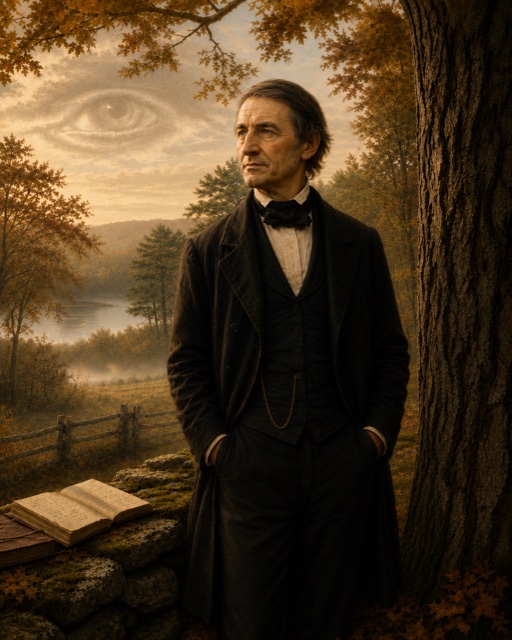
Transcendentalism · Essay
Essays: Second Series
by Emerson · The Voice of Self-Reliance · 19th-century America, 1803-1882
Nine later essays on poetic making, experience, character, manners, nature, politics, and reform.
- Advanced
- ~4 hr 15 min read
- 1 chapter guide
- Public domain
Start reading · Read the GIFTS guide free
Before the text
Editor's Prelude
After Self-Reliance
The second series begins where easy confidence ends. The poet may name the world, but experience keeps slipping from possession; character matters, yet circumstance and temperament resist command.
Emerson’s sentences still rise toward revelation, but these essays are more weathered by grief, limitation, manners, politics, and reform’s disappointments.
A conversation, a landscape, an unwelcome obligation or a gift can become the place where a large conviction meets its limits. These nine essays move by encounters and changes of perspective rather than a single system. Emerson’s faith in the individual is continually exposed to the difficulty of living with other people.
The opening pages
THE POET
I. THE POET.
A moody child and wildly wise
Pursued the game with joyful eyes,
Which chose, like meteors, their way,
And rived the dark with private ray:
They overleapt the horizon’s edge,
Searched with Apollo’s privilege;
Through man, and woman, and sea, and star
Saw the dance of nature forward far;
Through worlds, and races, and terms, and times
Saw musical order, and pairing rhymes.
Olympian bards who sung
Divine ideas below,
Which always find us young,
And always keep us so.
Those who are esteemed umpires of taste are often persons who have acquired some knowledge of admired pictures or sculptures, and have an inclination for whatever is elegant; but if you inquire whether they are beautiful souls, and whether their own acts are like fair pictures, you learn that they are selfish and sensual. Their cultivation is local, as if you should rub a log of dry wood in one spot to produce fire, all the rest remaining cold. Their knowledge of the fine arts is some study of rules and particulars, or some limited judgment of color or form, which is exercised for amusement or for show. It is a proof of the shallowness of the doctrine of beauty as it lies in the minds of our amateurs, that men seem to have lost the perception of the instant dependence of form upon soul. There is no doctrine of forms in our philosophy. We were put into our bodies, as fire is put into a pan to be carried about; but there is no accurate adjustment between the spirit and the organ, much less is the latter the germination of the former. So in regard to other forms, the intellectual men do not believe in any essential dependence of the material world on thought and volition. Theologians think it a pretty air-castle to talk of the spiritual meaning of a ship or a cloud, of a city or a contract, but they prefer to come again to the solid ground of historical evidence; and even the poets are contented with a civil and conformed manner of living, and to write poems from the fancy, at a safe distance from their own experience. But the highest minds of the world have never ceased to explore the double meaning, or shall I say the quadruple or the centuple or much more manifold meaning, of every sensuous fact; Orpheus, Empedocles, Heraclitus, Plato, Plutarch, Dante, Swedenborg, and the masters of sculpture, picture, and poetry. For we are not pans and barrows, nor even porters of the fire and torch-bearers, but children of the fire, made of it, and only the same divinity transmuted and at two or three removes, when we know least about it. And this hidden truth, that the fountains whence all this river of Time and its creatures floweth are intrinsically ideal and beautiful, draws us to the consideration of the nature and functions of the Poet, or the man of Beauty; to the means and materials he uses, and to the general aspect of the art in the present time.
Chapter guides · 1
GIFTS
What one person can give
Poetic vision, grief, character and courtesy meet the difficulty of giving another person something that is truly one’s own.
Expression and the distance from experience
In The Poet, expression is part of being human, not an ornament added to life. Emerson’s ideal poet discovers relations in ordinary things and releases thought from fixed meanings; the distinction lies in a shaping vision rather than a facility with meter. Experience tests the hope of such intimate knowledge. Even his son’s death has not brought Emerson the contact with reality that he expected from grief. Changing moods and temperament stand between the self and what happens to it. This disturbing admission does not settle into despair. The essay ends in patience and renewed effort: there is victory yet for all justice, and the true romance the world exists to realize is the transformation of genius into practical power.
A force that cannot be itemized
Character locates a person’s influence in something more enduring than a list of achievements or charitable acts. Emerson describes a reserve of moral force that can make a presence decisive before any speech is delivered. He ends by calling for thankful recognition of self-denying love and integrity when they appear in another person. Manners brings the question into company, where self-possession must coexist with attention to others. Polished society can cultivate this balance, but rank and expensive surroundings do not guarantee it. Emerson ends with a fable rather than a verdict: Silenus overhears Jove talking of destroying the earth, and Minerva answers that its ridiculous little creatures look bad or good according to what one calls them.
The gift and the debt
Gifts makes the difficulty small enough to hold in a hand. Necessity may give a present its obvious purpose, but a gift between friends should also carry something of the giver’s life: a poem, a harvest, a piece of work. Receiving can nevertheless feel like dependence, while the giver’s demand for gratitude turns generosity into a claim. Emerson does not solve this by prescribing a perfect object. His closing distinction is between services that attempt to purchase attachment and the mutual goodwill in which giving need not keep accounts. Love cannot be manufactured by a transaction.
Questions readers ask
- How long does it take to read Essays: Second Series?
- About 4 hr 15 min in total.
- How difficult is Essays: Second Series?
- Advanced. A long essay; about 4 hours of reading.
- Can I read Essays: Second Series for free?
- Essays: Second Series is part of Nexus Premium, so reading it needs an account and a Premium subscription. The opening above and one chapter guide on this page are free to read.
- How many chapter guides are there?
- One chapter guide, written by the Nexus editors; it opens in full here.
About Emerson
Ralph Waldo Emerson was an American essayist, lecturer, and central figure of Transcendentalism. Nexus stages his source works through self-reliance, nature, intuition, and the independence of the mind.
“What would it mean to trust the mind before convention?”
Emerson helped define a major American language of individual judgment, nature, and intellectual independence.
Source text: public domain. Chapter guides: original Nexus writing. Essays: Second Series is part of The Nexus Archive, guided Quests through the great works.