 The Nexus Archive
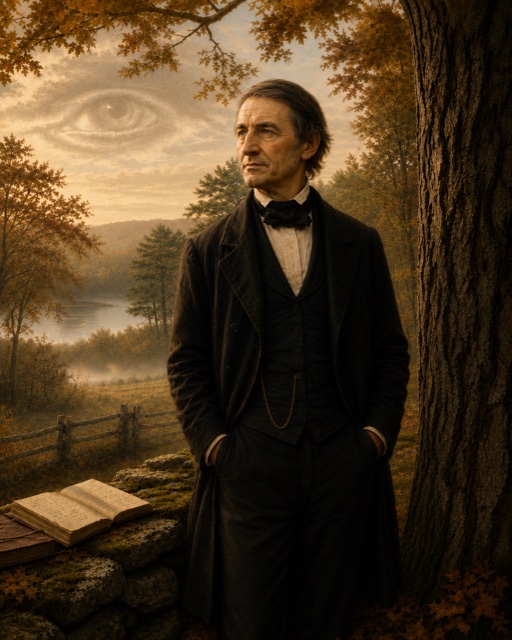
Transcendentalism · Address
An Address Delivered Before the Senior Class in Divinity College, Cambridge, Sunday Evening, 15 July, 1838
by Emerson · The Voice of Self-Reliance · 19th-century America, 1803-1882
Emerson's 1838 address challenges future ministers to recover immediate religious experience from inherited forms.
- Advanced
- ~35 min read
- 2 chapter guides
- Public domain
Start reading · Read the Title Page guide free
Before the text
Editor's Prelude
A Sermon against Secondhand Faith
A preacher speaks indoors while a snowstorm moves outside, and Emerson finds more life in the weather than in the sermon. The preacher has left his own loves, losses and doubts out of his words. When Emerson addressed the senior class at Harvard Divinity School in July 1838, this failure mattered urgently: his listeners were preparing to speak to other people about the life of the soul.
His alternative is not a new creed but immediate moral and spiritual perception—the soul encountering the divine law alive in nature and conscience. He honors Jesus as someone who spoke from that perception, while accusing the churches of making Jesus's person an obstacle to others' experience of it. Religious authority, on this account, cannot relieve anyone of the responsibility to discover what is true in their own life.
The attack comes from a speaker who still prizes worship, the Sabbath and the human possibilities of preaching. Emerson wants existing forms renewed by people whose words have been tested in living. His confidence is immense: he trusts the soul to find a moral order shared by nature and humanity. The address places that confidence beside the loneliness and courage of speaking without another person's authority to shelter behind.
The opening pages
Title Page
AN
ADDRESS
DELIVERED
BEFORE THE SENIOR CLASS
IN
DIVINITY COLLEGE, CAMBRIDGE,
SUNDAY EVENING, 15 JULY, 1838.
By RALPH WALDO EMERSON.
BOSTON: JAMES MUNROE AND COMPANY. 1838.
CAMBRIDGE PRESS:
METCALF, TORRY, AND BALLOU.
Address
ADDRESS.
In this refulgent summer it has been a luxury to draw the breath of life. The grass grows, the buds burst, the meadow is spotted with fire and gold in the tint of flowers. The air is full of birds, and sweet with the breath of the pine, the balm-of-Gilead, and the new hay. Night brings no gloom to the heart with its welcome shade. Through the transparent darkness pour the stars their almost spiritual rays. Man under them seems a young child, and his huge globe a toy. The cool night bathes the world as with a river, and prepares his eyes again for the crimson dawn. The mystery of nature was never displayed more happily. The corn and the wine have been freely dealt, to all creatures, and the never-broken silence with which the old bounty goes forward, has not yielded yet one word of explanation. One is constrained to respect the perfection of this world, in which our senses converse. How wide; how rich; what invitation from every property it gives to every faculty of man! In its fruitful soils; in its navigable sea; in its mountains of metal and stone; in its forests of all woods; in its animals; in its chemical ingredients; in the powers and path of light, heat, attraction, and life, is it well worth the pith and heart of great men to subdue and enjoy it. The planters, the mechanics, the inventors, the astronomers, the builders of cities, and the captains, history delights to honor.
But the moment the mind opens, and reveals the laws which traverse the universe, and make things what they are, then shrinks the great world at once into a mere illustration and fable of this mind. What am I? and What is? asks the human spirit with a curiosity new-kindled, but never to be quenched. Behold these outrunning laws, which our imperfect apprehension can see tend this way and that, but not come full circle. Behold these infinite relations, so like, so unlike; many, yet one. I would study, I would know, I would admire forever. These works of thought have been the entertainments of the human spirit in all ages.
A more secret, sweet, and overpowering beauty appears to man when his heart and mind open to the sentiment of virtue. Then instantly he is instructed in what is above him. He learns that his being is without bound; that, to the good, to the perfect, he is born, low as he now lies in evil and weakness. That which he venerates is still his own, though he has not realized it yet. He ought. He knows the sense of that grand word, though his analysis fails entirely to render account of it. When in innocency, or when by intellectual perception, he attains to say,—‘I love the Right; Truth is beautiful within and without, forevermore. Virtue, I am thine: save me: use me: thee will I serve, day and night, in great, in small, that I may be not virtuous, but virtue;’—then is the end of the creation answered, and God is well pleased.
Chapter guides · 2
Title Page
The Occasion in Print
The opening leaf fixes the speaker, audience and date, then names the publisher and printers.
A particular audience
Ralph Waldo Emerson delivered the address before the senior class in Divinity College, Cambridge, on Sunday evening, 15 July 1838.
The Boston imprint
James Munroe and Company published the address in Boston in 1838. The imprint gives the spoken occasion a second identity as a printed work.
The Cambridge printers
The separate printer statement names Cambridge Press and Metcalf, Torry, and Ballou. Publisher and printer appear as distinct participants in the making of the pamphlet.
Address
Faith That Must Be Lived
Emerson asks future ministers to speak from moral experience and bring inherited forms of worship back to life.
Questions readers ask
- How long does it take to read An Address Delivered Before the Senior Class in Divinity College, Cambridge, Sunday Evening, 15 July, 1838?
- About 35 min in total.
- How difficult is An Address Delivered Before the Senior Class in Divinity College, Cambridge, Sunday Evening, 15 July, 1838?
- Advanced. A short address; about 35 minutes of reading.
- Which edition is this?
- The original English text, first published in 1838. The text follows An Address Delivered Before the Senior Class in Divinity College, Cambridge (Boston: James Munroe and Company, 1838).
- Can I read An Address Delivered Before the Senior Class in Divinity College, Cambridge, Sunday Evening, 15 July, 1838 for free?
- An Address Delivered Before the Senior Class in Divinity College, Cambridge, Sunday Evening, 15 July, 1838 is part of Nexus Premium, so reading it needs an account and a Premium subscription. The opening above and one chapter guide on this page are free to read.
- How many chapter guides are there?
- 2 chapter guides, written by the Nexus editors. One opens in full here; the rest show their opening line.
About Emerson
Ralph Waldo Emerson was an American essayist, lecturer, and central figure of Transcendentalism. Nexus stages his source works through self-reliance, nature, intuition, and the independence of the mind.
“What would it mean to trust the mind before convention?”
Emerson helped define a major American language of individual judgment, nature, and intellectual independence.
Source text: public domain. Chapter guides: original Nexus writing. An Address Delivered Before the Senior Class in Divinity College, Cambridge, Sunday Evening, 15 July, 1838 is part of The Nexus Archive, guided Quests through the great works.