 The Nexus Archive
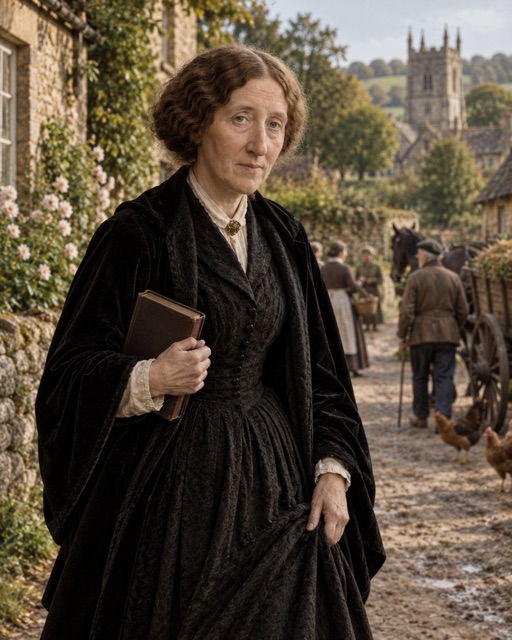
English Novel · Novel
Adam Bede
by George Eliot · The Moral Cartographer · Victorian England, 1819-1880
George Eliot sets desire, error, judgment, and compassion inside the working life of a rural community.
- Advanced
- ~16 hr read
- 5 chapter guides
- Public domain
Start reading · Read the Chapter IX Hetty’s World guide free
Before the text
Editor's Prelude
The Heart Behind the Work
A carpenter can judge a faulty joint more readily than a hopeful glance. In Hayslope, an English village in 1799, Adam Bede’s skill and strength give him a place of trust. But the young woman he loves dreams of a life far beyond the farm where she works, and the heir to the local estate enjoys being admired. Their desires move through a community in which everyone seems to know everyone.
George Eliot’s first novel, published in 1859, makes that familiar world tangible: a workshop’s shavings, the cool dairy, a harvest supper, a mother’s persistent complaints. Its narrator talks directly to us, sometimes pausing the story to dispute the judgments that beauty, rank, or religious belief can make too easy.
Dinah Morris, a Methodist preacher who earns her living in a cotton mill, brings another kind of attention to this world. Her readiness to share suffering stands beside Adam’s faith in useful work. Eliot asks what it takes to understand another person, and what sympathy can do when a deed’s consequences reach beyond the person who chose it.
The opening pages
Book First: Chapter I The Workshop
With a single drop of ink for a mirror, the Egyptian sorcerer undertakes to reveal to any chance comer far-reaching visions of the past. This is what I undertake to do for you, reader. With this drop of ink at the end of my pen, I will show you the roomy workshop of Mr. Jonathan Burge, carpenter and builder, in the village of Hayslope, as it appeared on the eighteenth of June, in the year of our Lord 1799.
The afternoon sun was warm on the five workmen there, busy upon doors and window-frames and wainscoting. A scent of pine-wood from a tentlike pile of planks outside the open door mingled itself with the scent of the elder-bushes which were spreading their summer snow close to the open window opposite; the slanting sunbeams shone through the transparent shavings that flew before the steady plane, and lit up the fine grain of the oak panelling which stood propped against the wall. On a heap of those soft shavings a rough, grey shepherd dog had made himself a pleasant bed, and was lying with his nose between his fore-paws, occasionally wrinkling his brows to cast a glance at the tallest of the five workmen, who was carving a shield in the centre of a wooden mantelpiece. It was to this workman that the strong barytone belonged which was heard above the sound of plane and hammer singing—
Awake, my soul, and with the sun
Thy daily stage of duty run;
Shake off dull sloth...
Here some measurement was to be taken which required more concentrated attention, and the sonorous voice subsided into a low whistle; but it presently broke out again with renewed vigour—
Let all thy converse be sincere,
Thy conscience as the noonday clear.
Such a voice could only come from a broad chest, and the broad chest belonged to a large-boned, muscular man nearly six feet high, with a back so flat and a head so well poised that when he drew himself up to take a more distant survey of his work, he had the air of a soldier standing at ease. The sleeve rolled up above the elbow showed an arm that was likely to win the prize for feats of strength; yet the long supple hand, with its broad finger-tips, looked ready for works of skill. In his tall stalwartness Adam Bede was a Saxon, and justified his name; but the jet-black hair, made the more noticeable by its contrast with the light paper cap, and the keen glance of the dark eyes that shone from under strongly marked, prominent and mobile eyebrows, indicated a mixture of Celtic blood. The face was large and roughly hewn, and when in repose had no other beauty than such as belongs to an expression of good-humoured honest intelligence.
Chapter guides · 5
Chapter IX Hetty’s World
A Dream Beyond the Farm
Arthur’s attention draws Hetty’s thoughts away from the people who care for her.
The future Hetty wants
Hetty admires Adam’s ability and enjoys his devotion, but she dreams of fine clothes, comfort, and freedom from work. Arthur’s looks and visits have filled her imagination. Now she begins picturing a meeting with him in the Chase the next day.
A warning on horseback
Arthur admits to Irwine that he went into the dairy to see Hetty. Irwine warns him against feeding her vanity and expectations of a gentleman’s attention. Arthur claims no present need for that advice, then proposes a canter. The conversation falls silent until they reach Adam’s cottage.
Chapter XIX Adam on a Working Day
Strength Turned to Work
Adam’s hopes take the shape of a practical plan, while Eliot looks beyond one remarkable workman.
A cupboard and a home
Adam mistakes Hetty’s sadness over Arthur’s absence for sympathy with his own bereavement. With fewer demands on his earnings, marriage seems nearer. He plans a small furniture business with Seth, beginning with a kitchen cupboard whose useful details he can calculate.
The work that remains
At the building site, private feeling becomes energy for measuring, lifting, and guiding other hands. Eliot ends by placing Adam among the skilled, conscientious artisans whose work lasts beyond them. Some prosper and some die poor; their value lies in the useful things they leave and the trust they earn.
Chapter XXVIII A Dilemma
A Promise in the Hermitage
Relief after the fight leaves Adam and Arthur facing the harm that brought them there.
Chapter XXXVII The Journey in Despair
Between Death and Disclosure
Hetty’s fear of shame keeps her wandering, while her need to live keeps drawing her toward help.
Chapter XLVII The Last Moment
The Horseman in the Crowd
Dinah stays beside Hetty as the execution cart approaches its destination.
Questions readers ask
- How long does it take to read Adam Bede?
- About 16 hr in total.
- How difficult is Adam Bede?
- Advanced. A long novel; about 16 hours of reading.
- Can I read Adam Bede for free?
- Adam Bede is part of Nexus Premium, so reading it needs an account and a Premium subscription. The opening above and two chapter guides on this page are free to read.
- How many chapter guides are there?
- 5 chapter guides, written by the Nexus editors. Two open in full here; the rest show their opening line.
About George Eliot
George Eliot was the pen name of Mary Ann Evans, a Victorian novelist whose fiction studies conscience, sympathy, community, marriage, intellectual ambition, and the social consequences of private choices.
“How much of a life can be changed by learning to see another person clearly?”
Eliot gives Nexus one of the great novelistic forms of moral attention: the patient tracing of how hidden motives, social pressure, and small acts shape whole lives.
Source text: public domain. Chapter guides: original Nexus writing. Adam Bede is part of The Nexus Archive, guided Quests through the great works.