 The Nexus Archive
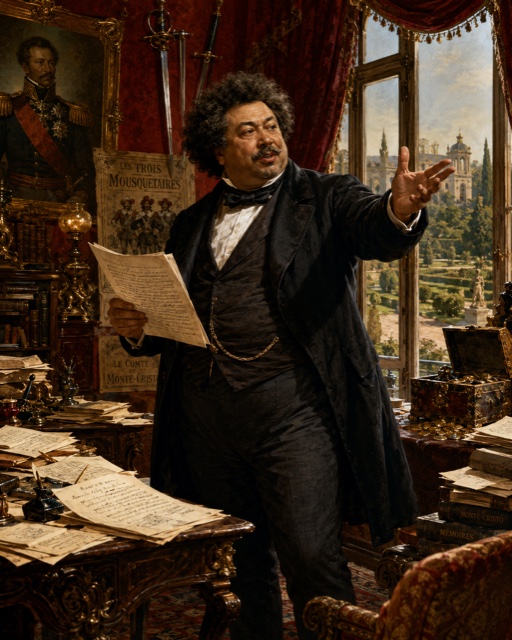
French Historical Romance · Novel
The Three Musketeers
by Dumas · The Master of Adventure · 19th-century France, 1802-1870
Dumas's full adventure novel of D'Artagnan, the Musketeers, court intrigue, friendship, and action.
- Advanced
- 1844
- ~17 hr 30 min read
- 17 chapter guides
- Public domain
Start reading · Read the Chapter I guide free
Before the text
Editor's Prelude
The Three Musketeers
Alexandre Dumas published The Three Musketeers in 1844 as a newspaper serial, built for momentum: cliffhangers, disguises, duels, secrets, jokes, reversals, and scenes that seem to leap from one danger to the next. He wrote with Auguste Maquet's historical plotting behind him and his own theatrical gift in full command. The result is not a quiet historical novel. It is adventure with a pulse.
Dumas sets the story in the France of Louis XIII and Cardinal Richelieu, but the historical machinery is there to create pressure around youth, ambition, friendship, and performance. D'Artagnan arrives with a ridiculous horse, a bruised pride, and a letter of introduction. From that comic entrance, he is pulled into a world where honor can be noble or foolish, loyalty can save a life or ruin one, and a private insult can become part of a national intrigue.
The famous bond of the musketeers is tested by vanity, money, desire, politics, and revenge. Dumas gives the pleasure of daring action while steadily darkening its cost. A quick-witted scheme can rescue a friend or place another life in danger. The laughter and the danger belong to the same world.
The opening pages
Chapter I: The Three Presents of D'Artagnan the Elder
On the first Monday of the month of April, 1625, the market town of Meung, in which the author of Romance of the Rose was born, appeared to be in as perfect a state of revolution as if the Huguenots had just made a second La Rochelle of it. Many citizens, seeing the women flying toward the High Street, leaving their children crying at the open doors, hastened to don the cuirass, and supporting their somewhat uncertain courage with a musket or a partisan, directed their steps toward the hostelry of the Jolly Miller, before which was gathered, increasing every minute, a compact group, vociferous and full of curiosity.
In those times panics were common, and few days passed without some city or other registering in its archives an event of this kind. There were nobles, who made war against each other; there was the king, who made war against the cardinal; there was Spain, which made war against the king. Then, in addition to these concealed or public, secret or open wars, there were robbers, mendicants, Huguenots, wolves, and scoundrels, who made war upon everybody. The citizens always took up arms readily against thieves, wolves or scoundrels, often against nobles or Huguenots, sometimes against the king, but never against the cardinal or Spain. It resulted, then, from this habit that on the said first Monday of April, 1625, the citizens, on hearing the clamor, and seeing neither the red-and-yellow standard nor the livery of the Duc de Richelieu, rushed toward the hostel of the Jolly Miller. When arrived there, the cause of the hubbub was apparent to all.
A young man—we can sketch his portrait at a dash. Imagine to yourself a Don Quixote of eighteen; a Don Quixote without his corselet, without his coat of mail, without his cuisses; a Don Quixote clothed in a woolen doublet, the blue color of which had faded into a nameless shade between lees of wine and a heavenly azure; face long and brown; high cheek bones, a sign of sagacity; the maxillary muscles enormously developed, an infallible sign by which a Gascon may always be detected, even without his cap—and our young man wore a cap set off with a sort of feather; the eye open and intelligent; the nose hooked, but finely chiseled. Too big for a youth, too small for a grown man, an experienced eye might have taken him for a farmer’s son upon a journey had it not been for the long sword which, dangling from a leather baldric, hit against the calves of its owner as he walked, and against the rough side of his steed when he was on horseback.
Read it in a Quest
A passage through adventure, secrecy, symbolic pursuit, and obsession's moral cost.
Chapter guides · 17
Chapter I
A young Gascon sets out
D’Artagnan reaches Paris with his pride intact and his letter of introduction missing.
A quarrel at Meung
D’Artagnan leaves home with a yellow horse, fifteen crowns and a letter to Tréville, captain of the king’s Musketeers. At Meung, a stranger’s laughter provokes him into a fight. The innkeeper and his men beat him, and his sword breaks. He later overhears the stranger sending Milady to England to watch a duke’s movements.
Paris without the letter
After treating his wounds, D’Artagnan discovers that the letter is gone. The innkeeper blames the stranger. D’Artagnan pays his bill, rides to Paris and sells his horse. He rents a garret, repairs his sword and adds braid to his clothes. Tréville’s house is nearby. Full of hope, he sleeps late and then sets out to visit him.
Chapter V
Four men against five
D’Artagnan joins the men he came to fight when the cardinal’s Guards threaten to arrest them.
The fourth man
When Jussac's Guards interrupt the first duel, D'Artagnan is free to withdraw. He instead chooses Athos, Porthos, and Aramis, fights beside them, and helps turn threatened arrest into an arm-in-arm public triumph. Fellowship begins as a decision under pressure, not as instant affection.
A shared victory
D’Artagnan wounds Jussac and helps the wounded Athos by disarming Cahusac. The four friends overcome the five Guards. Bicarat fights on alone until Jussac orders him to stop; he breaks his sword instead of surrendering it. After helping carry the wounded to the convent, the victors walk arm in arm toward Tréville’s house. D’Artagnan has found companions before he has won a Musketeer’s uniform.
Chapter XI
A jealous pursuit
D’Artagnan’s pursuit of Constance brings him into Buckingham’s secret visit to the queen.
Chapter XVI
The queen under threat
A forced search fails to uncover a love letter, but Richelieu prepares another test.
Chapter XX
The road to England
D’Artagnan reaches Buckingham after losing his friends to fights, wounds and delays.
Chapter XXII
Twelve diamonds at the ball
Anne’s appearance defeats Richelieu’s plan to expose her gift to Buckingham.
Chapter XXVII
Athos’s story
Athos tells D’Artagnan of a marriage that ended in violence.
Chapter XXXVII
The brand on Milady’s shoulder
D’Artagnan’s confession turns a secret affair into a fight for his life.
Chapter XLI
Assassins at the siege
Milady’s hired killers follow D’Artagnan into the war at La Rochelle.
Chapter XLVII
Breakfast under fire
The friends defend a ruined bastion while planning how to stop Milady.
Chapter XLIX
Milady is taken prisoner
At Portsmouth, a polite reception carries Milady into Lord de Winter’s power.
Chapter LVI
Milady works on her jailer
Milady turns Felton’s religious faith and pity into reasons to distrust Lord de Winter.
Chapter LIX
Buckingham is murdered
Felton kills the duke and discovers that Milady has left him behind.
Chapter LXI
A friend at the convent
Milady wins Constance’s trust while the Musketeers hurry toward Béthune.
Chapter LXIII
The rescue comes too late
Milady poisons Constance when her plan to take her away fails.
Chapter LXVI
The execution on the Lys
The pursuers put Milady to death despite her demand for a lawful tribunal.
Epilogue
The friends go their separate ways
D’Artagnan gains command as the companions begin new lives.
Questions readers ask
- How long does it take to read The Three Musketeers?
- About 17 hr 30 min in total.
- How difficult is The Three Musketeers?
- Advanced. A long novel; about 17 hours of reading.
- Which translation is this?
- The Translator unidentified in Project Gutenberg source witness translation from the French, first published in 1844. The text follows Project Gutenberg #1257, The Three Musketeers.
- Can I read The Three Musketeers for free?
- The Three Musketeers is part of Nexus Premium, so reading it needs an account and a Premium subscription, and completing an earlier Quest's Mastery. The opening above and two chapter guides on this page are free to read.
- How many chapter guides are there?
- 17 chapter guides, written by the Nexus editors. Two open in full here; the rest show their opening line.
About Dumas
Alexandre Dumas was a French novelist and dramatist whose historical romances became some of the most widely read adventure fiction in the world. Nexus stages him through the Musketeer sequence and The Count of Monte Cristo while preserving current source caveats where the Project Gutenberg English translator is unidentified.
“What does courage become when every insult can turn into a story?”
Dumas shaped the popular historical romance and gave later fiction one of its great models of momentum, loyalty, and swashbuckling moral pressure.
Source text: public domain. Chapter guides: original Nexus writing. The Three Musketeers is part of The Nexus Archive, guided Quests through the great works.