 The Nexus Archive
Civil Rights Thought · Biography
John Brown
by W. E. Burghardt Du Bois
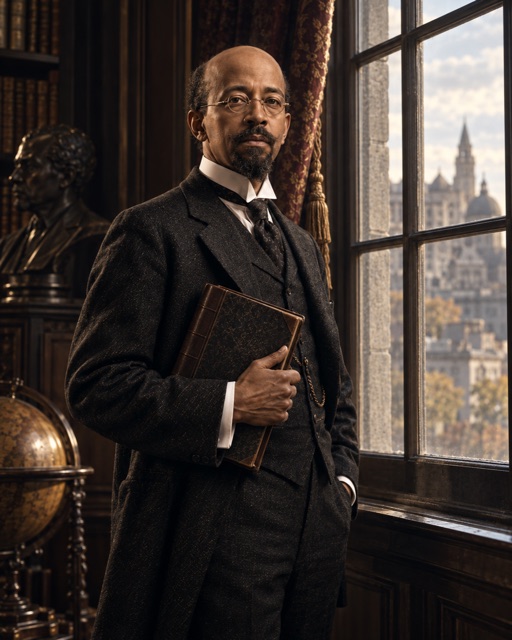
Featuring W. E. B. Du Bois
Du Bois places John Brown's life inside the history of slavery, resistance, political failure, and the unfinished struggle over emancipation.
- Advanced
- ~7 hr read
- 3 chapter guides
- Public domain
Start reading · Read the Chapter V — The Vision of the Damned — Part 1 guide free
Before the text
Editor's Prelude
The Raid Seen from the Long History
W. E. B. Du Bois published John Brown in 1909, when Jim Crow laws and racial violence were closing doors that emancipation had opened. He sets Brown's life within a struggle already being fought by enslaved people, fugitives, and Black abolitionists. Brown's friendships with them matter as much as his hatred of slavery.
This is a biography with an argument. Letters, family memories, and accounts from allies and opponents bring a stern, tender, often difficult man into view. Du Bois admires his willingness to act, and he also shows what that devotion cost Brown's family and followers.
For Du Bois, slavery's end has left a question unsettled: whether a country that calls itself free will allow all its people to become free. Brown's life makes that question personal. Belief has to meet work, money, family, danger, and the limits of one person's power.
The opening pages
Chronology
CHRONOLOGY
Boyhood and Youth
1800—John Brown is born in Torrington, Conn., May 9th. Attempted insurrection of slaves under Gabriel in Virginia, in September.
1805—The family migrates to Ohio.
1812—John Brown meets a slave boy.
1816—He joins the church.
1819—He attends school at Plainfield, Mass.
The Tanner
1819–1825—John Brown works as a tanner at Hudson, O.
1821—He marries Dianthe Lusk, June 21st.
1822—Attempted slave insurrection in South Carolina in June.
1825–1835—He works as a tanner at Randolph, Pa., and is postmaster.
1831—Nat Turner’s insurrection, in Virginia, August 21st.
1832—His first wife dies, August 10th.
1833—He marries Mary Ann Day, July 11th.
1834—He outlines his plan for Negro education, November 21st.
1835–1840—He lives in and near Hudson, O., and speculates in land.
1837—He loses heavily in the panic.
1839—He and his family swear blood-feud with slavery.
1840—He surveys Virginia lands for Oberlin College, and proposes buying 1,000 acres.
The Shepherd
1841—John Brown begins sheep-farming.
1842—He goes into bankruptcy.
1843—He loses four children in September.
1844—He forms the firm of “Perkins and Brown, wool-merchants.”
1845–51—He is in charge of the Perkins and Brown warehouse, Springfield, O.
1846—Gerrit Smith offers Adirondack farms to Negroes, August 1st.
1847—Frederick Douglass visits Brown and hears his plan for a slave raid.
1849—He goes to Europe to sell wool, and visits France and Germany, August and September.
1849—First removal of his family to North Elba, N. Y.
1850—The new Fugitive Slave Law is passed.
1851–1854—Winding up of the wool business.
1851—He founds the League of Gileadites, January 15th.
In Kansas
1854—Kansas and Nebraska Bill becomes a law, May 30th. Five sons start for Kansas in October.
1855—John Brown at the Syracuse convention of Abolitionists in June. He starts for Kansas with a sixth son and his son-in-law in September. Two sons take part in Big Springs convention in September. John Brown arrives in Kansas, October 6th. He helps to defend Lawrence in December.
1856—He attends a mass meeting at Osawatomie in April. He visits Buford’s camp in May. The sacking of Lawrence, May 21st. The Pottawatomie murders, May 23–26th. Arrest of two sons, May 28th. Battle of Black Jack, June 2d. Goes to Iowa with his wounded son-in-law and joins Lane’s army, July and August. Joins in attacks to rid Lawrence of surrounding forts, August. Battle of Osawatomie, August 30th. Missouri’s last invasion of Kansas, September 15th. Geary arrives and induces Brown to leave Kansas, September. Brown starts for the East with his sons, September 20th.
Chapter guides · 3
Chapter V — The Vision of the Damned — Part 1
Brown Turns toward Armed Resistance
Du Bois connects Brown's changing plans to slavery's violence and Black resistance.
Slavery meets resistance
Slavery denies people freedom, family security, and the chance to learn. Du Bois shows enslaved people resisting through revolt and escape. Free Black people build churches, schools, and organizations. The Underground Railroad is a network that helps people escape slavery; Black people begin this work and bear much of its danger.
Brown's commitment grows
Brown shelters fugitives, proposes a school, and challenges unequal seating in church. His school plan does not succeed. In 1839, he and his family pledge themselves to the fight against slavery. Du Bois says this commitment grows into a plan over time. In Springfield, Brown studies past slave revolts and decides that schools and persuasion are not enough. He also makes close friends among Black people there, who sit at his table as equals.
The meeting with Douglass
In 1847, Brown explains his plan to Frederick Douglass. Small armed groups would shelter in the mountains, help enslaved people escape, and make slaveholders' property insecure. Douglass questions how the groups could survive pursuit and get supplies. The account ends with Douglass saying that Brown has made him less hopeful that slavery will end peacefully.
Chapter VIII — The Great Plan
Means and Men for the Great Plan
Brown fixes his plan on the Virginia mountains and gathers money, arms, and followers to carry it out.
The plan takes shape
Brown believes the Alleghany Mountains could shelter fugitives and fighters. By 1858 his plan is set: armed bands would hold the mountains of Virginia, help enslaved people escape, and strike first in the counties with the most slaves, with Harper's Ferry named as a point to seize. His lieutenants and Black friends study the country, and Black organizations along the border offer help.
Money, arms, and a drillmaster
Brown leaves Kansas in 1856 and asks the national Kansas committee and the friends of freedom in Boston to equip a company. Stearns, Sanborn, and others are impressed, but the committee gives little. Brown speaks in Massachusetts and Connecticut, publishes appeals, and hires Hugh Forbes, a former officer of Garibaldi, to drill his men. Forbes delays, quarrels over pay, and goes East angry.
Followers, friends, and a reason to live
Brown gathers young men from Kansas, among them Cook, Realf, and Stevens, and they spend the winter at Springdale in Iowa, drilling and studying. In 1858 he stays with Frederick Douglass, persuades Sanborn and Gerrit Smith to stand by him, and turns to his Black friends for men. He asks his daughter Ruth to let her husband join him and asks Sanborn for help, but only from Sanborn's own conviction. He ends by saying that the work has made him want to live a few more years.
Chapter XI — The Blow
The Raid Is Trapped in Town
Brown's force takes the buildings it needs, but fails to reach the mountains before resistance closes around it.
Questions readers ask
- How long does it take to read John Brown?
- About 7 hr in total.
- How difficult is John Brown?
- Advanced. A long biography; about 7 hours of reading.
- Which edition is this?
- The original English text, first published in 1909. The text follows John Brown (American Crisis Biographies), George W. Jacobs & Company, 1909; Library of Congress deposit copy.
- Can I read John Brown for free?
- John Brown is part of Nexus Premium, so reading it needs an account and a Premium subscription. The opening above and two chapter guides on this page are free to read.
- How many chapter guides are there?
- 3 chapter guides, written by the Nexus editors. Two open in full here; the rest show their opening line.
About W. E. B. Du Bois
W. E. B. Du Bois was a scholar, writer, sociologist, activist, and co-founder of the NAACP. His work shaped modern thinking about race, citizenship, democracy, education, and the psychological burden of racial domination.
“What does it do to the soul to be forced to see yourself through another's contempt?”
Du Bois gives Nexus a bridge between literature, sociology, political thought, and moral witness.
Source text: public domain. Chapter guides: original Nexus writing. John Brown is part of The Nexus Archive, guided Quests through the great works.