 The Nexus Archive
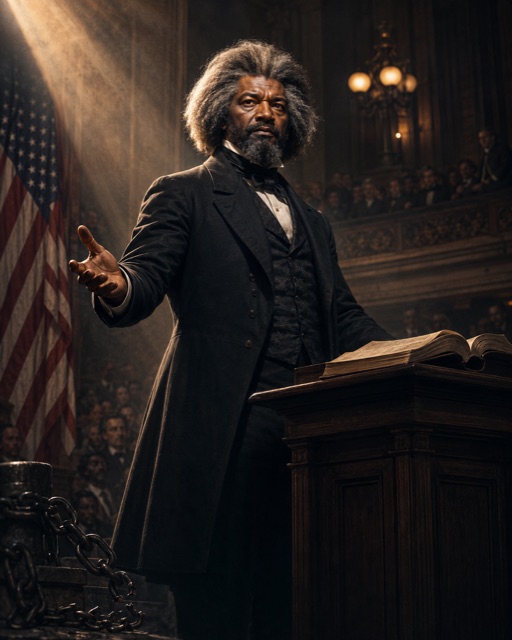
Abolitionism · Memoir
Narrative of the Life of Frederick Douglass
by Frederick Douglass · The Orator of Freedom · Abolition and Reconstruction, c. 1818-1895
Douglass's first autobiography and one of the most powerful arguments against slavery.
- Intermediate
- 1845
- ~3 hr read
- 22 chapter guides
- Public domain
Start reading · Read the Preface guide free
Before the text
Editor's Prelude
A Life Claimed In Public
Frederick Douglass begins with facts slavery has kept from him: his exact age, his father's identity, and ordinary life with his mother. From that first deprivation, his 1845 Narrative names people, places, violence, labor, hunger, and family separation with deliberate precision.
William Lloyd Garrison and Wendell Phillips introduce the book to a public taught by racism to doubt Black testimony. Douglass then makes his own authority unmistakable. Literacy reveals why slaveholders fear an educated mind, resistance to Edward Covey restores his sense of himself, and fellowship turns freedom from a private hope into shared work.
Douglass withholds the method of his escape to protect others, then follows freedom into paid labor, abolitionist print, and public speech. His Appendix draws a final distinction between Christianity and the slaveholding religion that uses its name.
The opening pages
Letter from Wendell Phillips
BOSTON, April 22, 1845.
My Dear Friend:
You remember the old fable of “The Man and the Lion,” where the lion complained that he should not be so misrepresented “when the lions wrote history.”
I am glad the time has come when the “lions write history.” We have been left long enough to gather the character of slavery from the involuntary evidence of the masters. One might, indeed, rest sufficiently satisfied with what, it is evident, must be, in general, the results of such a relation, without seeking farther to find whether they have followed in every instance. Indeed, those who stare at the half-peck of corn a week, and love to count the lashes on the slave’s back, are seldom the “stuff” out of which reformers and abolitionists are to be made. I remember that, in 1838, many were waiting for the results of the West India experiment, before they could come into our ranks. Those “results” have come long ago; but, alas! few of that number have come with them, as converts. A man must be disposed to judge of emancipation by other tests than whether it has increased the produce of sugar,—and to hate slavery for other reasons than because it starves men and whips women,—before he is ready to lay the first stone of his anti-slavery life.
I was glad to learn, in your story, how early the most neglected of God’s children waken to a sense of their rights, and of the injustice done them. Experience is a keen teacher; and long before you had mastered your A B C, or knew where the “white sails” of the Chesapeake were bound, you began, I see, to gauge the wretchedness of the slave, not by his hunger and want, not by his lashes and toil, but by the cruel and blighting death which gathers over his soul.
In connection with this, there is one circumstance which makes your recollections peculiarly valuable, and renders your early insight the more remarkable. You come from that part of the country where we are told slavery appears with its fairest features. Let us hear, then, what it is at its best estate—gaze on its bright side, if it has one; and then imagination may task her powers to add dark lines to the picture, as she travels southward to that (for the colored man) Valley of the Shadow of Death, where the Mississippi sweeps along.
Read it in a Quest
A witness path through freedom, dignity, law, and the unfinished demand for equality.
Chapter guides · 22
Preface
The Burden of Being Believed
Garrison presents Douglass's testimony to a public conditioned by racism to doubt Black authority.
What just happened
William Lloyd Garrison recalls hearing Douglass speak in Nantucket, defends his intellectual and moral authority, and insists that the cruelties in the Narrative are representative rather than exceptional.
Why it matters
Garrison answers skeptical readers by pointing to the people and places Douglass names, making his charges open to challenge. He cites further violence reported in a Baltimore newspaper and argues that barring Black witnesses leaves enslaved people without effective protection. The Preface ends by demanding active support for emancipation and rejecting compromise or union with slaveholders.
Letter from Wendell Phillips
Publishing Under Pursuit
Phillips frames the act of naming slavery's agents as both historical witness and present danger.
What just happened
Wendell Phillips welcomes the moment when the 'lions write history,' affirms Douglass's fairness, and admits that publishing real names and places may help enslavers find and recapture him.
Why it matters
Phillips argues that no part of the United States gives a fugitive legal safety and that those who shelter escaping people act against the law. His closing hope is that these acts of courage will become public law and that New England will openly welcome people escaping slavery.
Chapter I
Birth Into Slavery
Douglass begins with withheld knowledge, family separation, and the first violence he remembers.
Chapter II
The Plantation And The Songs
Douglass describes plantation order, scarcity, and the meaning outsiders miss in enslaved song.
Chapter III
Property, Power, And Distortion
Colonel Lloyd's wealth shows how ownership reshapes truth, fear, and speech.
Chapter IV
Violence Without Consequence
The overseer Gore reveals a system where killing can be treated as discipline.
Chapter V
A Door Opens, But Not Freedom
Douglass moves to Baltimore, where a change in place becomes a change in possibility.
Chapter VI
The Lesson Auld Gives Away
A prohibition against reading becomes Douglass's clearest map toward freedom.
Chapter VII
Literacy Becomes Resistance
Reading and writing become tools Douglass has to win by strategy.
Chapter VIII
Valued As Property
Douglass watches people appraised, divided, abandoned, and moved by decisions they do not control.
Chapter IX
The Breaker Is Introduced
Douglass moves from deprivation into the system designed to crush him.
Chapter X: The Breaker and the Breaking
The Breaker and the Breaking
Douglass shows Covey's system of control and the inner crisis it produces.
Chapter X: Appeal and Return
Appeal, Refusal, And Return
Douglass seeks protection from Thomas Auld, receives an order to return, and reaches Covey's farm with Sandy Jenkins's root in his pocket.
Chapter X: The Fight and False Freedom
The Turning Point and False Freedom
Douglass resists Covey, then exposes how slavery can falsify the language of freedom.
Chapter X: Freeland and the Escape Plan
Reading, Fellowship, Escape
Under Freeland, Douglass builds community and begins planning escape.
Chapter X: Betrayal, Jail, and Baltimore
Betrayal, Jail, And Baltimore
The failed escape leads through arrest and separation into shipyard violence, denied legal protection, skilled labor, and stolen wages.
Chapter XI: Why the Escape Is Withheld
Why Details Are Withheld
Douglass explains why he will not reveal the practical route of his escape.
Chapter XI: Hiring Time and Planning Escape
Hiring Time And Planning Escape
Douglass turns wage theft and limited autonomy into preparation for flight.
Chapter XI: New York, Ruggles, and Safety
Free, But Not Yet Safe
New York brings escape, fear, help from David Ruggles, and marriage to Anna.
Chapter XI: New Bedford and a New Name
A New Name In New Bedford
Work, mutual aid, and a free Black community give Douglass a safer beginning without ending the danger of recapture.
Chapter XI: Work and Public Voice
Freedom Acquires A Public Voice
Douglass supports himself, enters abolitionist print culture, and begins speaking from his own experience.
Appendix
Christianity And Slaveholding Religion
Douglass separates the faith he affirms from churches that turn slavery into respectable Christian practice.
Questions readers ask
- How long does it take to read Narrative of the Life of Frederick Douglass?
- About 3 hr in total.
- How difficult is Narrative of the Life of Frederick Douglass?
- Intermediate. A mid-length memoir; about 3 hours of reading.
- Which edition is this?
- The original English text, first published in 1845. The text follows Narrative of the Life of Frederick Douglass, an American Slave, Written by Himself (1845).
- Can I read Narrative of the Life of Frederick Douglass for free?
- Yes. Narrative of the Life of Frederick Douglass is free to read with a Nexus account.
- How many chapter guides are there?
- 22 chapter guides, written by the Nexus editors. Two open in full here; the rest show their opening line.
About Frederick Douglass
Frederick Douglass escaped slavery and became one of the most important abolitionists, writers, speakers, and reformers in American history. His autobiographies and speeches exposed slavery, defended liberty, and forced America to confront its founding promises.
“What does liberty mean when a nation denies it to the enslaved?”
Douglass gives Nexus one of its strongest voices of witness. His writing is direct, morally explosive, and essential to understanding American liberty.
Source text: public domain. Chapter guides: original Nexus writing. Narrative of the Life of Frederick Douglass is part of The Nexus Archive, guided Quests through the great works.