 The Nexus Archive
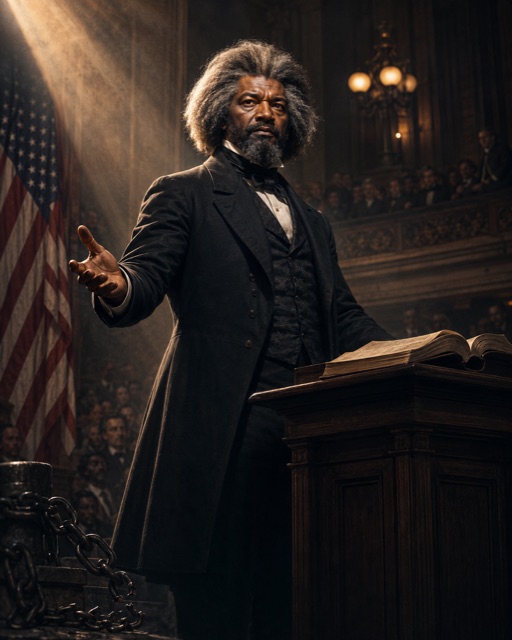
Abolitionism · Memoir
My Bondage and My Freedom
by Frederick Douglass · The Orator of Freedom · Abolition and Reconstruction, c. 1818-1895
Douglass's expanded account of slavery, freedom, and public life.
- Advanced
- ~10 hr read
- 36 chapter guides
- Public domain
Start reading · Read the Editor's Preface guide free
Before the text
Editor's Prelude
A Life Reclaimed, Then Enlarged
Ten years after his first autobiography made a fugitive's testimony impossible to ignore, Frederick Douglass returned to his life with more room, more independence, and a changed public voice. My Bondage and My Freedom does not merely retell the earlier story. It reaches further into childhood, family, literacy, religious awakening, resistance, escape, and the difficult work of becoming free in a country still organized around racial exclusion.
The book appeared in 1855, when Douglass had broken with William Lloyd Garrison's political strategy and was editing his own newspaper in Rochester. That independence shapes the work. Douglass can now examine not only individual cruelty but the institutions that make slavery durable: law, commerce, churches, political parties, habits of thought, and the stories a nation tells about itself. James McCune Smith's Introduction places the autobiography inside a larger argument about Black intellect, citizenship, and self-emancipation.
The title's two nouns reach beyond their simplest meanings. Bondage is more than chains, and freedom is more than flight. Douglass traces the recovery of self-command through reading, fellowship, refusal, paid labor, speech, print, and political judgment. The appended speeches and letter then carry the private life into public combat: the witness becomes an organizer, editor, orator, and critic of the republic that once claimed to own him.
The opening pages
Chapter I: Childhood
PLACE OF BIRTH—CHARACTER OF THE DISTRICT—TUCKAHOE—ORIGIN OF THE NAME—CHOPTANK RIVER—TIME OF BIRTH—GENEALOGICAL TREES—MODE OF COUNTING TIME—NAMES OF GRANDPARENTS—THEIR POSITION—GRANDMOTHER ESPECIALLY ESTEEMED—“BORN TO GOOD LUCK”—SWEET POTATOES—SUPERSTITION—THE LOG CABIN—ITS CHARMS—SEPARATING CHILDREN—MY AUNTS—THEIR NAMES—FIRST KNOWLEDGE OF BEING A SLAVE—OLD MASTER—GRIEFS AND JOYS OF CHILDHOOD—COMPARATIVE HAPPINESS OF THE SLAVE-BOY AND THE SON OF A SLAVEHOLDER.
In Talbot county, Eastern Shore, Maryland, near Easton, the county town of that county, there is a small district of country, thinly populated, and remarkable for nothing that I know of more than for the worn-out, sandy, desert-like appearance of its soil, the general dilapidation of its farms and fences, the indigent and spiritless character of its inhabitants, and the prevalence of ague and fever.
The name of this singularly unpromising and truly famine stricken district is Tuckahoe, a name well known to all Marylanders, black and white. It was given to this section of country probably, at the first, merely in derision; or it may possibly have been applied to it, as I have heard, because some one of its earlier inhabitants had been guilty of the petty meanness of stealing a hoe—or taking a hoe that did not belong to him. Eastern Shore men usually pronounce the word took, as tuck; Took-a-hoe, therefore, is, in Maryland parlance, Tuckahoe. But, whatever may have been its origin—and about this I will not be positive—that name has stuck to the district in question; and it is seldom mentioned but with contempt and derision, on account of the barrenness of its soil, and the ignorance, indolence, and poverty of its people. Decay and ruin are everywhere visible, and the thin population of the place would have quitted it long ago, but for the Choptank river, which runs through it, from which they take abundance of shad and herring, and plenty of ague and fever.
It was in this dull, flat, and unthrifty district, or neighborhood, surrounded by a white population of the lowest order, indolent and drunken to a proverb, and among slaves, who seemed to ask, “Oh! what’s the use?” every time they lifted a hoe, that I—without any fault of mine was born, and spent the first years of my childhood.
The reader will pardon so much about the place of my birth, on the score that it is always a fact of some importance to know where a man is born, if, indeed, it be important to know anything about him. In regard to the time of my birth, I cannot be as definite as I have been respecting the place. Nor, indeed, can I impart much knowledge concerning my parents. Genealogical trees do not flourish among slaves. A person of some consequence here in the north, sometimes designated father, is literally abolished in slave law and slave practice. It is only once in a while that an exception is found to this statement. I never met with a slave who could tell me how old he was. Few slave-mothers know anything of the months of the year, nor of the days of the month. They keep no family records, with marriages, births, and deaths. They measure the ages of their children by spring time, winter time, harvest time, planting time, and the like; but these soon become undistinguishable and forgotten. Like other slaves, I cannot tell how old I am. This destitution was among my earliest troubles. I learned when I grew up, that my master—and this is the case with masters generally—allowed no questions to be put to him, by which a slave might learn his age. …
Chapter guides · 36
Editor's Preface
Why Tell the Life Again?
The preface frames autobiography as evidence in a public trial of slavery.
What happens
The unnamed editor insists that the book offers facts, not fiction, while Douglass's embedded letter explains his hesitation about making himself the subject. He accepts autobiography because slavery and Black capacity are both being judged.
Why it matters
Douglass grounds his opposition to slavery in the humanity that everyone shares. His own suffering gives that argument a personal history; it is also a way to confront public claims of Black inferiority.
Where it ends
After Douglass supplies the manuscript, the editor welcomes the decision. He presents the author's rise from obscurity as reason enough for public interest in his life.
Introduction
A Life Placed Before the Nation
James McCune Smith presents Douglass as evidence for citizenship, intellect, and self-emancipation.
What happens
Smith traces Douglass from slavery through abolitionist speaking, British travel, independent editorship, and political disagreement. His praise sometimes uses the racial theories of his century even while attacking their conclusions.
Why it matters
Smith asks the nation to recognize Black intellect and citizenship in Douglass's achievements. His account also shows how racial theories burden even an argument directed against racial prejudice.
Where it ends
Smith closes as the son of a woman who freed herself, offering Douglass's example to his own child. He commends the book and immediate emancipation, then signs his name.
Chapter I
Childhood Under Ownership
Douglass begins with memory, family separation, and the first shape of slavery in a child's life.
Chapter II
A Child Enters the Plantation World
Removal from home turns ownership from an idea into a governing reality.
Chapter III
Kinship Made Uncertain
Slavery withholds family knowledge and turns separation into ordinary administration.
Chapter IV
Power Without Witnesses
The plantation's wealth and order rest on isolation, surveillance, and unequal vulnerability.
Chapter V
Esther's Whipping
A hidden child witnesses Anthony's possessiveness turn into brutal punishment.
Chapter VI
Songs Are Not Evidence of Contentment
Douglass reads hunger, punishment, and music against the interpretations slavery prefers.
Chapter VII
Luxury and Dependence
The great house displays refinement while producing another hierarchy among the enslaved.
Chapter VIII
When Murder Has No Court
Killers of enslaved people go free because the legal order refuses to hear an enslaved witness.
Chapter IX
Small Mercies, Permanent Exposure
Kindness can ease a child's suffering without changing his status as property.
Chapter X
Baltimore Opens a Door
A new household and city loosen the plantation's claim to be the whole world.
Chapter XI
Reading Changes The Prison
Baltimore gives Douglass a new kind of danger: knowledge that makes bondage impossible to accept.
Chapter XII
Faith Against Slaveholding Religion
Religious awakening gives Douglass fellowship and purpose without reconciling him to bondage.
Chapter XIII
Property Divided
Deaths in the Anthony family expose how quickly human relationships become an inventory.
Chapter XIV
Hunger Beneath Conversion
Thomas Auld's religious profession intensifies rather than restrains his mastery.
Chapter XV
How a Breaker Works
Covey combines exhaustion, surprise, deception, and punishment to attack inward resistance.
Chapter XVI
A Wound and a Refused Appeal
Physical collapse drives Douglass to Thomas Auld, who orders him back to Covey.
Chapter XVII
The Breaker Fails
Covey is supposed to crush Douglass; instead the struggle restores Douglass's sense of himself.
Chapter XVIII
Freedom Practiced in Secret
A less brutal master creates room for solidarity, teaching, and shared ambition.
Chapter XIX
Freedom Requires A Future
Douglass turns the desire for liberty into a shared plan, with fear and betrayal close by.
Chapter XX
Free Labor, Stolen Wages
Skilled shipyard work enlarges Douglass's power while ownership continues to seize its value.
Chapter XXI
The Departure from Baltimore
Douglass prepares to leave while making Hugh believe their arrangement is secure.
Chapter XXII
Freedom Becomes a Daily Life
Safety, marriage, work, worship, and print give liberty practical form.
Chapter XXIII
The Private Witness Takes the Platform
At Nantucket, Douglass's personal testimony becomes abolitionist public speech.
Chapter XXIV
The Witness Goes Abroad
Douglass's story moves from American testimony into an international abolitionist campaign.
Chapter XXV
An Independent Press
Douglass turns speaking authority into editorial power and confronts segregation directly.
Reception Speech at Finsbury Chapel: Religion and the Light of Exposure
Expose Slavery to Kill It
Before a British audience, Douglass makes distance from America a source of pressure.
Dr. Campbell's Reply
The Audience Answers
Campbell's reply records how Douglass's British appeal was received and amplified.
Letter to His Old Master
Fellow-Man, Not Property
Douglass addresses Thomas Auld with moral equality, unsparing accusation, and an offer of humane treatment.
The Nature of Slavery
Slavery as a Relation of Power
Douglass defines the institution through the authority it gives one person over another.
Inhumanity of Slavery
The Law Supplies the Evidence
Slave codes answer sentimental defenses with the institution's own declared rules.
What to the Slave Is the Fourth of July?
Independence Becomes An Indictment
The Fourth of July speech turns America's own language of liberty against slavery.
The Internal Slave Trade
A Market in Human Beings
The domestic slave trade makes national respectability coexist with open trafficking.
The Slavery Party
A Party Larger Than Its Name
Douglass identifies a cross-institutional coalition organized around slavery's power.
The Anti-Slavery Movement
The Cause Outlives Any One Form
Douglass closes by treating abolition as a living movement, not just an organization.
Questions readers ask
- How long does it take to read My Bondage and My Freedom?
- About 10 hr in total.
- How difficult is My Bondage and My Freedom?
- Advanced. A long memoir; about 10 hours of reading.
- Which edition is this?
- The original English text, first published in 1855. The text follows My Bondage and My Freedom (1855).
- Can I read My Bondage and My Freedom for free?
- Yes. My Bondage and My Freedom is free to read with a Nexus account.
- How many chapter guides are there?
- 36 chapter guides, written by the Nexus editors. Two open in full here; the rest show their opening line.
About Frederick Douglass
Frederick Douglass escaped slavery and became one of the most important abolitionists, writers, speakers, and reformers in American history. His autobiographies and speeches exposed slavery, defended liberty, and forced America to confront its founding promises.
“What does liberty mean when a nation denies it to the enslaved?”
Douglass gives Nexus one of its strongest voices of witness. His writing is direct, morally explosive, and essential to understanding American liberty.
Source text: public domain. Chapter guides: original Nexus writing. My Bondage and My Freedom is part of The Nexus Archive, guided Quests through the great works.