 The Nexus Archive
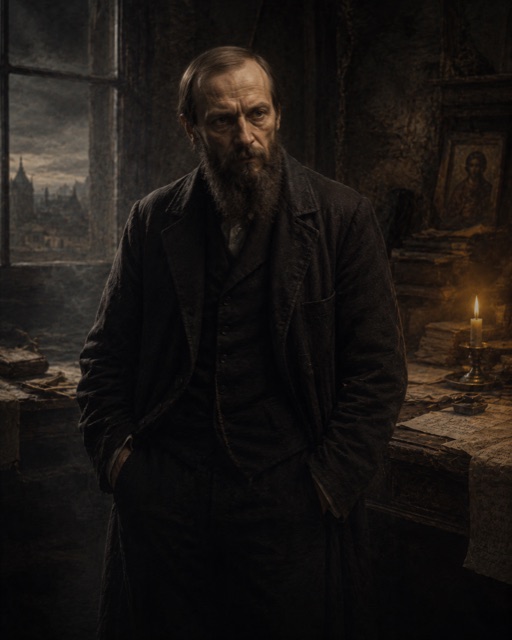
Existential Literature · Novel
The House of the Dead; or, Prison Life in Siberia
by Dostoevsky · The Underground Prophet · Russian Existentialism, 1821-1881
A fictionalized prison memoir turns Siberian penal life into a study of suffering, hierarchy, cruelty, and stubborn human freedom.
- Advanced
- ~9 hr 15 min read
- 2 chapter guides
- Public domain
Start reading · Read the Part I, CHAPTER VII. THE FIRST MONTH (continued) guide free
Before the text
Editor's Prelude
People Behind the Sentences
Prison puts men under common rules without making them equals. Money, former rank, nationality and the power to punish still shape life inside this Siberian fortress. A cup of tea, a chance to earn a few coins or an evening's play can matter intensely to people denied control over their days.
Dostoevsky draws on his own imprisonment, but gives these recollections to a fictional former convict, Alexander Petrovitch Goriantchikoff. Short portraits, conversations and remembered scenes take the place of a continuous plot. The narrator watches closely, yet other people's motives often remain beyond him.
Cruelty and kindness can come from the same person. Friendship can survive a theft, while one harsh remark can wound someone deeply. The book gives these contradictions room to unsettle first impressions. Behind each sentence of hard labour stands a life that the official account of a crime cannot explain.
The opening pages
Part I, CHAPTER I. TEN YEARS A CONVICT
PRISON LIFE IN SIBERIA.
Part I.
CHAPTER I. TEN YEARS A CONVICT
In the midst of the steppes, of the mountains, of the impenetrable forests of the desert regions of Siberia, one meets from time to time with little towns of a thousand or two inhabitants, built entirely of wood, very ugly, with two churches—one in the centre of the town, the other in the cemetery—in a word, towns which bear much more resemblance to a good-sized village in the suburbs of Moscow than to a town properly so called. In most cases they are abundantly provided with police-master, assessors, and other inferior officials. If it is cold in Siberia, the great advantages of the Government service compensate for it. The inhabitants are simple people, without liberal ideas. Their manners are antique, solid, and unchanged by time. The officials who form, and with reason, the nobility in Siberia, either belong to the country, deeply-rooted Siberians, or they have arrived there from Russia. The latter come straight from the capitals, tempted by the high pay, the extra allowance for travelling expenses, and by hopes not less seductive for the future. Those who know how to resolve the problem of life remain almost always in Siberia; the abundant and richly-flavoured fruit which they gather there recompenses them amply for what they lose.
As for the others, light-minded persons who are unable to deal with the problem, they are soon bored in Siberia, and ask themselves with regret why they committed the folly of coming. They impatiently kill the three years which they are obliged by rule to remain, and as soon as their time is up, they beg to be sent back, and return to their original quarters, running down Siberia, and ridiculing it. They are wrong, for it is a happy country, not only as regards the Government service, but also from many other points of view.
The climate is excellent, the merchants are rich and hospitable, the Europeans in easy circumstances are numerous; as for the young girls, they are like roses and their morality is irreproachable. Game is to be found in the streets, and throws itself upon the sportsman’s gun. People drink champagne in prodigious quantities. The caviare is astonishingly good and most abundant. In a word, it is a blessed land, out of which it is only necessary to be able to make profit; and much profit is really made.
Chapter guides · 2
Part I, CHAPTER VII. THE FIRST MONTH (continued)
The First Weeks Behind the Palisade
Goriantchikoff recalls entering a prison whose routines he can see but whose people he struggles to understand. Hostility toward his former rank makes the first days harder; acts of help complicate his first impressions.
A nobleman among convicts
Locked in crowded barracks at night and escorted to work, Goriantchikoff finds the loss of solitude especially painful. His fellow prisoners still see a gentleman in him. When the drunken Gazin threatens him and his companion with a heavy box, no one openly intervenes. A cry that Gazin's vodka has been stolen draws him away. Goriantchikoff never learns whether the theft was real or the warning a device to save them.
Money and loyalties
Private trades, lending and smuggled drink continue under the official rules. Goriantchikoff sees money as a means of exercising some choice, even when months of earnings disappear in a day's drinking. Akim Akimitch helps him obtain bedding. Other recollections disclose attachments that cannot be reduced to payment: he teaches Ali to read, and wounds Suchiloff by treating his service as merely a claim for money. Suchiloff's tears expose what he has failed to understand.
The barge and the prison dog
At the frozen river, the men work listlessly until a definite task and the prospect of returning early transform their efforts. They finish ahead of time, but Goriantchikoff's attempts to help bring insults and rejection. Back at the prison after the day's work, he embraces Bull, the dog he has befriended with bread and caresses. In his loneliness, he thinks of Bull as his only friend.
Part II, CHAPTER II. THE HOSPITAL (continued).
From Christmas to the Hospital
Christmas gives way to drunken quarrels; the convicts' theatre ends in unaccustomed peace. In the hospital, Goriantchikoff watches wounded men receive care without being freed from their chains.
Questions readers ask
- How long does it take to read The House of the Dead; or, Prison Life in Siberia?
- About 9 hr 15 min in total.
- How difficult is The House of the Dead; or, Prison Life in Siberia?
- Advanced. A long novel; about 9 hours of reading.
- Which translation is this?
- The Attributed to H. S. Edwards; not named in this edition translation from the Russian. The text follows The House of the Dead; or, Prison Life in Siberia, Everyman's Library No. 533 (1914 reprint).
- Can I read The House of the Dead; or, Prison Life in Siberia for free?
- The House of the Dead; or, Prison Life in Siberia is part of Nexus Premium, so reading it needs an account and a Premium subscription. The opening above and one chapter guide on this page are free to read.
- How many chapter guides are there?
- 2 chapter guides, written by the Nexus editors. One opens in full here; the rest show their opening line.
About Dostoevsky
Fyodor Dostoevsky survived a staged execution, years in a Siberian prison camp, financial ruin, epilepsy, and political repression. His novels turned those experiences into intense examinations of freedom, guilt, faith, violence, and the divided human mind.
“What if human beings do not actually want what is good for them?”
Dostoevsky exposes the psychological and spiritual chaos beneath modern theories of progress.
Source text: public domain. Chapter guides: original Nexus writing. The House of the Dead; or, Prison Life in Siberia is part of The Nexus Archive, guided Quests through the great works.