 The Nexus Archive
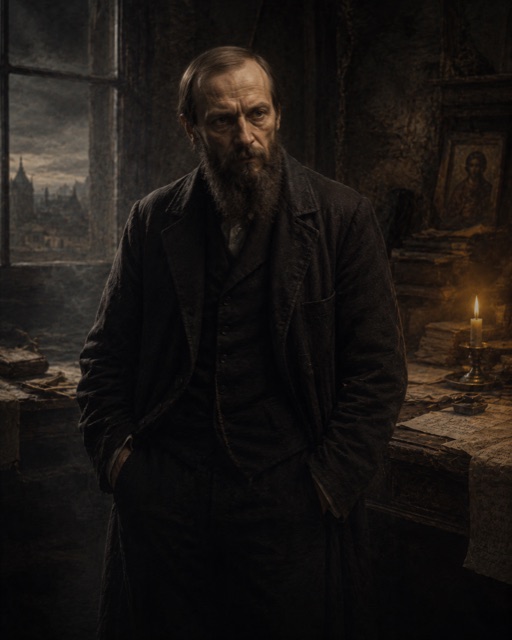
Existential Literature · Novel
Demons
by Dostoevsky · The Underground Prophet · Russian Existentialism, 1821-1881
- Brutal
- ~19 hr 15 min read
- 23 chapter guides
- Public domain
Start reading · Read the I.I.IX · Introductory guide free
Before the text
Editor's Prelude
When Ideas Learn To Use People
A town wants to be modern. Its drawing rooms welcome new opinions, its writers want applause, and its officials hope to guide the young. Beneath the talk are familiar needs: money, affection, respect, and somewhere to belong. In Demons, those needs give people who promise a new world a dangerous hold over others.
Dostoevsky begins with an old friendship. Stepan Trofimovitch Verhovensky, a proud but dependent intellectual, has spent years under the protection of Varvara Petrovna Stavrogina. Her son Nikolay attracts fierce devotion and uneasy speculation. Stepan's son Pyotr knows how to turn other people's expectations to his advantage. Their households open into a crowded provincial world where a private grievance can quickly become public gossip.
A local chronicler tells the story. He knows some people intimately, hears others through rumor, and sometimes revises his earlier understanding. The voices clash, and comedy can become frightening without warning. Grand arguments about freedom and belief share the room with awkward silences, wounded pride, and acts of kindness. The pressure falls on what people do to one another when their cherished ideas meet another person's life.
The opening pages
Epigraphs
“Strike me dead, the track has vanished,
Well, what now? We’ve lost the way,
Demons have bewitched our horses,
Led us in the wilds astray.
“What a number! Whither drift they?
What’s the mournful dirge they sing?
Do they hail a witch’s marriage
Or a goblin’s burying?”
A. Pushkin.
“And there was one herd of many swine feeding on this mountain; and they besought him that he would suffer them to enter into them. And he suffered them.
“Then went the devils out of the man and entered into the swine; and the herd ran violently down a steep place into the lake and were choked.
“When they that fed them saw what was done, they fled, and went and told it in the city and in the country.
“Then they went out to see what was done; and came to Jesus and found the man, out of whom the devils were departed, sitting at the feet of Jesus, clothed and in his right mind; and they were afraid.”
Luke, ch. viii. 32–37.
Introductory
Part I
Chapter I. Introductory
SOME DETAILS OF THE BIOGRAPHY OF THAT HIGHLY RESPECTED GENTLEMAN STEPAN TROFIMOVITCH VERHOVENSKY.
IN UNDERTAKING to describe the recent and strange incidents in our town, till lately wrapped in uneventful obscurity, I find myself forced in absence of literary skill to begin my story rather far back, that is to say, with certain biographical details concerning that talented and highly-esteemed gentleman, Stepan Trofimovitch Verhovensky. I trust that these details may at least serve as an introduction, while my projected story itself will come later.
I will say at once that Stepan Trofimovitch had always filled a particular rôle among us, that of the progressive patriot, so to say, and he was passionately fond of playing the part--so much so that I really believe he could not have existed without it. Not that I would put him on a level with an actor at a theatre, God forbid, for I really have a respect for him. This may all have been the effect of habit, or rather, more exactly of a generous propensity he had from his earliest years for indulging in an agreeable day-dream in which he figured as a picturesque public character. He fondly loved, for instance, his position as a "persecuted" man and, so to speak, an "exile." There is a sort of traditional glamour about those two little words that fascinated him once for all and, exalting him gradually in his own opinion, raised him in the course of years to a lofty pedestal very gratifying to vanity. In an English satire of the last century, Gulliver, returning from the land of the Lilliputians where the people were only three or four inches high, had grown so accustomed to consider himself a giant among them, that as he walked along the streets of London he could not help crying out to carriages and passers-by to be careful and get out of his way for fear he should crush them, imagining that they were little and he was still a giant. He was laughed at and abused for it, and rough coachmen even lashed at the giant with their whips. But was that just? What may not be done by habit? Habit had brought Stepan Trofimovitch almost to the same position, but in a more innocent and inoffensive form, if one may use such expressions, for he was a most excellent man.
Chapter guides · 23
I.I.IX · Introductory
A Friendship Built on Dependence
Stepan speaks of freedom while depending on Varvara for his home, money, and sense of importance.
A scholar and his protector
Stepan Trofimovitch Verhovensky has spent years feeling like a persecuted thinker. The narrator explains that the authorities were scarcely interested in him. Varvara Petrovna Stavrogina brought him into her household as her son's tutor. Their long friendship mixes affection with pride, resentment, and her control of his life.
Ideas around the table
Their attempt to enter Petersburg's literary world ends in disappointment. Back home, Stepan gathers a small circle for arguments about politics and belief. Shatov, a former serf whose views have changed, attacks their distance from ordinary Russians. As usually happened after such outbursts, he starts to leave in anger. Stepan offers his hand, Shatov sits down again, and they drink together. Their quarrel gives way to a brief moment of warmth.
I.II.VIII · Prince Harry. Matchmaking.
A Marriage Arranged Around Money
Varvara arranges a marriage for Dasha and Stepan while managing the debts and rumors around her household.
Her son returns to view
The chapter traces Nikolay Stavrogin's disturbing earlier visit home. He pulls a man's nose, forcibly kisses a woman, and bites the governor's ear. Doctors attribute his behavior to brain fever. Years later, talk of his possible marriage to Liza becomes tangled with suspicions about Dasha, Varvara's young companion.
The proposed match
Varvara orders Stepan to marry Dasha. Dasha agrees if Varvara wishes it; Stepan accepts after painful hesitation. The plan also solves a money problem. He has mismanaged the estate he holds for his son, Pyotr, and needs Varvara's help to settle the debt.
A fragile agreement
Varvara tells Stepan to keep the engagement secret and wait. After she leaves, he boasts to the narrator that he could still refuse. The chapter ends with him and the narrator drinking too much. His claim to independence rests on another arrangement Varvara has made for him.
I.III.X · The Sins Of Others
Private Suspicions Become Public Talk
Rumors about Stavrogin give Stepan a way to explain his own uneasiness about marrying Dasha.
I.IV.VII · The Cripple
Marya Enters the Drawing Room
The woman at the center of the rumors appears as a vulnerable person whom others struggle to understand.
I.V.VIII · The Subtle Serpent
An Explanation That Serves Its Teller
Pyotr makes himself useful by explaining the household scandal, then turns private letters against his father.
II.I.VII · Night
Two Men Claim Stavrogin as Their Teacher
Stavrogin faces ideas he once encouraged in both Kirillov and Shatov.
II.II.IV · Night (Continued)
A Marriage Becomes a Threat
Stavrogin's visit to the Lebyadkins brings his hidden marriage close to public view and violence.
II.III.IV · The Duel
Restraint Leaves the Wound Open
Stavrogin spares Gaganov in the duel, but his restraint brings neither reconciliation nor peace.
II.IV.III · All In Expectation
Everyone Thinks Pyotr Is Useful
Pyotr gains room to act because other people believe they can make him serve their purposes.
II.V.III · On The Eve Of The Fete
Amusement Without Mercy
The town turns vulnerable people into entertainment while Stepan prepares a grand farewell.
II.VI.VII · Pyotr Stepanovitch Is Busy
Pyotr Gives Everyone a Different Story
Pyotr uses flattery, false explanations, and fear to move people toward the meeting he has arranged.
II.VII.II · A Meeting
A Meeting Becomes a Test of Obedience
Pyotr turns a confused political discussion into pressure to keep silent about murder.
II.VIII · Ivan The Tsarevitch
The Leader Pyotr Wants to Invent
Pyotr wants Stavrogin's image to give his conspiracy the authority it lacks.
II.IX · A Raid At Stepan Trofimovitch's
The Search Makes Fear Real
A search of Stepan's rooms turns his old dream of persecution into panic.
II.X.III · Filibusters. A Fatal Morning
A Marriage Is Finally Announced
Private misery and public authority collide before Stavrogin reveals his marriage to the assembled guests.
III.I.IV · The Fete—First Part
The Audience Joins the Disorder
The literary fête becomes a struggle for attention in which the audience helps turn embarrassment into cruelty.
III.II.IV · The End Of The Fete
The Fire Reveals Three Murders
The fête's collapse leads into a real disaster and the discovery of the murdered Lebyadkins and their servant.
III.III.III · A Romance Ended
Liza Goes to the Victims
Liza rejects Pyotr's convenient explanation and goes to the house where three people have been killed.
III.IV.IV · The Last Resolution
Fear Prevents Escape
Pyotr persuades the conspirators to kill Shatov, then makes Liputin afraid to break away.
III.V.VI · A Wanderer
A New Life Seems Possible
Caring for his wife and her newborn child draws Shatov away from political hatred and toward a shared future.
III.VI.III · A Busy Night
The Crime Fails to Secure Obedience
Pyotr uses murder and a false confession to protect himself, while the people he controls begin to break down.
III.VII.III · Stepan Trofimovitch's Last Wandering
Stepan Learns to Receive Care
Stepan's wandering ends with an admission of dishonesty and a new sense of what he owes other people.
III.VIII · Conclusion
The Crimes Come to Light
The conspiracy is exposed, but the closing deaths leave the surviving families with losses that testimony cannot repair.
Questions readers ask
- How long does it take to read Demons?
- About 19 hr 15 min in total.
- How difficult is Demons?
- Brutal. A long novel; about 19 hours of reading.
- Which translation is this?
- The Constance Garnett translation from the Russian, first published in 1872. The text follows The Possessed (The Devils): A Novel in Three Parts (1916).
- Can I read Demons for free?
- Demons is part of Nexus Premium, so reading it needs an account and a Premium subscription. The opening above and two chapter guides on this page are free to read.
- How many chapter guides are there?
- 23 chapter guides, written by the Nexus editors. Two open in full here; the rest show their opening line.
About Dostoevsky
Fyodor Dostoevsky survived a staged execution, years in a Siberian prison camp, financial ruin, epilepsy, and political repression. His novels turned those experiences into intense examinations of freedom, guilt, faith, violence, and the divided human mind.
“What if human beings do not actually want what is good for them?”
Dostoevsky exposes the psychological and spiritual chaos beneath modern theories of progress.
Source text: public domain. Chapter guides: original Nexus writing. Demons is part of The Nexus Archive, guided Quests through the great works.