 The Nexus Archive
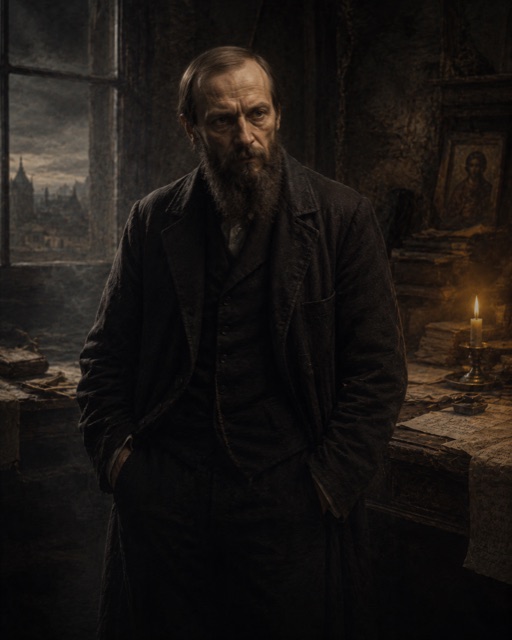
Existential Literature · Novel
The Brothers Karamazov
by Dostoevsky · The Underground Prophet · Russian Existentialism, 1821-1881
Dostoevsky's final great novel of family, faith, rebellion, murder, guilt, and judgment.
- Brutal
- 1880
- ~29 hr 15 min read
- 17 chapter guides
- Public domain
Start reading · Read the Book I · V. Elders guide free
Before the text
Editor's Prelude
The Family That Puts The World On Trial
A father’s money, an unpaid debt, a woman’s choice: in this Russian provincial town, private quarrels draw in servants, monks, children, and strangers. Dostoevsky makes a crowded household the meeting place of urgent questions about freedom, belief, and responsibility.
The three Karamazov brothers have grown up largely apart. Dmitri longs to live generously but is driven by jealous anger. Ivan wants an answer to suffering that reason can accept. Alyosha learns from a monk who asks people to answer cruelty with active love. Their father’s neglect binds them even as their wishes pull them apart. Smerdyakov, a servant raised in the household, hears their arguments from a very different position.
The novel moves between confession, comedy, fierce debate, and the pressure of a criminal case. Its storyteller belongs to the town and shares its curiosity, gossip, and uncertainty. Great ideas arrive in voices that can plead, boast, wound, or ask forgiveness. A small act of kindness matters here as much as an impressive argument. The question of what people believe stays close to what they do when someone else needs them.
The opening pages
I. Fyodor Pavlovitch Karamazov
Part I
Book I. The History Of A Family
Alexey Fyodorovitch Karamazov was the third son of Fyodor Pavlovitch Karamazov, a land owner well known in our district in his own day, and still remembered among us owing to his gloomy and tragic death, which happened thirteen years ago, and which I shall describe in its proper place. For the present I will only say that this “landowner”—for so we used to call him, although he hardly spent a day of his life on his own estate—was a strange type, yet one pretty frequently to be met with, a type abject and vicious and at the same time senseless. But he was one of those senseless persons who are very well capable of looking after their worldly affairs, and, apparently, after nothing else. Fyodor Pavlovitch, for instance, began with next to nothing; his estate was of the smallest; he ran to dine at other men’s tables, and fastened on them as a toady, yet at his death it appeared that he had a hundred thousand roubles in hard cash. At the same time, he was all his life one of the most senseless, fantastical fellows in the whole district. I repeat, it was not stupidity—the majority of these fantastical fellows are shrewd and intelligent enough—but just senselessness, and a peculiar national form of it.
He was married twice, and had three sons, the eldest, Dmitri, by his first wife, and two, Ivan and Alexey, by his second. Fyodor Pavlovitch’s first wife, Adelaïda Ivanovna, belonged to a fairly rich and distinguished noble family, also landowners in our district, the Miüsovs. How it came to pass that an heiress, who was also a beauty, and moreover one of those vigorous, intelligent girls, so common in this generation, but sometimes also to be found in the last, could have married such a worthless, puny weakling, as we all called him, I won’t attempt to explain. I knew a young lady of the last “romantic” generation who after some years of an enigmatic passion for a gentleman, whom she might quite easily have married at any moment, invented insuperable obstacles to their union, and ended by throwing herself one stormy night into a rather deep and rapid river from a high bank, almost a precipice, and so perished, entirely to satisfy her own caprice, and to be like Shakespeare’s Ophelia. Indeed, if this precipice, a chosen and favorite spot of hers, had been less picturesque, if there had been a prosaic flat bank in its place, most likely the suicide would never have taken place. This is a fact, and probably there have been not a few similar instances in the last two or three generations. Adelaïda Ivanovna Miüsov’s action was similarly, no doubt, an echo of other people’s ideas, and was due to the irritation caused by lack of mental freedom. She wanted, perhaps, to show her feminine independence, to override class distinctions and the despotism of her family. And a pliable imagination persuaded her, we must suppose, for a brief moment, that Fyodor Pavlovitch, in spite of his parasitic position, was one of the bold and ironical spirits of that progressive epoch, though he was, in fact, an ill-natured buffoon and nothing more. What gave the marriage piquancy was that it was preceded by an elopement, and this greatly captivated Adelaïda Ivanovna’s fancy. Fyodor Pavlovitch’s position at the time made him specially eager for any such enterprise, for he was passionately anxious to make a career in one way or another. …
Read it in a Quest
A moral trial where guilt, death, faith, and revolt press the soul into the open.
Chapter guides · 17
Book I · V. Elders
Why Alyosha trusts an elder
Alyosha sees obedience to an experienced monk as a way to become less selfish.
The elder’s role
An elder is a spiritual guide to whom a follower freely entrusts his decisions. The aim is to overcome pride and gain inner freedom. The narrator also admits the danger: obedience can become a source of pride itself. Zossima draws people to him through his kindness and his close understanding of their troubles.
The planned meeting
Alyosha wants to stay near Zossima, whose health is failing. Meanwhile, his father and Dmitri have agreed to bring their dispute to the elder. Fyodor treats the visit as a possible joke, while Miüsov comes partly from curiosity. Alyosha fears a scandal. Dmitri sends him a letter promising to behave respectfully, but the promise does not calm him.
Book II · VIII. The Scandalous Scene
A holy meal becomes another quarrel
Fyodor turns his own embarrassment into an attack on the monastery.
From apology to insult
Miüsov and the other guests go to the Superior’s meal after the disorder in Zossima’s cell. Miüsov wants to make amends. Fyodor first heads home, then changes his mind and returns. Wanting revenge for his own disgrace, he chooses to make the scene still worse.
The departure
Fyodor attacks the monks’ food, money, and use of confession. The narrator points out that his charges about confession and about the monastery’s harm to him are false. The Superior bows and accepts the insults without returning them. Fyodor announces that he will remove Alyosha from the monastery and leaves with Ivan. Maximov tries to join their carriage, but Ivan strikes him and pushes him away. Father and son ride home in silence.
Book III · XI. Another Reputation Ruined
Two messages and a quiet prayer
Dmitri’s shame and Lise’s love reach Alyosha during the same troubled evening.
Book IV · VII. And In The Open Air
Help becomes a question of honor
The captain needs money, but accepting it begins to feel like another humiliation.
Book V · IV. Rebellion
Ivan refuses the price of harmony
Ivan cannot accept a future happiness that requires the suffering of innocent children.
Book V · V. The Grand Inquisitor
Freedom and the wish to be ruled
Ivan’s Inquisitor offers people safety by taking away their freedom to choose.
Book V · VII. “It’s Always Worth While Speaking To A Clever Man”
Ivan leaves the household behind
Leaving gives Ivan a brief sense of freedom, followed by a deep uneasiness.
Book VI · III. Conversations And Exhortations Of Father Zossima
Love as a daily responsibility
Zossima teaches that freedom grows through self-restraint and care for other people.
Book VII · IV. Cana Of Galilee
Joy returns beside the coffin
Alyosha finds strength in a love that shares people’s joy as well as their sorrow.
Book VIII · VIII. Delirium
Love is interrupted by an accusation
Just as Grushenka chooses Dmitri, the consequences he fears arrive in a different form.
Book IX · IX. They Carry Mitya Away
Dmitri is taken away
Dmitri accepts the need to change his life while continuing to deny his father’s murder.
Book X · VII. Ilusha
A promise to return
Ilusha needs the people he loves beside him, and his father cannot imagine another child taking his place.
Book XI · VIII. The Third And Last Interview With Smerdyakov
Smerdyakov confesses
Smerdyakov admits killing Fyodor and claims that Ivan’s ideas and departure gave him permission.
Book XI · IX. The Devil. Ivan’s Nightmare
Ivan’s thoughts acquire a voice
A shabby, talkative devil turns Ivan’s own ideas into a tormenting conversation.
Book XI · X. “It Was He Who Said That”
Alyosha stays with his brother
Ivan cannot escape his accusing thoughts, and Alyosha answers his distress by staying.
Book XII · XIV. The Peasants Stand Firm
The verdict overturns the room’s hopes
The audience expects mercy, but the jury finds Dmitri guilty without qualification.
Epilogue · III. Ilusha’s Funeral. The Speech At The Stone
Memory becomes a promise
Remembering their kindness to Ilusha gives the boys something to hold onto beyond his death.
Questions readers ask
- How long does it take to read The Brothers Karamazov?
- About 29 hr 15 min in total.
- How difficult is The Brothers Karamazov?
- Brutal. A very long novel; about 29 hours of reading.
- Which translation is this?
- The Constance Garnett translation from the Russian, first published in 1880. The text follows Project Gutenberg #28054 transcription of the undated Lowell Press, New York edition of Constance Garnett's translation.
- Can I read The Brothers Karamazov for free?
- The Brothers Karamazov is part of Nexus Premium, so reading it needs an account and a Premium subscription, and completing an earlier Quest's Mastery. The opening above and two chapter guides on this page are free to read.
- How many chapter guides are there?
- 17 chapter guides, written by the Nexus editors. Two open in full here; the rest show their opening line.
About Dostoevsky
Fyodor Dostoevsky survived a staged execution, years in a Siberian prison camp, financial ruin, epilepsy, and political repression. His novels turned those experiences into intense examinations of freedom, guilt, faith, violence, and the divided human mind.
“What if human beings do not actually want what is good for them?”
Dostoevsky exposes the psychological and spiritual chaos beneath modern theories of progress.
Source text: public domain. Chapter guides: original Nexus writing. The Brothers Karamazov is part of The Nexus Archive, guided Quests through the great works.