 The Nexus Archive
English Novel · Novel
Great Expectations
by Dickens · The Conscience of the City · Victorian England, 1812-1870
Dickens's full Great Expectations from the PG 1867-edition witness.
- Advanced
- 1861
- ~14 hr read
- 15 chapter guides
- Public domain
Start reading · Read the Chapter V guide free
Before the text
Editor's Prelude
Great Expectations
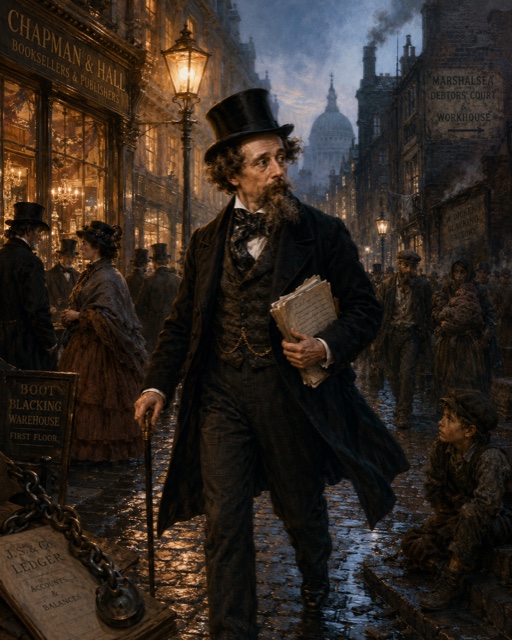
Charles Dickens was already the most famous novelist in England when he began Great Expectations, and he was writing late in his career out of a wound he had kept almost entirely hidden. As a child, Dickens worked in a blacking warehouse by the Thames during a period of family poverty that also brought his father's imprisonment for debt. The humiliation outlasted his rise to fame. It echoes in Pip's shame: the terror of being common, the ache to rise, and the cruelty a person can learn toward the people who first loved him.
The novel first appeared in weekly installments in 1860 and 1861, partly because Dickens needed to revive the circulation of his magazine, All the Year Round. That pressure helped give the book its unusual tightness. The opening graveyard, the secrets, the reversals, the sudden returns of buried guilt all have the urgency of serial fiction, but the design is controlled and dark: a master storyteller making every expectation dangerous.
The title means more than hope. In Victorian usage, "expectations" could mean an anticipated inheritance, and Pip's life will be seized by the dream of becoming a gentleman. That dream carries a cost. The story is told by an older Pip looking back on the boy and young man he once was, so there are always two Pips on the page: one living the mistake, and one who has learned enough to regret it.
The opening pages
Chapter I
My father’s family name being Pirrip, and my Christian name Philip, my infant tongue could make of both names nothing longer or more explicit than Pip. So, I called myself Pip, and came to be called Pip.
I give Pirrip as my father’s family name, on the authority of his tombstone and my sister,—Mrs. Joe Gargery, who married the blacksmith. As I never saw my father or my mother, and never saw any likeness of either of them (for their days were long before the days of photographs), my first fancies regarding what they were like, were unreasonably derived from their tombstones. The shape of the letters on my father’s, gave me an odd idea that he was a square, stout, dark man, with curly black hair. From the character and turn of the inscription, “Also Georgiana Wife of the Above,” I drew a childish conclusion that my mother was freckled and sickly. To five little stone lozenges, each about a foot and a half long, which were arranged in a neat row beside their grave, and were sacred to the memory of five little brothers of mine,—who gave up trying to get a living, exceedingly early in that universal struggle,—I am indebted for a belief I religiously entertained that they had all been born on their backs with their hands in their trousers-pockets, and had never taken them out in this state of existence.
Ours was the marsh country, down by the river, within, as the river wound, twenty miles of the sea. My first most vivid and broad impression of the identity of things seems to me to have been gained on a memorable raw afternoon towards evening. At such a time I found out for certain that this bleak place overgrown with nettles was the churchyard; and that Philip Pirrip, late of this parish, and also Georgiana wife of the above, were dead and buried; and that Alexander, Bartholomew, Abraham, Tobias, and Roger, infant children of the aforesaid, were also dead and buried; and that the dark flat wilderness beyond the churchyard, intersected with dikes and mounds and gates, with scattered cattle feeding on it, was the marshes; and that the low leaden line beyond was the river; and that the distant savage lair from which the wind was rushing was the sea; and that the small bundle of shivers growing afraid of it all and beginning to cry, was Pip.
Read it in a Quest
A mirror held to manners, class, conscience, and the societies fiction exposes.
Chapter guides · 15
Chapter V
A Theft, a Capture, and an Unexpected Protection
Pip's terror gives way to pity, and the convict answers the boy's stolen food by taking the blame.
Fear becomes action
The churchyard threat drives Pip to steal a file and food. Fear is not his only response. He sees the convict shiver and swallow the meal, and begins to feel pity for his hunger and exposure. When Pip mentions the other escaped man, the convict turns fiercely to filing his leg-iron.
The hunt
Soldiers arrive at the forge for repaired handcuffs, and Joe carries Pip across the marsh with the search party. The two convicts are found fighting each other. Even at the capture, Pip's private question is whether the man will expose him.
A claim Pip understands
The convict says he stole the food himself. Pip knows the confession is false and understands the protection without being named. Joe answers that the man should not have starved when food was available. The convict is taken by boat to the prison-ship. Pip watches him disappear aboard, and the torches are thrown hissing into the water.
Chapter VIII
A New Shame Takes Hold
Estella's contempt makes Pip see his hands, boots, schooling, and home through a hostile social gaze.
Two kinds of education
Joe tells Pip that his violent father kept him from school and then explains why he refuses to master Mrs. Joe in return. Biddy gives Pip practical help with reading and writing. Before Satis House, education is already linked to gentleness and mutual aid, not merely polish.
A house stopped in time
Satis House shuts out daylight; its clocks have stopped, and Miss Havisham sits among the remains of a bridal morning. Estella places Pip inside that arrangement by calling him a common laboring boy and treating his hands, boots, and speech as evidence against him.
The wound
Pip had not been ashamed of his hands or boots until Estella mocks them. Her contempt makes his own home seem common. After she sends him away, he walks the four miles back to the forge, brooding over his hands, boots, ignorance, and low position.
Chapter XI
Satis House Teaches Pip to Perform
Pip's shame produces lies at home, while Miss Havisham's stopped wedding feast turns affection and status into staged tests.
Chapter XV
The Forge Becomes a Place of Suspicion
Pip's apprenticeship closes one expectation, and an unknown attacker turns home into an unresolved crime scene.
Chapter XIX
The Wish Arrives With Conditions
Pip receives the fortune he imagined, then begins treating his own assumptions as evidence.
Chapter XXII
London Refuses the Picture Pip Expected
The city offers dirt, law, debt, and improvisation where Pip expected the polish of a gentleman's life.
Chapter XXIX
The Story Pip Wants Meets Estella's Warning
Pip treats Miss Havisham's encouragement as destiny even while Estella tells him not to expect tenderness.
Chapter XXXV
A Funeral Exposes the Distance
Pip comes home grieving, yet still converts guilt into promises and correction of the people who know him best.
Chapter XXXVIII
Kindness in Secret, Entrapment in Public
Pip uses his new income to help Herbert while Estella shows him the human method Miss Havisham taught her.
Chapter XXXIX
The Gentleman Is the Convict's Work
The stranger from the marshes returns not to ask for help, but to claim Pip as the life his labor and money created.
Chapter XLIV
No Inheritance Can Carry the Fantasy
Pip accepts that Miss Havisham never promised him Estella, while Estella refuses to translate his devotion into a feeling she does not possess.
Chapter XLIX
Help, Forgiveness, and Fire
Pip's rescue plan depends on quiet cooperation; his meeting with Miss Havisham asks whether remorse can become repair.
Chapter LIV
The River Plan Meets the Waiting Galley
Pip, Herbert, and Startop turn weeks of quiet preparation into an escape attempt, but Compeyson has already made secrecy impossible.
Chapter LVI
He Is Not Left Alone
The law removes Magwitch's property and condemns his return; Pip answers by staying, reading, petitioning, and holding his hand.
Chapter LIX
Care Without Expectations
Joe's unasked care, Pip's working life, and Estella's changed understanding close the novel without restoring the old fantasy.
Questions readers ask
- How long does it take to read Great Expectations?
- About 14 hr in total.
- How difficult is Great Expectations?
- Advanced. A long novel; about 14 hours of reading.
- Which edition is this?
- The original English text, first published in 1861. The text follows Project Gutenberg #1400, Great Expectations [1867 Edition].
- Can I read Great Expectations for free?
- Great Expectations is part of Nexus Premium, so reading it needs an account and a Premium subscription. The opening above and two chapter guides on this page are free to read.
- How many chapter guides are there?
- 15 chapter guides, written by the Nexus editors. Two open in full here; the rest show their opening line.
About Dickens
Charles Dickens was a Victorian novelist whose works explore class, poverty, childhood, debt, law, memory, and moral change.
“What does society do to the vulnerable, and who becomes responsible?”
Dickens shaped the modern social novel and gave popular fiction lasting moral force.
Source text: public domain. Chapter guides: original Nexus writing. Great Expectations is part of The Nexus Archive, guided Quests through the great works.