 The Nexus Archive
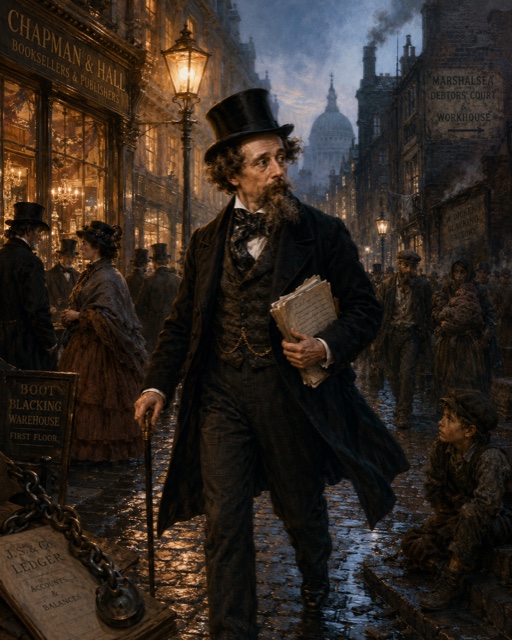
English Novel · Novel
David Copperfield
by Dickens · The Conscience of the City · Victorian England, 1812-1870
David tells how work, humiliation, friendship, love, and memory made the person holding the pen.
- Advanced
- ~26 hr 15 min read
- 6 chapter guides
- Public domain
Start reading · Read the CHAPTER 8. MY HOLIDAYS. ESPECIALLY ONE HAPPY AFTERNOON guide free
Before the text
Editor's Prelude
The Life He Tells
David begins by asking whether he will be the hero of his own life. He tells it from the far side of childhood, but memory keeps returning him to a room, a face or a voice with the force of something happening now. The grown man gives words to the boy’s humiliation; he also preserves his extravagant loves and loyalties.
Published in monthly parts in 1849–50, David Copperfield follows a child through homes and schools, work, friendship and marriage into the life of a writer. Dickens later called it his favorite child. Its people often announce themselves through a phrase or a gesture: a creditor’s knock, a promise that something will turn up, an aunt’s sudden command. Comedy makes these figures vivid, while dependence gives their smallest acts of kindness or contempt lasting weight.
The question of who shapes a life runs through the telling. David’s intense feeling can attach itself to the wrong person, and his certainty about himself can hide what another person needs. The older narrator has to recover more than a sequence of events. He has to understand what he once admired, what he failed to see and what he owes to the people who made room for him.
The opening pages
Prefaces
PREFACE TO 1850 EDITION
I do not find it easy to get sufficiently far away from this Book, in the first sensations of having finished it, to refer to it with the composure which this formal heading would seem to require. My interest in it, is so recent and strong; and my mind is so divided between pleasure and regret—pleasure in the achievement of a long design, regret in the separation from many companions—that I am in danger of wearying the reader whom I love, with personal confidences, and private emotions.
Besides which, all that I could say of the Story, to any purpose, I have endeavoured to say in it.
It would concern the reader little, perhaps, to know, how sorrowfully the pen is laid down at the close of a two-years’ imaginative task; or how an Author feels as if he were dismissing some portion of himself into the shadowy world, when a crowd of the creatures of his brain are going from him for ever. Yet, I have nothing else to tell; unless, indeed, I were to confess (which might be of less moment still) that no one can ever believe this Narrative, in the reading, more than I have believed it in the writing.
Instead of looking back, therefore, I will look forward. I cannot close this Volume more agreeably to myself, than with a hopeful glance towards the time when I shall again put forth my two green leaves once a month, and with a faithful remembrance of the genial sun and showers that have fallen on these leaves of David Copperfield, and made me happy.
London,
October, 1850.
PREFACE TO THE CHARLES DICKENS EDITION
I REMARKED in the original Preface to this Book, that I did not find it easy to get sufficiently far away from it, in the first sensations of having finished it, to refer to it with the composure which this formal heading would seem to require. My interest in it was so recent and strong, and my mind was so divided between pleasure and regret—pleasure in the achievement of a long design, regret in the separation from many companions—that I was in danger of wearying the reader with personal confidences and private emotions.
Besides which, all that I could have said of the Story to any purpose, I had endeavoured to say in it.
It would concern the reader little, perhaps, to know how sorrowfully the pen is laid down at the close of a two-years’ imaginative task; or how an Author feels as if he were dismissing some portion of himself into the shadowy world, when a crowd of the creatures of his brain are going from him for ever. Yet, I had nothing else to tell; unless, indeed, I were to confess (which might be of less moment still), that no one can ever believe this Narrative, in the reading, more than I believed it in the writing.
Chapter guides · 6
CHAPTER 8. MY HOLIDAYS. ESPECIALLY ONE HAPPY AFTERNOON
One Happy Afternoon
David’s holiday briefly restores the intimacy of home.
Mother and child
With the Murdstones away, David spends an afternoon with his mother, Peggotty and his new baby brother. His mother plays with the baby and listens to his school stories. Their happiness has the ease of the household he remembers, until the sound of the Murdstones’ return drives him upstairs. Miss Murdstone forbids him to touch the baby and silences his mother when she notices a likeness between her sons.
The image at the gate
The rest of the holiday leaves David apart from the adults and under constant suspicion. When he goes back to school, his mother stands alone at the garden gate, holding the baby up for him to see. The adult narrator preserves her there in the still, cold air. At school, the same silent image keeps returning in his dreams.
CHAPTER 18. A RETROSPECT
Growing Up in Memory
David compresses his school years into successive passions and embarrassments.
The boy’s grand passions
Crushes, displays of courage and anxiety about his appearance mark David’s progress through school. After a butcher defeats him in a fight, Agnes keeps him company and reads to him while he recovers. At seventeen, he falls in love with Miss Larkins, dances with her and treasures a flower from her hair. He imagines a future together, although she is much older and treats him as a boy.
The flower and the rematch
News that Miss Larkins has married Mr. Chestle, a hop-grower, leaves David desperate. A week or two later he throws away the faded flower. He defeats the butcher in their second fight and returns to his ring and bear’s grease with greater moderation. The years pass through these changes in what feels momentous: the narrator remembers the intensity while smiling at how quickly it moves to another object.
CHAPTER 27. TOMMY TRADDLES
Traddles, Waiting and Hoping
An old school friend’s modest room opens onto two very different hopes for the future.
CHAPTER 36. ENTHUSIASM
Enthusiasm Put to Work
David meets his aunt’s losses with a new determination to earn and learn.
CHAPTER 45. MR. DICK FULFILS MY AUNT’S PREDICTIONS
Mr. Dick Brings Them Together
The person who calls himself simple finds a way through the Strongs’ silence.
CHAPTER 55. TEMPEST
Tempest
A journey to deliver a letter brings David to the shore during a devastating storm.
Questions readers ask
- How long does it take to read David Copperfield?
- About 26 hr 15 min in total.
- How difficult is David Copperfield?
- Advanced. A very long novel; about 26 hours of reading.
- Can I read David Copperfield for free?
- David Copperfield is part of Nexus Premium, so reading it needs an account and a Premium subscription. The opening above and two chapter guides on this page are free to read.
- How many chapter guides are there?
- 6 chapter guides, written by the Nexus editors. Two open in full here; the rest show their opening line.
About Dickens
Charles Dickens was a Victorian novelist whose works explore class, poverty, childhood, debt, law, memory, and moral change.
“What does society do to the vulnerable, and who becomes responsible?”
Dickens shaped the modern social novel and gave popular fiction lasting moral force.
Source text: public domain. Chapter guides: original Nexus writing. David Copperfield is part of The Nexus Archive, guided Quests through the great works.