 The Nexus Archive
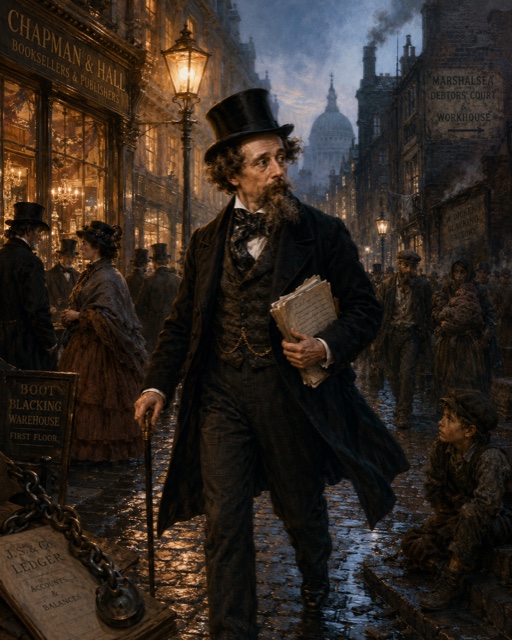
English Novel · Novel
Bleak House
by Dickens · The Conscience of the City · Victorian England, 1812-1870
A double-voiced novel in which a chancery suit spreads fog, delay, secrecy, and damage across English lives.
- Brutal
- ~26 hr 15 min read
- 8 chapter guides
- Public domain
Start reading · Read the CHAPTER VII guide free
Before the text
Editor's Prelude
Fog in the Court of Chancery
Jarndyce and Jarndyce has been in the Court of Chancery so long that young people inherit it as others inherit land. No one alive still understands it, and no two of its lawyers can discuss it for five minutes without disagreeing. Fog thickens around the courthouse, but the damage travels far beyond it.
Dickens gives this vast, crowded world two narrators. One surveys London in the present tense, moving through drawing rooms, lawyers’ offices and streets where a child has nowhere to sleep. The other is Esther Summerson, looking back on a childhood burdened by shame and the household that gives her a place to belong. Her affectionate, modest account makes acts of care matter as much as the secrets surrounding her.
In his Preface, Dickens recalls a judge blaming Chancery’s delays on public penny-pinching. He answers with cases whose costs have swallowed fortunes while their claimants wait. That anger runs through the comedy, the mystery and the tenderness of Bleak House. The question of who owes what to whom reaches from disputed wills to the smallest acts of care.
The opening pages
CHAPTER I
In Chancery
London. Michaelmas term lately over, and the Lord Chancellor sitting in Lincoln’s Inn Hall. Implacable November weather. As much mud in the streets as if the waters had but newly retired from the face of the earth, and it would not be wonderful to meet a Megalosaurus, forty feet long or so, waddling like an elephantine lizard up Holborn Hill. Smoke lowering down from chimney-pots, making a soft black drizzle, with flakes of soot in it as big as full-grown snowflakes—gone into mourning, one might imagine, for the death of the sun. Dogs, undistinguishable in mire. Horses, scarcely better; splashed to their very blinkers. Foot passengers, jostling one another’s umbrellas in a general infection of ill temper, and losing their foot-hold at street-corners, where tens of thousands of other foot passengers have been slipping and sliding since the day broke (if this day ever broke), adding new deposits to the crust upon crust of mud, sticking at those points tenaciously to the pavement, and accumulating at compound interest.
Fog everywhere. Fog up the river, where it flows among green aits and meadows; fog down the river, where it rolls defiled among the tiers of shipping and the waterside pollutions of a great (and dirty) city. Fog on the Essex marshes, fog on the Kentish heights. Fog creeping into the cabooses of collier-brigs; fog lying out on the yards and hovering in the rigging of great ships; fog drooping on the gunwales of barges and small boats. Fog in the eyes and throats of ancient Greenwich pensioners, wheezing by the firesides of their wards; fog in the stem and bowl of the afternoon pipe of the wrathful skipper, down in his close cabin; fog cruelly pinching the toes and fingers of his shivering little ’prentice boy on deck. Chance people on the bridges peeping over the parapets into a nether sky of fog, with fog all round them, as if they were up in a balloon and hanging in the misty clouds.
Gas looming through the fog in divers places in the streets, much as the sun may, from the spongey fields, be seen to loom by husbandman and ploughboy. Most of the shops lighted two hours before their time—as the gas seems to know, for it has a haggard and unwilling look.
The raw afternoon is rawest, and the dense fog is densest, and the muddy streets are muddiest near that leaden-headed old obstruction, appropriate ornament for the threshold of a leaden-headed old corporation, Temple Bar. And hard by Temple Bar, in Lincoln’s Inn Hall, at the very heart of the fog, sits the Lord High Chancellor in his High Court of Chancery.
Chapter guides · 8
CHAPTER VII
A Footstep at Chesney Wold
A portrait and a housekeeper’s story disturb the stillness of the Dedlocks’ house.
The family behind the great house
Mrs. Rouncewell has served the Dedlocks for fifty years. Her elder son has prospered through industry; her younger son, George, went away as a soldier. Her grandson Watt visits Chesney Wold and takes an interest in Rosa, the shy village girl Mrs. Rouncewell is training to show the house. Guppy, touring the house, finds Lady Dedlock’s portrait oddly familiar.
The housekeeper’s warning
Mrs. Rouncewell tells Watt and Rosa the story of an earlier Lady Dedlock, injured while opposing her husband’s side in the Civil War. Dying on the terrace, she vowed to keep walking until the house’s pride was humbled. The housekeeper connects the returning sound with a calamity in the family. At the chapter’s close, Watt stands near Lady Dedlock’s pillow and hears the footstep through the clock’s music and beat. Mrs. Rouncewell says Lady Dedlock hears it too.
CHAPTER XIV
Who Does the Work
Caddy’s engagement leads Esther into a household built around someone else’s comfort.
A father’s deportment, a son’s labour
Caddy confides that she is secretly engaged to Prince Turveydrop. At the dancing academy, Esther sees Prince teach while his father displays the manners that make him an admired gentleman. The old man’s elegance depends on the work of others. Caddy wants to learn housekeeping so she can become a useful wife, though her own mother’s charitable schemes have given her little preparation.
Care in a cramped lodging
Caddy has turned to Miss Flite for help. A visit to the old woman brings Esther, Ada and John into Krook’s shop and into contact with Woodcourt, the surgeon who attends her. Miss Flite’s birds and her confidence in a coming judgment keep Chancery’s human cost close to the cheerful engagement. At dinner Caddy brightens among friends. Esther finally identifies Woodcourt as the doctor from the Badgers’ dinner, then leaves Ada’s teasing reply untold.
CHAPTER XXII
Bucket Tests a Disguise
Jo recognizes the clothes he saw, but disputes the identity of the woman wearing them.
CHAPTER XXIX
The Child Lady Dedlock Thought Dead
Guppy’s investigation breaks through Lady Dedlock’s composure.
CHAPTER XXXVII
Richard’s Hope, Vholes’s Business
Ada’s appeal to leave Chancery meets Richard’s determination to pursue it.
CHAPTER XLIV
Esther Answers Her Guardian
John offers marriage; Esther brings him an answer shaped by love, gratitude and duty.
CHAPTER LII
George’s Truth and Mrs. Bagnet’s Remedy
George’s refusal of legal help alarms the friends who believe in him.
CHAPTER LIX
The Figure at the Gate
The search returns to London and the burial ground where Nemo lies.
Questions readers ask
- How long does it take to read Bleak House?
- About 26 hr 15 min in total.
- How difficult is Bleak House?
- Brutal. A very long novel; about 26 hours of reading.
- Can I read Bleak House for free?
- Bleak House is part of Nexus Premium, so reading it needs an account and a Premium subscription. The opening above and two chapter guides on this page are free to read.
- How many chapter guides are there?
- 8 chapter guides, written by the Nexus editors. Two open in full here; the rest show their opening line.
About Dickens
Charles Dickens was a Victorian novelist whose works explore class, poverty, childhood, debt, law, memory, and moral change.
“What does society do to the vulnerable, and who becomes responsible?”
Dickens shaped the modern social novel and gave popular fiction lasting moral force.
Source text: public domain. Chapter guides: original Nexus writing. Bleak House is part of The Nexus Archive, guided Quests through the great works.