 The Nexus Archive
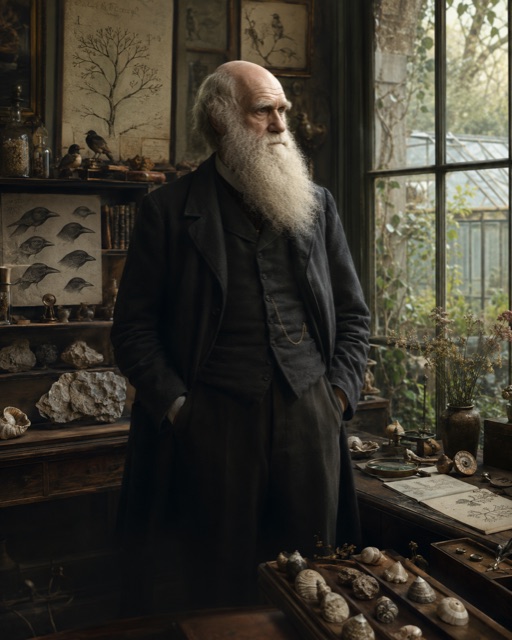
Evolutionary Biology · Memoir
The Voyage of the Beagle
by Charles Darwin · The Naturalist of Deep Time · Victorian Science, 1809-1882
Darwin's travel narrative of observation, geology, species, and science as adventure.
- Advanced
- ~14 hr 45 min read
- 21 chapter guides
- Public domain
Start reading · Read the St. Jago and Cape de Verd Islands guide free
Before the text
Editor's Prelude
Science In Motion
A bed of shells lies high above the sea. A lizard swims out to feed on seaweed. An earthquake turns houses into heaps of wreckage. In The Voyage of the Beagle, Charles Darwin keeps returning to one question: how did the world before his eyes come to be this way?
Darwin joined Captain FitzRoy's surveying voyage as a young naturalist, with room aboard ship and freedom to explore ashore. The journey lasted nearly five years. This is his revised account, shaped from travel and study, with later comparisons and corrections. It moves between a traveller's encounters, close descriptions of living things and arguments about changes too slow for one person to watch. Local guides, residents, sailors and specialists help supply what he knows.
The same curiosity that leads him to fossils and coral reefs also brings him into plantations, military camps and colonial settlements. His anger at slavery and his pride in British expansion can stand close together. Wonder, generosity and harsh judgments all belong to this voice. Its deepest interest lies in the effort to connect small observations with large explanations, and in the difficulty of knowing when an explanation has outrun the evidence.
The opening pages
St. Jago and Cape de Verd Islands
CHAPTER I — ST. JAGO—CAPE DE VERD ISLANDS
Porto Praya—Ribeira Grande—Atmospheric Dust with Infusoria—Habits of a Sea-slug and Cuttle-fish—St. Paul's Rocks, non-volcanic—Singular Incrustations—Insects the first Colonists of Islands—Fernando Noronha—Bahia—Burnished Rocks—Habits of a Diodon—Pelagic Confervae and Infusoria—Causes of discoloured Sea.
AFTER having been twice driven back by heavy southwestern gales, Her Majesty's ship Beagle, a ten-gun brig, under the command of Captain Fitz Roy, R. N., sailed from Devonport on the 27th of December, 1831. The object of the expedition was to complete the survey of Patagonia and Tierra del Fuego, commenced under Captain King in 1826 to 1830,—to survey the shores of Chile, Peru, and of some islands in the Pacific—and to carry a chain of chronometrical measurements round the World. On the 6th of January we reached Teneriffe, but were prevented landing, by fears of our bringing the cholera: the next morning we saw the sun rise behind the rugged outline of the Grand Canary island, and suddenly illuminate the Peak of Teneriffe, whilst the lower parts were veiled in fleecy clouds. This was the first of many delightful days never to be forgotten. On the 16th of January, 1832, we anchored at Porto Praya, in St. Jago, the chief island of the Cape de Verd archipelago.
The neighbourhood of Porto Praya, viewed from the sea, wears a desolate aspect. The volcanic fires of a past age, and the scorching heat of a tropical sun, have in most places rendered the soil unfit for vegetation. The country rises in successive steps of table-land, interspersed with some truncate conical hills, and the horizon is bounded by an irregular chain of more lofty mountains. The scene, as beheld through the hazy atmosphere of this climate, is one of great interest; if, indeed, a person, fresh from sea, and who has just walked, for the first time, in a grove of cocoa-nut trees, can be a judge of anything but his own happiness. The island would generally be considered as very uninteresting, but to anyone accustomed only to an English landscape, the novel aspect of an utterly sterile land possesses a grandeur which more vegetation might spoil. A single green leaf can scarcely be discovered over wide tracts of the lava plains; yet flocks of goats, together with a few cows, contrive to exist. It rains very seldom, but during a short portion of the year heavy torrents fall, and immediately afterwards a light vegetation springs out of every crevice. This soon withers; and upon such naturally formed hay the animals live. It had not now rained for an entire year. When the island was discovered, the immediate neighbourhood of Porto Praya was clothed with trees, the reckless destruction of which has caused here, as at St. Helena, and at some of the Canary islands, almost entire sterility. The broad, flat-bottomed valleys, many of which serve during a few days only in the season as water-courses, are clothed with thickets of leafless bushes. Few living creatures inhabit these valleys. The commonest bird is a kingfisher (Dacelo Iagoensis), which tamely sits on the branches of the castor-oil plant, and thence darts on grasshoppers and lizards. It is brightly coloured, but not so beautiful as the European species: in its flight, manners, and place of habitation, which is generally in the driest valley, there is also a wide difference.
Chapter guides · 21
St. Jago and Cape de Verd Islands
Islands Make Geology Visible
Land and sea carry signs of a history that Darwin tries to reconstruct.
Present traces, past events
Darwin treats ordinary things as evidence of earlier changes. A bed of sea-shells beneath volcanic rock suggests that land once lay under the sea. Dust, animals and coloured water raise further questions about movement and life.
From St. Jago to coloured seas
After leaving England, the Beagle reaches St. Jago. Darwin studies its dry landscape, shell-bed and lava, then describes the small colonies of life on St. Paul's rocks. At Bahia, the tropical forest delights him. The account turns to marine creatures and the organisms that sometimes colour the sea. It ends with a puzzle: why do such organisms gather in long narrow bands? Darwin considers winds and currents, while admitting that much remains unexplained.
Rio de Janeiro
Rio Reveals Interdependence
The Brazilian forest rewards close study, while encounters with slavery expose daily cruelty.
A forest full of activity
Darwin's forest is alive with feeding, movement and noise. Its smaller creatures become clearer through patient observation. His travels also expose the violence of slavery, including threatened separation of families and an enslaved man's fear of being struck.
Journeys and small experiments
An excursion from Rio takes Darwin through estates, forests and rough inns. Back near the city, he examines small animals, including land flatworms; specimens he later kept in Tasmania regrew after being cut in two. He follows the sounds and habits of insects, then watches ants, wasps and spiders catch their prey. The closing pages compare spiders' webs and behaviour. The chapter ends with a web from the Cordillera whose unusual shape resembles a wedge.
Maldonado
Comparison Needs Local Detail
Local habits and physical traces give Darwin material for wider comparisons.
Rio Negro to Bahia Blanca
Patagonia Makes Time Physical
The journey crosses a landscape shaped by drought and salt, during Rosas's violent campaign.
Bahia Blanca
Fossils Change the Scale
Fossils challenge simple ideas about animal life, while accounts of war reveal deliberate destruction.
Bahia Blanca to Buenos Ayres
Travel Becomes Experiment
Travelling across the plains shows Darwin how animals, plants and people's work change a landscape.
Buenos Ayres and St. Fe
Society and Ecology Interlock
Drought, fossils and political unrest expose different kinds of change around the Plata.
Banda Oriental and Patagonia
Extinction Connects Past and Present
Darwin connects living animals and ancient remains, then asks why species become rare and disappear.
Santa Cruz, Patagonia, and the Falkland Islands
Islands Make Adaptation Concrete
River travel and island life lead Darwin to ask how landscape and living things are put together.
Tierra del Fuego
Tierra del Fuego Tests Assumptions
The return of three Fuegians taken to England brings Darwin's judgments into contact with their own choices.
Strait of Magellan and the Southern Coasts
Climate Shapes Life
Food, shelter and climate matter more than latitude alone in explaining life on these southern shores.
Central Chile
The Andes Show Slow Forces
A journey through central Chile joins the history of its mountains to the work and life around them.
Chiloe and Chonos Islands
Island Life Rewards Attention
The wet islands make travel difficult, but close study reveals distinctive plants and animals.
Chiloe, Concepcion, and the Great Earthquake
Earthquake Makes Geology Immediate
The earthquake makes human destruction and lasting changes in the land part of the same event.
Passage of the Cordillera
The Andes Record Slow Change
Fossils high in the Andes make Darwin reconstruct a history of sinking, uplift and erosion.
Northern Chile and Peru
Deserts Preserve Memory
Scarce water governs settlement, while coastal relics raise questions about the land's history.
Galapagos Archipelago
The Galapagos Makes Variation Visible
Related plants and animals differ between nearby islands, making their distribution a central puzzle.
Tahiti and New Zealand
Coral and Culture Share a World
Visits to Tahiti and New Zealand reveal both local skill and Darwin's strong preference for Christian missions.
Australia
Australia Complicates Progress
Australia's colonial growth impresses Darwin, but its human costs complicate his admiration.
Keeling Island and Coral Formations
Coral Reefs Record Subsidence
Darwin explains coral rings by joining the upward growth of living reefs to the slow sinking of land.
Mauritius to England
Return Turns Memory into Synthesis
Returning home brings Darwin to reflect on slavery, scientific judgment and the people who helped him.
Questions readers ask
- How long does it take to read The Voyage of the Beagle?
- About 14 hr 45 min in total.
- How difficult is The Voyage of the Beagle?
- Advanced. A long memoir; about 15 hours of reading.
- Which edition is this?
- The original English text, first published in 1839. The text follows Journal of Researches into the Natural History and Geology of the Countries Visited during the Voyage of H.M.S. Beagle, revised edition (1845).
- Can I read The Voyage of the Beagle for free?
- The Voyage of the Beagle is part of Nexus Premium, so reading it needs an account and a Premium subscription. The opening above and two chapter guides on this page are free to read.
- How many chapter guides are there?
- 21 chapter guides, written by the Nexus editors. Two open in full here; the rest show their opening line.
About Charles Darwin
Charles Darwin was an English naturalist whose theory of evolution by natural selection transformed biology and the modern understanding of life. On the Origin of Species gathers evidence for variation, common descent, adaptation, and change over deep time.
“What if life itself is a history of change?”
Darwin gives Nexus a science path with major philosophical consequences for nature, humanity, and historical thinking.
Source text: public domain. Chapter guides: original Nexus writing. The Voyage of the Beagle is part of The Nexus Archive, guided Quests through the great works.