 The Nexus Archive
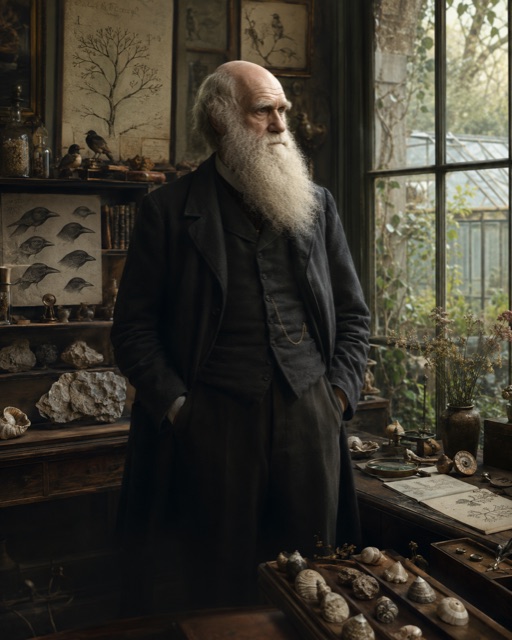
Evolutionary Biology · Treatise
On the Origin of Species
by Charles Darwin · The Naturalist of Deep Time · Victorian Science, 1809-1882
Darwin's transformative argument for natural selection, common descent, and biological change over time.
- Brutal
- 1859
- ~14 hr read
- 65 chapter guides
- Public domain
Start reading · Read the Introduction guide free
Before the text
Editor's Prelude
A World That Changes
Prepared by the Nexus Editors
On the Origin of Species asks the reader to look at familiar life until it becomes strange. Pigeons, islands, fossils, instincts, flowers, and geological gaps all become evidence for one patient claim: living forms have histories.
Darwin had carried the question from the Beagle voyage through years of breeding experiments, geological reading, and correspondence before publishing. Wallace's independent conclusions hastened the book into print, but the argument had already grown into a vast web of variation, inheritance, struggle, extinction, geography, and time.
The book does not offer one dramatic proof. It asks what happens when many ordinary facts are allowed to converge on a single historical explanation—and whether the living world becomes more intelligible when species are understood as changing descendants rather than fixed creations.
The opening pages
Chapter I: Causes of Variability
Causes of Variability. Effects of Habit. Correlation of Growth. Inheritance. Character of Domestic Varieties. Difficulty of distinguishing between Varieties and Species. Origin of Domestic Varieties from one or more Species. Domestic Pigeons, their Differences and Origin. Principle of Selection anciently followed, its Effects. Methodical and Unconscious Selection. Unknown Origin of our Domestic Productions. Circumstances favourable to Man’s power of Selection.
When we look to the individuals of the same variety or sub-variety of our older cultivated plants and animals, one of the first points which strikes us, is, that they generally differ much more from each other, than do the individuals of any one species or variety in a state of nature. When we reflect on the vast diversity of the plants and animals which have been cultivated, and which have varied during all ages under the most different climates and treatment, I think we are driven to conclude that this greater variability is simply due to our domestic productions having been raised under conditions of life not so uniform as, and somewhat different from, those to which the parent-species have been exposed under nature. There is, also, I think, some probability in the view propounded by Andrew Knight, that this variability may be partly connected with excess of food. It seems pretty clear that organic beings must be exposed during several generations to the new conditions of life to cause any appreciable amount of variation; and that when the organisation has once begun to vary, it generally continues to vary for many generations. No case is on record of a variable being ceasing to be variable under cultivation. Our oldest cultivated plants, such as wheat, still often yield new varieties: our oldest domesticated animals are still capable of rapid improvement or modification.
It has been disputed at what period of life the causes of variability, whatever they may be, generally act; whether during the early or late period of development of the embryo, or at the instant of conception. Geoffroy St. Hilaire’s experiments show that unnatural treatment of the embryo causes monstrosities; and monstrosities cannot be separated by any clear line of distinction from mere variations. But I am strongly inclined to suspect that the most frequent cause of variability may be attributed to the male and female reproductive elements having been affected prior to the act of conception. Several reasons make me believe in this; but the chief one is the remarkable effect which confinement or cultivation has on the functions of the reproductive system; this system appearing to be far more susceptible than any other part of the organisation, to the action of any change in the conditions of life. Nothing is more easy than to tame an animal, and few things more difficult than to get it to breed freely under confinement, even in the many cases when the male and female unite. How many animals there are which will not breed, though living long under not very close confinement in their native country! This is generally attributed to vitiated instincts; but how many cultivated plants display the utmost vigour, and yet rarely or never seed! In some few such cases it has been found out that very trifling changes, such as a little more or less water at some particular period of growth, will determine whether or not the plant sets a seed. …
Read it in a Quest
A revelation of nature through observation, experiment, evidence, and transformed scale.
Chapter guides · 65
Introduction
Darwin Opens The Case
The book begins as a promised abstract of a much larger argument.
A long inquiry reaches print
Observations from the Beagle voyage led Darwin to collect evidence about the origin of species. He has worked on the question for years. Wallace’s independent conclusions help persuade him to publish this shorter account before the larger work is ready.
Why it matters
The Introduction gives the map: variation, inheritance, struggle, selection, geology, geography, and classification will be gathered into one long argument.
Descent needs a means of change
Common ancestry alone does not explain the woodpecker’s structure or the relations between plants and animals. Darwin proposes that useful inherited differences accumulate through the struggle for existence. He ends by calling natural selection the main means of modification, while allowing that it is not the only one.
Chapter I: Causes of Variability
Variation Begins At Home
Darwin starts with cultivated plants and domestic animals because their changes are visible.
Variation and inheritance
Domestic animals and plants vary under changed conditions. Darwin considers effects on reproduction, habit, use and disuse, and changes in one part that accompany changes in another. He admits that the causes of particular differences are often unknown.
Why it matters
Darwin needs inherited differences for selection to work. Domestic life lets him compare changes across generations, even when he cannot identify their causes.
Traits can appear at corresponding ages
A variation must be inherited for it to accumulate. Darwin ends with the tendency of inherited traits to appear at the same stage of life in parent and offspring. He ends by separating when a trait appears from what causes it: longer horns may show only late in life yet still come from the bull that sired the calf.
Chapter I: Domestic Breeds and Pigeons
Pigeons Make Variation Concrete
Darwin uses domestic pigeons to show how large differences can grow inside one lineage.
Chapter I: Descent from the Rock-Pigeon
Domestic Difference Has A History
Darwin ties the pigeon breeds back to a common source.
Chapter I: Selection by Breeders
Selection Becomes Visible
Human selection shows how small inherited differences can accumulate.
Chapter I: Adaptation under Domestication
Domestic Races Are Shaped
Darwin closes the domestic chapter by summarizing what selection can do.
Chapter II: Individual Differences and Doubtful Species
Nature Also Varies
Darwin moves from the breeder's yard into wild populations.
Chapter II: Dominant Species and Varieties
Successful Forms Vary Most
Darwin connects variation with wide range and dominance.
Chapter III: The Struggle for Existence
Abundance Becomes Pressure
Variation matters because life produces more than the world can hold.
Chapter III: Checks on Increase
Nature Checks Every Species
The struggle is not only predator against prey.
Chapter III: Competition and Complex Relations
The Web Is Hard To See
Darwin ends the struggle chapter by emphasizing competition among close forms.
Chapter IV: Natural and Sexual Selection
Selection Becomes The Engine
Darwin joins variation and struggle into a mechanism.
Chapter IV: Illustrations of Natural Selection
The Mechanism Gets Examples
Darwin uses imagined and observed cases to make selection easier to see.
Chapter IV: Intercrossing of Individuals
Crosses Can Keep a Line Vigorous
Darwin asks how crossing between individuals can affect vigour and fertility.
Chapter IV: Circumstances and Extinction
Selection Also Removes
Darwin shows that favorable conditions and extinction shape the branching process.
Chapter IV: Divergence of Character
Lineages Spread Apart
Darwin explains why descendants branch instead of improving in one straight line.
Chapter IV: The Diagram of Divergence
Darwin Builds the Branching Diagram
Darwin turns selection and inheritance into a visible pattern of branching descent.
Chapter IV: Extinction and Classification
Extinction Shapes the Tree
Darwin explains why branching descent also leaves gaps between living groups.
Chapter IV: Summary and Tree of Life
The Tree of Life
Darwin closes the chapter by linking selection, extinction, classification, and the tree metaphor.
Chapter V: Conditions, Use, and Disuse
Variation Has Many Causes
Darwin complicates the source of variation.
Chapter V: Acclimatisation and Correlation
One Change Can Pull Others Along
Darwin shows that organisms vary as connected wholes.
Chapter V: Variable Specific Characters
Newer Differences Are Less Settled
Darwin links variability to recent and unusual development.
Chapter V: Analogy, Reversion, and Summary
Variation Is Lawful But Obscure
Darwin admits ignorance while still finding patterns.
Chapter VI: Transitional Forms
Darwin Faces The Gaps
The theory must explain why nature is not full of visible intermediates.
Chapter VI: Transitions in Habit and Structure
Old Habits Can Become New Forms
Darwin looks for gradual paths between different ways of life.
Chapter VI: Organs of Extreme Perfection
The Eye Becomes A Test
Darwin takes up one of the hardest objections: complex organs.
Chapter VI: Small Organs and Natural Selection
Small Traits May Still Matter
Darwin asks how selection handles features that seem minor or imperfect.
Chapter VI: Summary of the Difficulties
Difficulty Is Not Defeat
Darwin closes the objection chapter by gathering the hard cases.
Chapter VII: Instinct and Inheritance
Behavior Enters The Theory
Darwin treats instinct as another inherited feature that can vary.
Chapter VII: Cuckoos, Parasitic Bees, and Ants
Strange Instincts Need Gradual Paths
Darwin tests instinct through vivid cases.
Chapter VII: The Hive-Bee Cell
Geometry Without Design
Darwin asks how the hive-bee's perfect cells could arise gradually.
Chapter VII: Sterile Insects and Summary
Selection Can Work Through Families
Sterile insects force Darwin to extend the unit selection can benefit.
Chapter VIII: First Crosses and Hybrids
Sterility Is Not Simple
Darwin separates first crosses from hybrid offspring.
Chapter VIII: Laws of Hybrid Sterility
The Rules Are Irregular
Darwin looks for patterns in sterility without pretending they are clean.
Chapter VIII: Causes of Hybrid Sterility
Sterility Has Hidden Causes
Darwin compares reproductive failures in crosses, hybrids and unfamiliar conditions.
Chapter VIII: Varieties When Crossed
Varieties Blur The Boundary
Darwin compares varieties with species through fertility.
Chapter VIII: Hybrids, Mongrels, and Summary
Crossed Forms Look Alike In Degree
The chapter ends by weakening a sharp species-variety divide.
Chapter IX: Transitional Forms and Deep Time
Geology Begins With Missing Links
Darwin asks why the fossil record does not show every intermediate form.
Chapter IX: Poor Fossil Collections
The Archive Is Fragmentary
Darwin argues that fossil preservation is deeply uneven.
Chapter IX: Formations and Missing Links
Even Formations Have Gaps
Darwin explains why one formation may not show every transition.
Chapter IX: Sudden Groups and the Lowest Strata
The Hardest Geological Objection Remains
Darwin faces the abrupt appearance of whole groups in the record.
Chapter X: Slow Appearance and Extinction
Fossils Change By Succession
Darwin turns from gaps to the pattern of appearance and disappearance.
Chapter X: Simultaneous Succession
The Same Broad Changes Recur
Darwin studies parallel fossil succession across regions.
Chapter X: Affinities among Fossil Forms
Fossils Fill The Family Picture
Darwin uses extinct forms to explain why living groups have gaps.
Chapter X: Ancient and Modern Forms
Progress Is Not A Straight Ladder
Darwin treats development cautiously.
Chapter X: Geological Succession Summed Up
The Geological Pattern Fits Descent
Darwin gathers the fossil argument.
Chapter XI: Barriers, Continents, and Affinity
Place Has A History
Darwin argues that climate alone cannot explain distribution.
Chapter XI: Single Centres and Dispersal
Organisms Move From Sources
Darwin weighs origin points and means of migration.
Chapter XI: Birds, Seeds, and Glacial Movement
Chance Transport Matters
Small events can explain large distribution puzzles.
Chapter XI: Mountains and Temperate Forms
Cold Links Distant Places
Darwin uses climate history to connect separated populations.
Chapter XI: Glacial Distribution Summed Up
Climate History Explains Range
Darwin gathers the distribution argument around glacial change.
Chapter XII: Fresh-Water Distribution
Water Barriers Are Not Absolute
Darwin explains how fresh-water organisms can still range widely.
Chapter XII: Oceanic Islands
Islands Test The Theory
Oceanic islands have few kinds of life but many peculiar forms.
Chapter XII: Islands and Mainlands
Island Life Points Back To Sources
Darwin links island organisms to nearby continents and migration routes.
Chapter XII: Distribution Summed Up
Time And Space Tell One Story
Darwin gathers the lessons of geography.
Chapter XIII: Classification and the Natural System
Classification Starts To Look Like Genealogy
Darwin asks why living things fall into groups within groups.
Chapter XIII: Genealogy in Classification
Names Point To Descent
Darwin argues that natural classification should be genealogical.
Chapter XIII: Analogy, Affinity, and Extinction
Resemblance Is Not Always Relationship
Adaptation to similar conditions can make distant lineages look alike.
Chapter XIII: Morphology
Body Plans Preserve History
Shared structures become evidence of common descent.
Chapter XIII: Embryology
Early Development Reveals Kinship
Embryos show relationships adults can hide.
Chapter XIII: Rudimentary Organs and Summary
Bodies Carry Old Traces
Rudimentary organs become historical evidence.
Chapter XIV: Difficulties Reconsidered
Darwin Reopens The Objections
The conclusion begins by returning to the strongest difficulties.
Chapter XIV: The Case for Descent
The Positive Case Returns
Darwin gathers variation, selection, and classification into one argument.
Chapter XIV: Evidence from Records and Relations
Many Records Now Agree
Darwin pulls fossils, geography, and affinities into the final case.
Chapter XIV: The Grandeur of This View of Life
The Argument Ends In A Larger Vision
Darwin closes by changing how life itself should be seen.
Questions readers ask
- How long does it take to read On the Origin of Species?
- About 14 hr in total.
- How difficult is On the Origin of Species?
- Brutal. A long treatise; about 14 hours of reading.
- Which edition is this?
- The original English text, first published in 1859. The text follows On the Origin of Species By Means of Natural Selection, first edition (1859).
- Can I read On the Origin of Species for free?
- On the Origin of Species is part of Nexus Premium, so reading it needs an account and a Premium subscription. The opening above and two chapter guides on this page are free to read.
- How many chapter guides are there?
- 65 chapter guides, written by the Nexus editors. Two open in full here; the rest show their opening line.
About Charles Darwin
Charles Darwin was an English naturalist whose theory of evolution by natural selection transformed biology and the modern understanding of life. On the Origin of Species gathers evidence for variation, common descent, adaptation, and change over deep time.
“What if life itself is a history of change?”
Darwin gives Nexus a science path with major philosophical consequences for nature, humanity, and historical thinking.
Source text: public domain. Chapter guides: original Nexus writing. On the Origin of Species is part of The Nexus Archive, guided Quests through the great works.